Sanctions screening for cross-border payments in real time
How sanctions screening works across originator, beneficiary and on-chain wallet exposure, and why it must run before settlement releases.
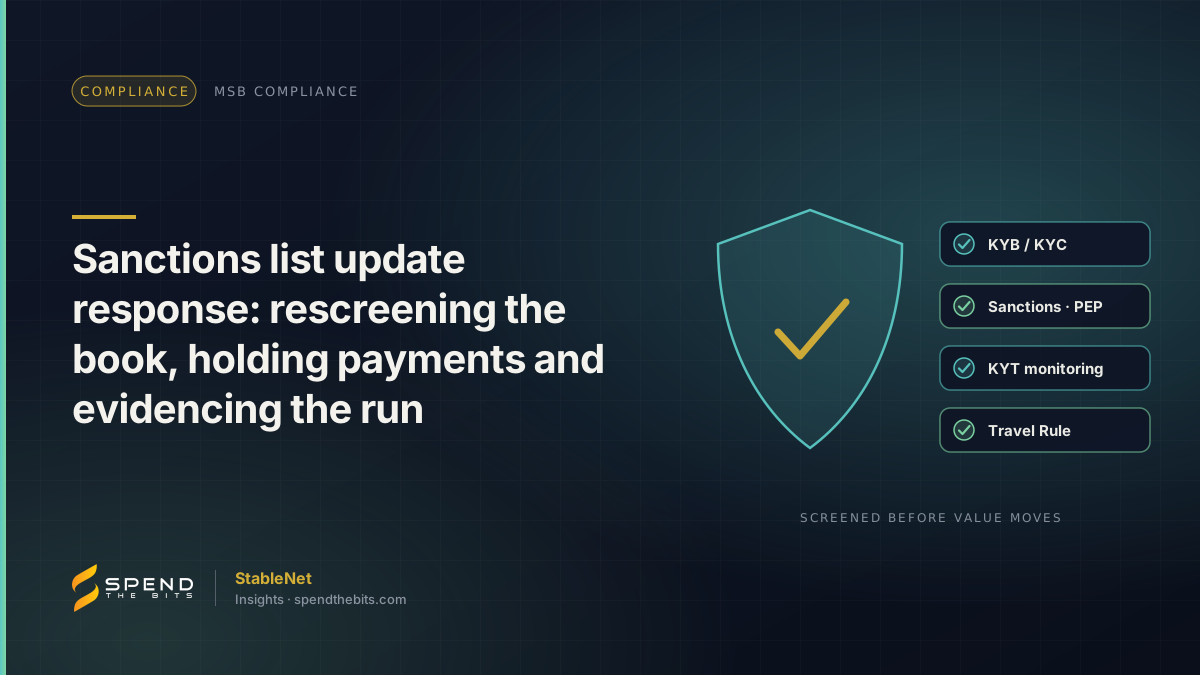
- Sanctions screening for cross-border payments must cover the originator, the beneficiary and, on chain, the settlement wallet address — checked against OFAC, UN, EU, UK and other lists alongside PEP and adverse-media data.
- Batch or after-the-fact screening cannot contain risk when settlement is near-instant and irreversible, so screening has to happen in-flight before value is released.
- False positives, fuzzy matching, list freshness and ownership or secondary-sanctions exposure are the recurring operational challenges institutions must engineer around.
Sanctions screening for cross-border payments is the control that determines whether a transaction is allowed to leave one jurisdiction and settle in another. For decades it has operated against a comfortable assumption: that there is time. Correspondent banking moves value over hours or days, leaving room to queue a payment, screen it, investigate an alert and release or reject it before anything is final. As settlement compresses toward real time — and as stablecoin rails make value transfer instant and irreversible — that assumption no longer holds, and the screening model has to be rebuilt around the moment of settlement itself.
What sanctions screening for cross-border payments actually involves
Screening is not a single check. For any given cross-border payment, an institution must evaluate multiple parties and data points against multiple watchlists. At minimum this means screening the originator and the beneficiary — their names, identifiers and the financial institutions on each side of the chain — against the lists maintained by OFAC, the UN, the EU, the UK and other relevant authorities. It also extends beyond binary list membership.
- Originator and beneficiary name screening against consolidated sanctions and watchlists.
- Politically exposed person (PEP) screening to capture elevated-risk individuals who may not appear on a sanctions list.
- Adverse-media screening to surface negative news and reputational risk signals.
- Intermediary and counterparty institution screening across the full payment chain.
- On-chain wallet and address screening where settlement occurs over a public ledger.
On-chain settlement adds a layer that traditional payments never had. When value moves as a stablecoin transfer, the destination is a wallet address, and that address carries its own risk history. A name may screen clean while the wallet it settles into is associated with a sanctioned entity, a mixer or an exchange with no controls. Address screening therefore sits on top of name screening, not in place of it.
Why batch and after-the-fact screening fails at instant settlement
Legacy screening was often designed as a periodic or post-event process: payments are screened in batches, or transactions are reviewed shortly after they are submitted, on the understanding that settlement can be held. When settlement is near-instant and irreversible, there is no hold to rely on. A payment that is screened after value has already moved is no longer a control — it is a record of an exposure that has already occurred. Once a stablecoin transfer confirms on chain, it cannot be clawed back, and a sanctions breach detected afterward becomes a remediation and disclosure problem rather than a prevented event.
When settlement is irreversible, screening that runs after the fact does not reduce sanctions risk — it merely documents it.
False positives, fuzzy matching and the cost of getting it wrong
The central operational tension in screening is between catching true matches and drowning in false ones. Names are transliterated inconsistently, abbreviated, reordered and misspelled across languages and scripts, so screening engines rely on fuzzy matching to catch variants. Loosen the matching and alert volumes climb, overwhelming analysts and slowing every payment; tighten it and genuine matches slip through. In a real-time context this trade-off is sharper still, because each alert that requires human review competes directly against a settlement window measured in seconds rather than days. The objective is not to eliminate alerts but to resolve them with enough precision that legitimate payments are not held hostage to noise.
List freshness, ownership and secondary sanctions
A screening result is only as good as the data behind it. Sanctions lists change frequently, and a payment screened against a stale list provides false assurance. Effective screening depends on lists that are refreshed continuously and applied consistently across every payment, including those in flight.
- List freshness: designations are added and amended often, so screening must reference current data rather than periodically refreshed copies.
- Ownership exposure: entities owned or controlled by sanctioned parties may be restricted even when not separately listed, requiring screening logic that accounts for ownership thresholds.
- Secondary sanctions: dealings with certain parties can create exposure for institutions that are not themselves the primary target, extending the screening perimeter.
Screening must run in-flight, before settlement is released
The conclusion that follows from instant, irreversible settlement is straightforward: screening has to happen in-flight, as part of the payment message and before value is released, not as a parallel or downstream process. The screening decision becomes a gate on settlement itself. Originator, beneficiary, intermediary and — on chain — wallet-address checks resolve within the settlement flow, and only a cleared payment is allowed to settle. StableNet is built on this model, attaching sanctions screening and the surrounding compliance controls to the settlement message so that screening is completed before stablecoin value moves rather than after it is already gone.
See it on your corridors
Book a working session and we’ll map StableNet’s compliance and settlement to one of your live payment flows.