How to get an MSB license in the USA: FinCEN registration, state money transmitter licensing and 2026 costs
MSB license USA guide for 2026: FinCEN registration, state money transmitter licensing, surety bonds, real costs and timelines, and what examiners check.
- Getting an MSB license in the USA is two separate exercises, not one: a federal FinCEN registration that is free and fast, and a state money transmitter license in nearly every state you serve, which is neither.
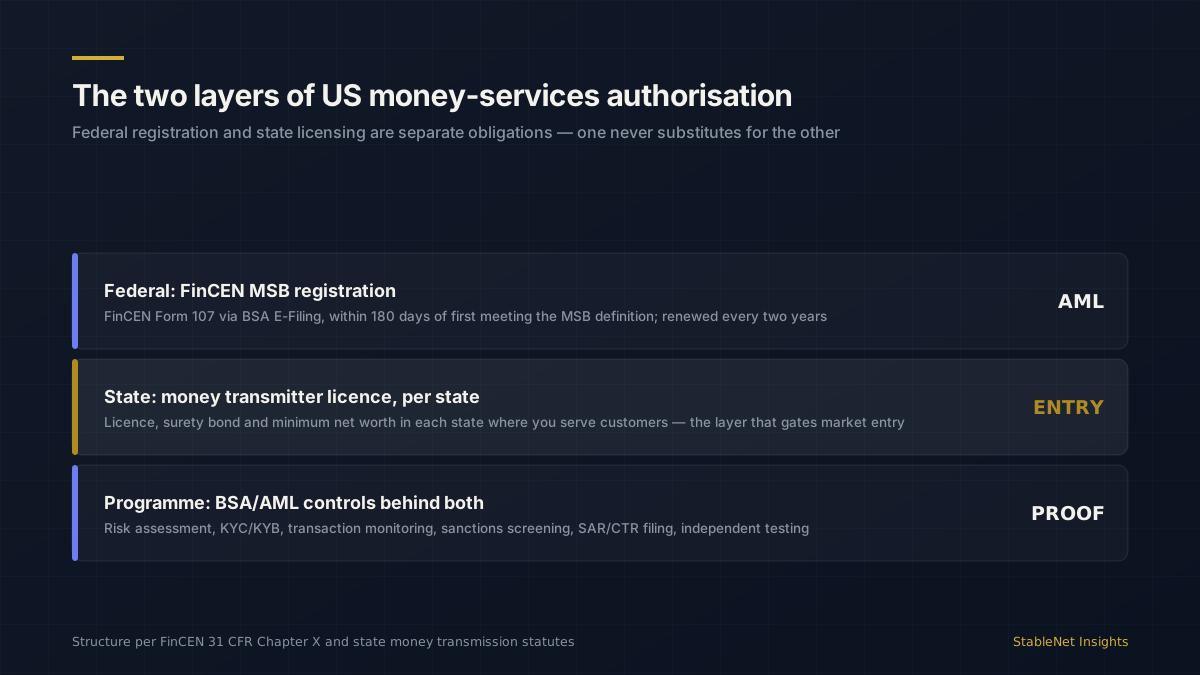
- FinCEN registration is filed on Form 107 through the BSA E-Filing system within 180 days of first meeting the MSB definition, and renewed every two years. It authorises nothing on its own — it is an anti-money-laundering registration, not permission to transmit money.
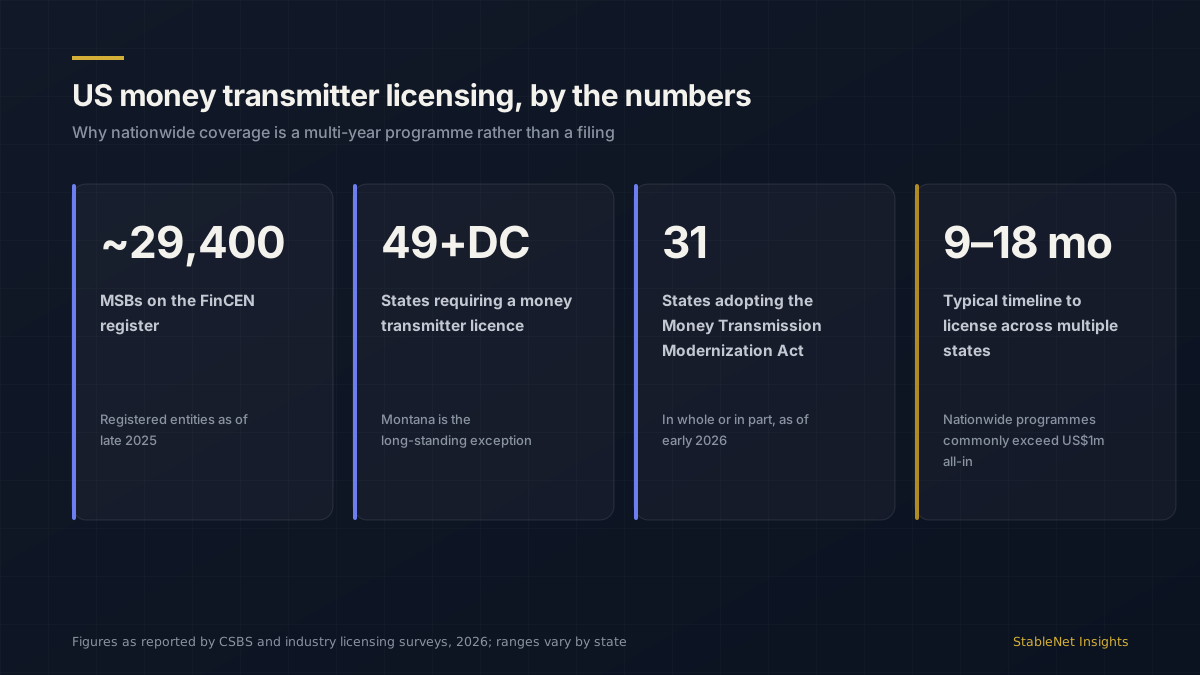
- State licensing is where the money and the calendar go. Application fees, surety bonds and minimum net worth are set state by state, and firms pursuing broad coverage typically plan nine to eighteen months and a budget that can pass US$1m all-in.
- The Money Transmission Modernization Act has been adopted in whole or in part by roughly 31 states as of early 2026, which is slowly standardising definitions, net-worth formulas and control-person rules across the patchwork.
- The single biggest controllable factor in approval speed is the quality of the BSA/AML programme sitting behind the application. Regulators and sponsor banks read the same evidence, so building it once serves both audiences.
To operate as a money services business in the United States you need two things that people routinely confuse: a federal MSB registration with FinCEN, and a money transmitter license from each state in which you serve customers. The federal registration is free, filed electronically on FinCEN Form 107, and must be completed within 180 days of first meeting the MSB definition. The state licenses are the real barrier — each has its own application, fee, surety bond and net-worth requirement, and obtaining them across a meaningful footprint typically takes nine to eighteen months and a budget that runs well into six figures. This guide walks the whole path in the order a real applicant meets it.
What counts as an MSB in the first place?
Under the Bank Secrecy Act and FinCEN regulation, an MSB is defined by activity rather than by how a business describes itself. The categories are money transmitters, currency dealers or exchangers, check cashers, issuers or sellers of traveller’s cheques or money orders, prepaid access providers and sellers, and the US Postal Service. Money transmission is the broadest of these and the one that captures most payment companies, remittance operators and stablecoin businesses: accepting value from one person and transmitting it to another person or location by any means.
Two points catch firms out. First, the classification follows the activity even where the business considers itself a technology provider — an application that accepts customer funds and pays a third party is transmitting money regardless of the branding. Second, being located outside the United States is not an exemption. A foreign-located business doing business wholly or in substantial part within the United States falls inside the definition and must register with FinCEN in the same way, and appoint a US-resident agent for service of process.
How do you register with FinCEN?
FinCEN MSB registration is filed on Form 107 through the BSA E-Filing system. There is no government filing fee. The deadline is 180 days from the date the business first meets the MSB definition, and registration is renewed every two years, by the end of the calendar year preceding the two-year renewal period. A separate agent list must be maintained and kept current where you operate through agents, even though it is not filed with the form.
The form itself is short. What makes it consequential is what it presumes: that a written anti-money-laundering programme already exists behind it. Under the BSA, an MSB must have a programme with the four pillars — internal policies, procedures and controls; a designated compliance officer; ongoing training; and independent testing — plus, for most firms, risk-based customer due diligence. Registering without that programme in place is a compliance failure from day one, and it is the failure most commonly surfaced at first examination.
A related sequencing point: register too early and you begin a two-year renewal clock and an examination exposure before you have revenue. Register too late and you have a documented late filing on the record you will show to every state regulator and sponsor bank thereafter. The 180-day window is generous enough to build the programme first, and that is what it is for.
Why does a state money transmitter license matter more?
Because FinCEN registration is an anti-money-laundering obligation, not an authorisation. The legal right to transmit money is granted by the states, and nearly all of them require a licence — Montana is the long-standing exception, and a small number of states apply narrower definitions to particular activities. Serving customers in a state without its licence is unlicensed money transmission, which carries civil and, in several states, criminal exposure, and it is discovered quickly because banks ask for the licence register during onboarding.
Applications are submitted through the Nationwide Multistate Licensing System, which at least gives one document repository and one set of individual disclosures across states. What NMLS does not do is standardise the substance. Each state sets its own application fee, investigation fee, surety bond, minimum tangible net worth, permissible-investment rules, control-person definitions and reporting cadence. The submission itself is substantial: business plan, financial statements, flow-of-funds diagrams, the AML programme, biographical and financial statements plus fingerprints for every control person, and often audited accounts.
What does an MSB license cost in the USA?
There is no single number, and any source that gives one is describing a single state. Application and investigation fees commonly land in the low thousands of dollars per state. Surety bonds are the wider variable: coverage requirements start in the low tens of thousands in smaller states and reach several hundred thousand dollars in the largest, with the annual premium a percentage of the bond amount that depends on the applicant’s credit and financials. Minimum tangible net worth requirements sit alongside the bond, and permissible-investment rules require you to hold eligible assets against outstanding transmission liability at all times.
Then there are the costs that do not appear on any fee schedule: legal and licensing-consultant support, audited financial statements, background checks for each control person, compliance staffing, transaction-monitoring and screening software, and the independent testing the BSA requires. Firms that have completed broad multi-state programmes commonly report all-in costs passing US$1m before the first payment is processed. That figure is a programme budget, not a licensing invoice, and treating it as one is why so many applicants stall halfway.
The application is not the work. The application is the point at which a regulator finally reads the compliance programme you either did or did not build first.
How long does licensing take?
FinCEN registration can be completed in a sitting once the underlying programme exists. State licensing runs on a different clock entirely: several months to a year or more per state, with the spread driven by regulator backlog, the completeness of the filing and how conventional the business model looks. Firms building broad coverage generally sequence it — a first tranche of commercially important states, then waves behind it — and plan for nine to eighteen months to reach a workable footprint, with genuinely nationwide coverage often taking longer.
The main controllable variable is application quality. The recurring causes of delay are consistent across states: incomplete or inconsistent submissions, opaque ownership structures, an AML programme that reads as a downloaded template, unclear flow-of-funds documentation, and a business plan whose banking arrangements are unresolved. Each triggers a deficiency letter, and each round of correspondence adds weeks.
What has changed in 2026?
The most consequential trend is the Money Transmission Modernization Act, the model law developed through the Conference of State Bank Supervisors to harmonise a genuinely fragmented regime. As of early 2026 it has been adopted in whole or in part by roughly 31 states, standardising definitions, control-person tests, net-worth formulas and permissible investments, and reducing the number of places where the same fact pattern produced different answers in different states. It has not removed the need to apply state by state, and it will not, but it is compressing the variance that made multi-state programmes so expensive to run.
The second trend is digital-asset scope. Some states expressly bring virtual-currency activity inside money transmission; others license it separately or apply distinct guidance. A firm dealing in stablecoins will also usually fall inside the FATF-derived virtual asset service provider perimeter as adopted in other jurisdictions, which brings Travel Rule obligations and on-chain monitoring on top of conventional MSB duties. Working out which of your activities sit in which perimeter, in each state, is now a standard part of the licensing analysis rather than an edge case.
The third is supervisory intensity. With roughly 29,400 MSBs on the FinCEN register, examination and enforcement attention has concentrated on the quality of AML programmes rather than the fact of registration — on whether monitoring is calibrated to the firm’s actual corridors and customers, whether alerts are worked and documented, and whether records can be produced on demand. A registration certificate proves very little on its own in 2026.
What should you build before you apply?
- A documented risk assessment that names your actual products, corridors, customer types and delivery channels — not a generic template with your company name replaced.
- Written AML policies and procedures covering onboarding, KYC and KYB, enhanced due diligence, sanctions and PEP screening, transaction monitoring, SAR and CTR filing, and record retention.
- A named BSA compliance officer with genuine authority and a documented reporting line to senior management, plus evidence of a training programme that has actually run.
- Independent testing arranged on a defined cadence, with the first review scoped before the licence arrives rather than after the first examination request.
- Clean flow-of-funds documentation showing exactly where customer money sits at each moment, who holds it and under what agreement — the question every state asks and many applicants answer vaguely.
- A resolved banking arrangement, or at least a credible one. Regulators want to see it; banks want to see the licences. Building the compliance evidence that satisfies both at once is what shortens the overall timeline in practice.
Licensed — and then what?
A licence buys the right to move money. It does not make moving money economical. Newly licensed MSBs routinely discover that the correspondent banking arrangements available to them are slow, expensive and offered grudgingly, and that the pre-funding required to serve each corridor consumes the working capital the licensing programme just depleted. The compliance evidence built for the application, however, is exactly what a modern settlement rail expects to carry.
Where StableNet fits
StableNet is the settlement and compliance layer a licensed MSB connects to once the paperwork is done. Payments enter over the messaging formats institutions already run — SWIFT MT and ISO 20022 — and settle as compliant stablecoin transfers reaching finality in seconds, with KYC, KYB, KYT, sanctions screening and Travel Rule originator and beneficiary data attached to each payment. For a firm that has just spent a year and a substantial budget proving it can evidence every transaction, a rail that produces that evidence automatically is worth more than a marginally cheaper one that does not.
See it on your corridors
Book a working session and we’ll map StableNet’s compliance and settlement to one of your live payment flows.