MSB registration in Canada: the FINTRAC process, Québec licensing and foreign MSB rules
MSB license Canada guide: FINTRAC registration steps, the Québec AMF licence, foreign MSB rules, costs and the compliance programme regulators now test.
- Canada operates a registration regime, not a licensing one. A money services business registers federally with FINTRAC under the PCMLTFA, there is no registration fee, no statutory minimum capital and no staffing threshold.
- Free does not mean easy. Registration is routinely refused or revoked where the compliance programme behind it is absent or unworkable, and FINTRAC escalated revocations sharply through 2026 — including 23 in a single day in March.
- Québec is the exception to the federal-only picture: serving Québec residents or holding a place of business there also requires a separate licence from the Autorité des marchés financiers, with its own fees and conditions.
- A firm outside Canada that directs services at persons in Canada must register as a foreign money services business, even with no Canadian office, and must meet comparable obligations.
- The regulated perimeter now covers foreign exchange dealing, money transferring, issuing or redeeming money orders, virtual currency exchange and transfer, and crowdfunding platform services — so most stablecoin payment firms are inside it.
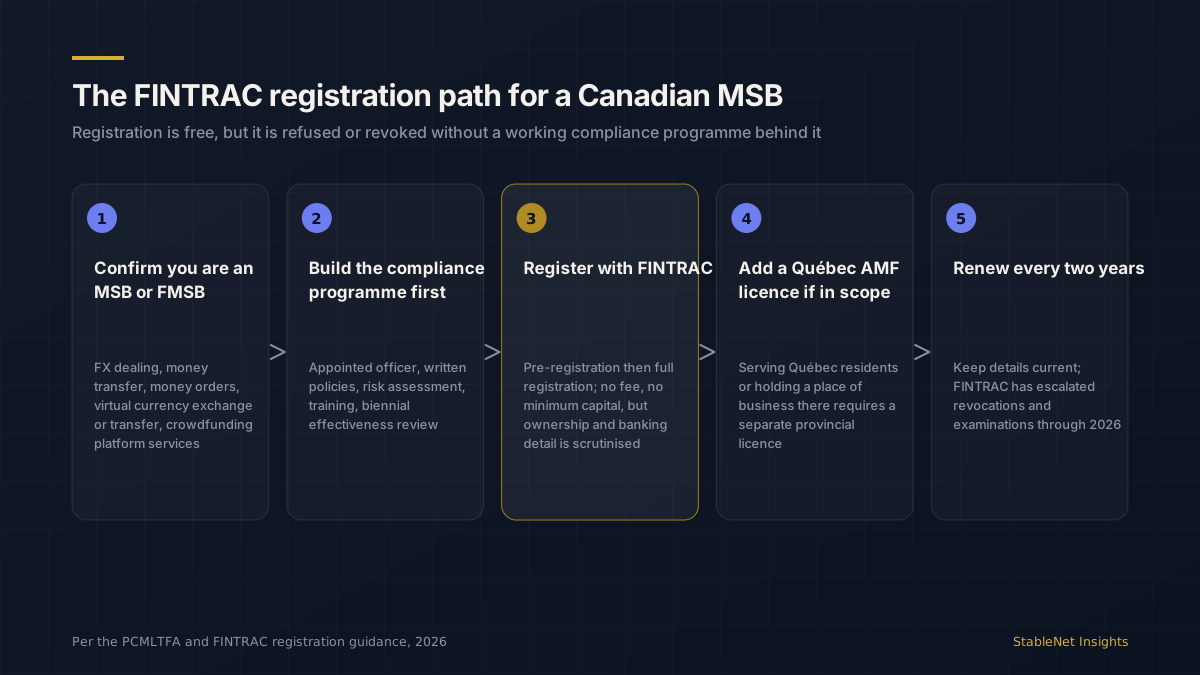
There is no MSB licence in Canada in the way there is in the United States. Canada runs a federal registration regime: a money services business registers with FINTRAC under the Proceeds of Crime (Money Laundering) and Terrorist Financing Act, and registration carries no government fee, no statutory minimum capital and no mandated staffing levels. The obligation that actually binds is what sits behind the registration — a documented, tested compliance programme — and that is where refusals, revocations and examination findings now concentrate. Québec adds one provincial layer on top for firms serving Québec residents.
Who has to register as an MSB in Canada?
The test is activity-based. A business must register if it provides one or more of the regulated money services: foreign exchange dealing; money transferring; issuing or redeeming money orders, traveller’s cheques or similar instruments; dealing in virtual currency, meaning virtual currency exchange services and virtual currency transfer services; and crowdfunding platform services. The virtual-currency and crowdfunding categories were added through amendments across 2020 and the 2024–2025 cycle, which is why a number of firms that considered themselves outside the perimeter are now firmly inside it.
A stablecoin payment operator will usually meet more than one of these tests at once — transferring value, exchanging between fiat and a digital asset, and in many cases dealing in foreign exchange. The registration is per business, not per activity, but the compliance programme must address every activity the business actually performs, and FINTRAC examines against the activities you declared.
What is a foreign money services business?
Canada closed the offshore gap with the foreign money services business regime. An entity with no place of business in Canada that directs its services at persons or entities in Canada, and provides those services to clients in Canada, must register as an FMSB and meet obligations comparable to a domestic MSB. Directing services at the Canadian market is interpreted broadly: marketing to Canadian customers, offering Canadian-dollar services, or operating a website oriented toward Canadian users can all bring a foreign firm inside the perimeter.
This matters commercially as well as legally. Canadian banks and payment partners check the FINTRAC register before onboarding, and an unregistered foreign operator serving Canadian customers is not a counterparty most institutions will accept. Registration is also the practical prerequisite for a Canadian bank account, which is the real bottleneck for most new entrants.
How does the FINTRAC registration process work?
Registration is completed through FINTRAC’s online system in two stages — a pre-registration that establishes the entity and its contact, followed by the full registration form. The information required is substantial even though the process is free: corporate details and incorporation documents, a description of every regulated service offered, the number and location of branches and agents, estimated transaction volumes, details of the banking arrangements, and identifying and criminal-record information for owners, directors and senior officers.
FINTRAC can refuse registration, and does. The statutory grounds include convictions for specified offences among the owners or senior officers, and the provision of false or misleading information. In practice, applications also fail on incoherence — an entity whose described business model, declared volumes, banking arrangements and compliance programme do not reconcile with one another. Registration must be renewed every two years, and changes to the registered information must be reported as they occur rather than at renewal.
What does the compliance programme have to contain?
- An appointed compliance officer with the authority to implement the programme and a clear reporting line to senior management.
- Written compliance policies and procedures, kept current and approved by a senior officer, covering every regulated service the business actually provides.
- A documented risk assessment addressing clients and business relationships, products and delivery channels, geography, new technologies and the activities of any affiliates.
- An ongoing training programme for employees, agents and anyone authorised to act on the business’s behalf, with records showing it has been delivered.
- A biennial effectiveness review — every two years — testing the programme in practice, with findings reported to senior management and remediation tracked.
- Record keeping and reporting: know-your-client records, large virtual currency and large cash transaction reports, electronic funds transfer reports, suspicious transaction reports with no minimum threshold, and Travel Rule data on qualifying transfers.
The Travel Rule point deserves emphasis for virtual-currency businesses. Canada applies originator and beneficiary information requirements to qualifying virtual currency transfers, so a stablecoin operator must be able to send, receive, screen and retain that data — not merely record the on-chain hash. Firms that treat blockchain transparency as a substitute for Travel Rule compliance are describing a different obligation from the one they have.
A registration that costs nothing to obtain still costs a great deal to keep. What FINTRAC examines is not the certificate but the programme underneath it.
What about Québec?
Québec runs its own regime alongside the federal one. Under the Money-Services Businesses Act, a firm with a place of business in Québec, or offering money services to Québec residents, requires a licence from the Autorité des marchés financiers in addition to FINTRAC registration. The AMF process is a licensing process in the conventional sense: it carries fees, requires security clearance investigations by the Sûreté du Québec for directors and officers, and imposes ongoing reporting. Firms building a Canadian footprint should decide early whether Québec is in scope, because retrofitting the provincial licence after launch is materially slower than including it in the initial plan.
How does Canada compare with the United States?
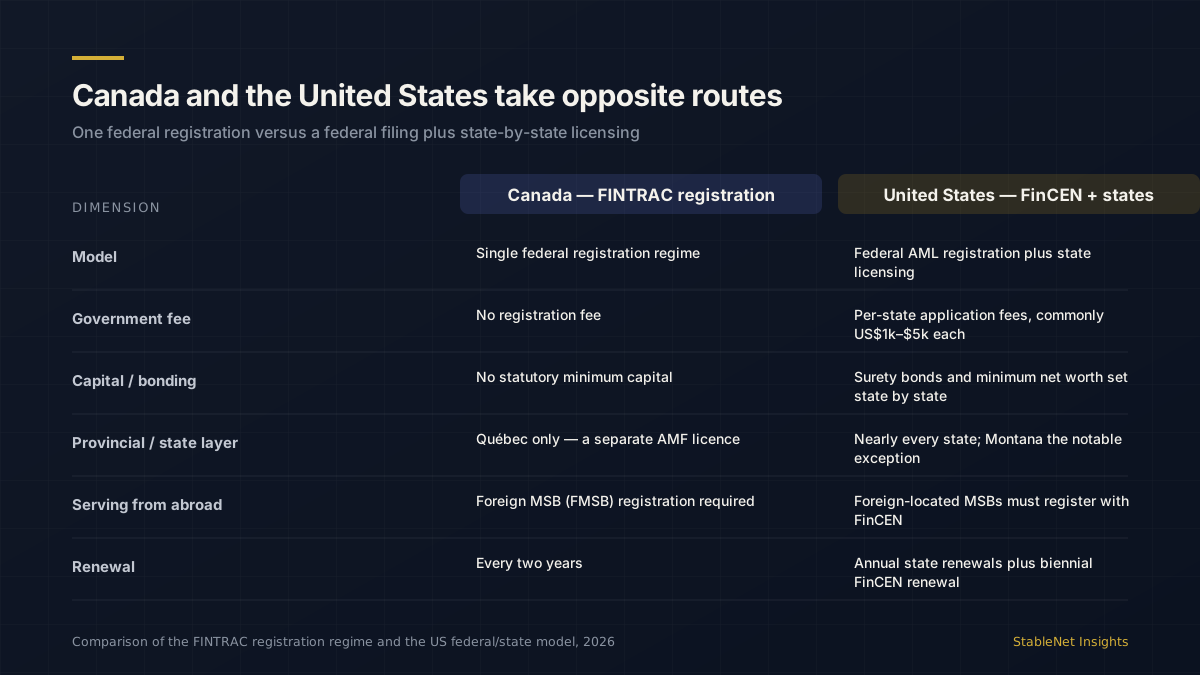
The contrast is instructive for anyone choosing where to start. The United States imposes a low-friction federal registration and then a high-friction, state-by-state licensing programme with fees, surety bonds and minimum net worth in each state — commonly nine to eighteen months and a budget passing US$1m for broad coverage. Canada imposes one federal registration with no fee and no capital requirement, plus a single provincial licence in Québec. On paper Canada is dramatically cheaper and faster to enter.
The difficulty simply sits elsewhere. In Canada the binding constraints are banking access and supervisory tolerance, not licensing cost. Canadian financial institutions have been conservative about MSB relationships for years, and a registered MSB without a bank account is a business on paper only. Firms that budget for a cheap Canadian entry and then discover a six-month search for banking have mis-sequenced the project rather than mis-read the rules.
What changed for Canadian MSBs in 2026?
Two developments matter. First, enforcement intensity rose sharply: FINTRAC has escalated registration revocations, including a widely reported set of 23 revocations on a single day in March 2026, alongside a broader federal push on anti-money-laundering effectiveness. Revocation is not a technicality — it terminates the right to operate and is visible on the public register to every bank and partner you deal with. Second, a further layer of payment-related safeguard rules took effect during 2026, tightening expectations around how customer funds are handled and how retail payment activity is supervised.
The direction of travel is consistent with the rest of the world: the entry ticket stays cheap, and the ongoing evidential burden rises. For a stablecoin business that means monitoring calibrated to on-chain behaviour, wallet screening alongside name screening, Travel Rule data attached to qualifying transfers, and records that reconcile the chain to the ledger and to the client statement.
How do you get banking as a Canadian MSB?
This is the question that decides whether a Canadian MSB actually launches, and it is the one least covered by registration guidance. Canadian financial institutions have de-risked the money services sector for over a decade, because the cost of supervising an opaque customer exceeded what the account earned. The consequence is that a newly registered MSB frequently spends longer securing a bank account than it spent registering — and that the FINTRAC registration, far from being the finish line, is merely the first document the bank asks for.
What shortens the search is evidence, presented in the order a bank’s onboarding team reads it: an active registration, a compliance programme with a named officer and a completed effectiveness review, a documented risk assessment that names your actual corridors and customer types, sample monitoring output showing that alerts are generated and worked, and a clean flow-of-funds diagram identifying exactly where client money sits at every moment. Where virtual currency is involved, add wallet-screening evidence and your Travel Rule policy, including how you handle counterparties that cannot receive the data.
It is worth being direct about the underlying dynamic. Banks are not refusing MSBs on principle; they are pricing the cost of visibility. Anything that makes your flows legible and your controls verifiable moves the account from a supervision expense toward a commercial relationship. That is the same logic that makes settlement rails carrying their own compliance data valuable to an MSB — they lower the cost of being supervised, not just the cost of a transfer.
Where StableNet fits
Several of the obligations above are far easier when the settlement rail produces the evidence itself. StableNet attaches KYC, KYB, KYT, sanctions screening and Travel Rule originator and beneficiary data to each payment, and reconciles the on-chain record against SWIFT MT and ISO 20022 messaging, so a registered Canadian MSB is running a reporting process rather than a manual reconciliation project. For a regime where the registration is free and the supervision is the real cost, a rail that carries its own audit trail is exactly the right asset.
See it on your corridors
Book a working session and we’ll map StableNet’s compliance and settlement to one of your live payment flows.