Remittance corridor selection: a scoring framework for launching stablecoin settlement corridor by corridor
Remittance corridor selection on stablecoin settlement: score demand, payout reach, regulatory clarity at both ends, FX liquidity and screening complexity.
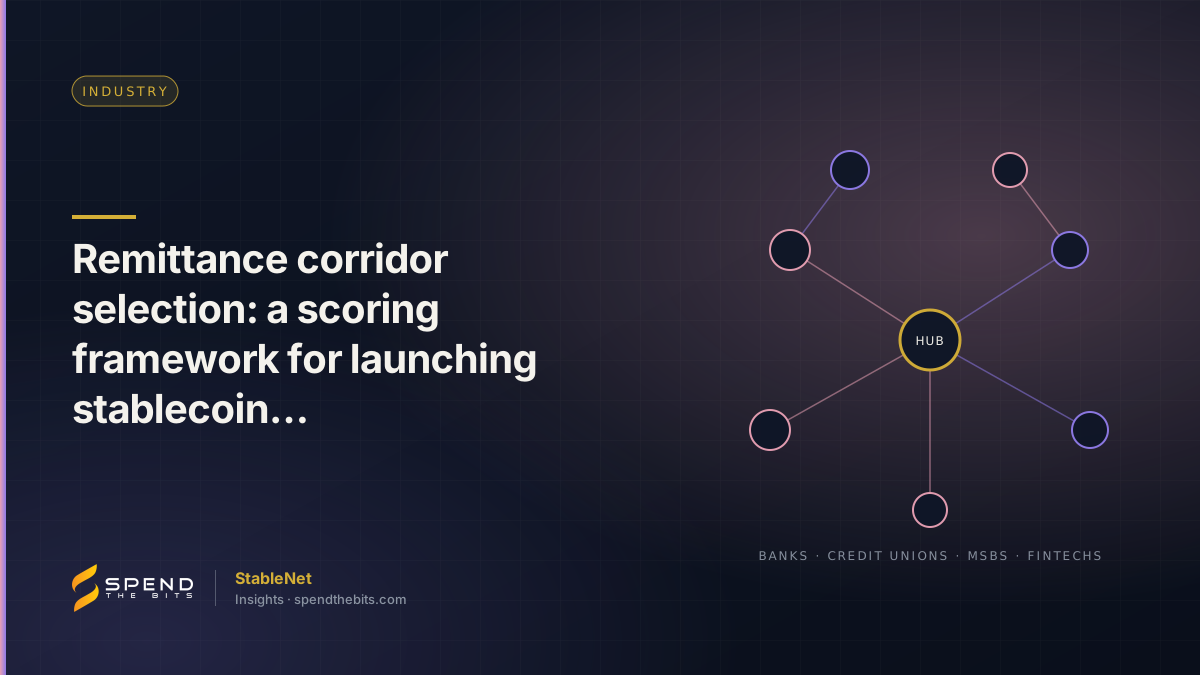
- Remittance corridor selection has two gates and five scores. The gates are regulatory clarity at both ends and a live, licensed payout partner; a corridor that fails either is not scored, it is deferred.
- Demand should come from the institution's own data, such as existing customer nationalities, inbound salary sources and support tickets, and from public sources such as the World Bank's Remittance Prices Worldwide database, never from a guess about a diaspora.
- Local payout reach means the share of likely beneficiaries who can be credited on a domestic rail within the delivery promise, not the number of banks a partner lists on a slide.
- FX liquidity in the stablecoin pair and screening complexity in the receive market are the two criteria most often underweighted, and they are the two that produce the ugliest surprises after launch.
- Score each corridor from one to five on each criterion, apply weights agreed by treasury, compliance and product together, and launch the top two or three, then re-score every quarter with live data.
Remittance corridor selection for stablecoin settlement comes down to two gates and five scored criteria. The gates are regulatory clarity on stablecoin settlement at both the send and receive ends, and the existence of a live, licensed payout partner with a domestic rail; a corridor that fails either gate is deferred, not scored. The scored criteria are demand, local payout reach, depth of that regulatory clarity, FX liquidity in the stablecoin pair and screening complexity, each rated from one to five and weighted by a group that includes treasury, compliance and product. This article explains how to assess each criterion with evidence rather than instinct, how to combine the scores, and how to sequence the launch.
What makes a corridor a good first launch on stablecoin settlement?
A good first corridor is one the institution can run to a high standard on day one, not the one with the largest headline market. The largest corridors in the world, such as those from the United States into Mexico, from the Gulf states into South Asia or from Canada into India and the Philippines, are well served by incumbents and are contested on price. That does not disqualify them, but it means the first launch must be judged on the institution's own advantage in that corridor: existing customers who send there, a payout partner it already trusts, or a compliance team that already knows the receive market.
The operational test is simple. Can the institution promise a delivery time and a beneficiary amount before the sender confirms, and keep that promise on most days without manual intervention? On stablecoin settlement the on-chain leg is fast and visible, so the promise is set by the slower of the two fiat legs: the domestic collection at the send end and the local payout at the receive end. A corridor where the payout partner credits on an instant domestic rail during local business hours allows a promise measured in hours. One where the partner relies on a SWIFT fallback for many beneficiary banks does not, whatever the on-chain leg achieves.
How should demand be measured without guessing?
Demand is the criterion most often estimated and least often measured. The reliable source is the institution's own data. For a bank or credit union, that is the share of business or retail customers with a second nationality on file, inbound payments received from a given country, and outbound wires already sent there through the correspondent channel. For a fintech or MSB, it is support tickets asking about a destination, search terms on the app store listing and the countries customers name at onboarding when asked why they are opening the account.
Public data adds context but should not replace the institution's own signal. The World Bank publishes remittance flow estimates by corridor and, through its Remittance Prices Worldwide database, tracks the cost of sending in a large number of corridors, which shows where incumbents charge most and where a lower all-in price could win. The United Nations Sustainable Development Goal target 10.c, to reduce remittance costs to below three percent of the amount sent, is a useful benchmark for what a corridor price should aim at, but a corridor with high incumbent pricing and no customer demand inside the institution is still not a first launch.
- Count existing customers with a documented link to the receive country, and count the outbound and inbound payments already flowing there through current rails.
- Record the destinations customers ask about in support and onboarding, and treat repeated requests as stronger evidence than a large diaspora figure.
- Check the corridor's incumbent pricing in the Remittance Prices Worldwide database to see whether a lower all-in cost is a real advantage there.
- Estimate the average and largest expected transfer sizes from existing payment data, because they drive the FX liquidity and float sizing questions later.
- Score demand from one to five on the institution's own evidence, and record the evidence next to the score so it can be challenged.
What does local payout reach actually mean?
Payout reach is the share of the corridor's likely beneficiaries who can be credited on a domestic rail, inside the delivery promise, by a partner that is licensed to do so. It is not the number of banks a partner lists in a presentation. The distinction matters because most receive markets have a domestic clearing system that reaches every bank account, but a partner may only be connected to some of them directly, with the rest reached by a slower route. In the euro area the question is SEPA reach; in the United States it is ACH and, where available, an instant rail; in Canada it is EFT; in many other markets it is the national instant payment scheme and, for unbanked recipients, the licensed mobile money operators.
The evidence to collect is a list of the ten to twenty beneficiary institutions that the institution's own customers are most likely to send to, taken from existing payment data, and a written confirmation from the payout partner of the rail, the cut-off time and the expected credit time for each. Where the partner also offers cash pickup or mobile wallet payout, the same confirmation applies. A partner that cannot give that list has not yet earned a five on this criterion.
A corridor is not a line on a map. It is a list of beneficiary banks, a rail to each of them, and a person at the payout partner whose telephone number the operations team has.
How do you assess regulatory clarity at both ends?
Regulatory clarity is a gate before it is a score. At the send end the institution needs its own permission to accept funds for transfer and to settle in stablecoins, whether that is a state money transmitter licence and FinCEN registration in the United States, a FINTRAC registration and, where in scope, Bank of Canada registration under the Retail Payment Activities Act in Canada, or the equivalent elsewhere. At the receive end, the payout partner needs a licence that covers receiving stablecoins from abroad, converting them and paying out locally, and the local regulator's position on that activity must be knowable in writing.
The score, once the gate is passed, reflects how settled the position is. A five is a receive market with a published regime for stablecoin or virtual asset service providers, a licensed partner operating under it and no announced changes. A three is a market where the activity is permitted but the regime is new or under consultation. A one is a market where the position depends on an interpretation that counsel would not put in writing. The FATF Travel Rule applies at both ends regardless, so a further question is whether the payout partner can receive and act on originator and beneficiary data in IVMS101 form, or whether the institution will have to carry that data by another route.
How do FX liquidity and screening complexity change the score?
FX liquidity determines whether the institution can quote a firm rate to the sender before confirmation and honour it at payout. In a corridor where the stablecoin pair against the local currency trades deeply through the payout partner or a liquidity provider, a firm quote for the transfer sizes the institution expects is straightforward. In a thinner corridor the partner may only quote for small sizes or during local hours, and the institution either absorbs the rate risk, pre-positions local currency at the partner, which reintroduces a form of pre-funding, or narrows the delivery promise. The test is to ask the partner for a firm quote at the largest expected transfer size at three times of day and see whether the answer changes.
Screening complexity is about the receive market's sanctions and financial crime profile and about the practical difficulty of screening its beneficiaries. Markets with common transliterated names, limited beneficiary identifiers or a high volume of false positives against sanctions lists cost more per payment in analyst time, and that cost does not appear until the corridor is live. The evidence to collect is a sample screening run of beneficiary names typical of the corridor against the institution's own lists, with the false-positive rate recorded, together with the payout partner's own screening obligations and the identifiers it requires for a credit, such as a national identity number or a tax reference.
- Obtain firm FX quotes from the payout partner at the largest expected transfer size at three different times of day, and score liquidity on how firm and consistent they are.
- Run a sample of typical beneficiary names for the corridor through the institution's own screening and record the false-positive rate before launch.
- List the beneficiary identifiers the receive market requires for a credit, and check that the sender-side form can collect them.
- Confirm the payout partner can receive Travel Rule data in IVMS101 form and what it does with it.
- Estimate analyst minutes per payment for the corridor from the sample run, and include that cost in the corridor pricing.
How do you score and sequence corridors?
Apply the gates first. Any corridor without written regulatory clarity at both ends or without a live, licensed payout partner leaves the list until that changes. Score the remaining corridors from one to five on demand, payout reach, depth of regulatory clarity, FX liquidity and screening complexity, with a higher score meaning easier. Agree the weights in a single meeting of treasury, compliance and product, because each function will otherwise weight its own criterion highest. A common outcome is that demand and payout reach carry the largest weights, with regulatory depth, FX liquidity and screening complexity sharing the rest, but the weights should reflect the institution's own tolerance and should be written down with the reasoning.
Launch the top two or three, each with limits, a soft-launch group and a delivery promise agreed with the partner in writing. Measure four things per corridor from the first day: delivery within promise, payments held for review, returns and reconciliation breaks. Re-score every quarter using that live data in place of the pre-launch estimates, and expect the ranking to move. A corridor that scored well on demand but poorly on live returns is telling the institution something about payout reach that the partner's list did not. The framework is not a one-time exercise; it is the agenda for the quarterly corridor review.
Where StableNet fits
StableNet, built by SpendTheBits, is a cross border B2B payment and settlement platform for banks, credit unions, licensed money service businesses, exchange houses and remittance fintechs, and it is built to be launched corridor by corridor. Settlement runs in regulated stablecoins such as USDC and USDT on public blockchains, multi-chain, completing in minutes with on chain auditability, so the on-chain leg is never the constraint on a corridor's delivery promise. Rails out include local fiat through ACH, SEPA and EFT for last-mile delivery and SWIFT payout by MT103 or pacs.008 where a beneficiary bank is not reachable locally, with pacs.002 status reports and pacs.004 returns tracked end to end by UETR to feed the quarterly re-scoring. Sanctions and PEP screening, wallet screening, KYT and FATF Travel Rule data in IVMS101 form are built in, with a compliance workbench for the analyst work each corridor generates. SpendTheBits is a Bank of Canada registered payment service provider and a named finalist in the Swift Hackathon 2026 Technical Challenge.
See it on your corridors
Book a working session and we’ll map StableNet’s compliance and settlement to one of your live payment flows.