What happens if you operate as a money services business without a license?
Operating without an MSB license risks federal felony charges, state cease-and-desist orders, five-figure daily fines, and being frozen out of banking.
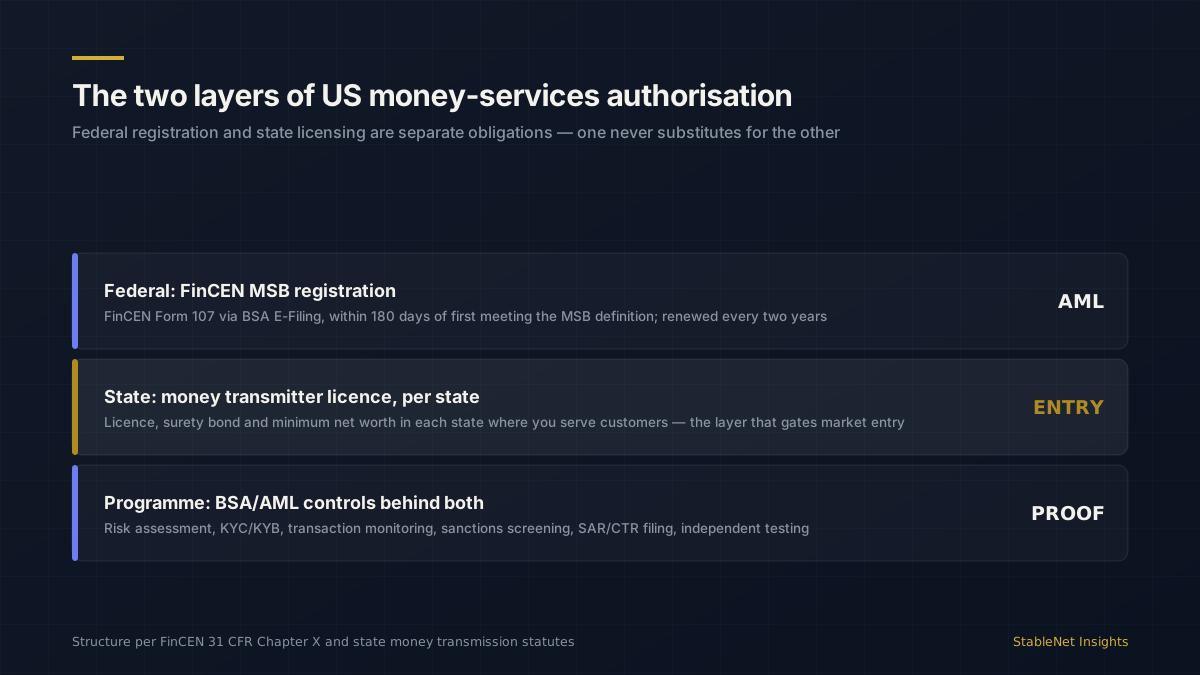
- Operating as a money transmitter without the required state license, or without FinCEN registration, is not a paperwork lapse — 18 U.S.C. § 1960 makes unlicensed money transmission a federal felony, and most states carry their own separate criminal and civil penalties.
- Discovery usually does not come from a regulator investigation first — it comes from a bank. Correspondent and sponsor banks ask for licence numbers during onboarding and periodic review, and an unlicensed operator is typically caught there before any examiner gets involved.
- Civil penalties compound daily in many states, so a violation discovered after months of unlicensed operation can produce a fine far larger than the licence would have cost to obtain in the first place.
- Consent orders and cease-and-desist actions are public record and get pulled by every future banking partner, acquirer and state regulator — the reputational cost usually outlasts the financial penalty.
- A firm that discovers it is unintentionally unlicensed in a state has real, if painful, options — voluntary disclosure, wind-down of the affected corridor, or expedited licensing — and regulators consistently treat self-reporting more favourably than being caught.
Operating as a money services business without the required licence exposes a firm to federal criminal liability, state civil and criminal penalties, forced account closures, and public enforcement records that follow the business indefinitely. At the federal level, 18 U.S.C. § 1960 makes conducting an unlicensed money transmitting business a felony, carrying up to five years in prison, independent of any state-level consequence. States layer their own penalties on top — typically a combination of cease-and-desist orders, civil fines that can run into the thousands of dollars per day of violation, and in many states independent criminal charges. None of this requires intent to defraud anyone: operating the activity without the licence is the violation.
What actually triggers the "unlicensed money transmission" classification?
The classification follows the activity, not the label a business gives itself. A company that accepts funds from one person and transmits value to another person or location — including a stablecoin transfer, a prepaid balance, or a peer-to-peer payment app — is money transmission under most state definitions and under FinCEN's MSB rule, regardless of whether the founders think of the product as a "technology platform" or a "wallet." Firms are frequently surprised to learn that a feature added well after launch — holding customer balances even briefly, letting one user send value to another, adding a payout rail — crossed the line into money transmission without a corresponding update to the compliance programme.
How does an unlicensed operator actually get caught?
Rarely by a regulator showing up first. In practice, discovery routes through the banking relationship: correspondent banks, sponsor banks and payment processors ask for state licence numbers as a standard part of onboarding and again during periodic account review, and an inability to produce them is usually the first concrete signal something is wrong. A bank that discovers an unlicensed money transmitter in its portfolio faces its own regulatory exposure for facilitating the activity, so the typical response is an immediate account freeze or closure — which is often how a growing business first learns its own licensing gap has become an existential problem, in the middle of processing live customer funds.
What are the actual penalties?
- Federal: 18 U.S.C. § 1960 makes operating an unlicensed money transmitting business a felony carrying up to five years' imprisonment, applied independently of any state action and regardless of whether the operator intended harm.
- State civil fines: many states impose per-day or per-violation civil penalties, commonly in the low thousands of dollars per day, which compound quickly — a violation running undetected for several months can produce a fine well into six figures.
- State criminal exposure: a majority of states also carry independent criminal statutes for unlicensed money transmission, layered on top of the federal charge rather than replacing it.
- Cease-and-desist orders: state regulators can order an immediate halt to the activity in that state, which for a firm with concentrated volume in one corridor can mean an abrupt, forced shutdown of a material part of the business.
- Restitution and disgorgement: several enforcement actions have required the unlicensed operator to return fees collected during the unlicensed period, on top of the fine itself.
The bank usually finds it before the regulator does — and once a bank finds an unlicensed money transmitter in its portfolio, the account closes first and the questions come after.
Why does the reputational damage often outlast the fine?
Consent orders, cease-and-desist actions and civil settlements are public record, indexed by state regulators and by the Nationwide Multistate Licensing System, and they do not disappear once resolved. Every future banking partner, payment processor, acquirer conducting due diligence, and state regulator reviewing a subsequent licence application in a different state will find the record. A firm that resolves an unlicensed-operation finding still carries that history into every future compliance conversation — sponsor banks in particular treat a prior enforcement action as a materially higher-risk signal, even years later, which can make securing new banking relationships harder than the original fine.
What should a firm do if it discovers it is unintentionally unlicensed?
- Stop serving customers in the affected state or jurisdiction immediately, or confirm the activity genuinely falls outside that state's money transmission definition before continuing — do not keep operating while assessing the exposure.
- Engage counsel experienced in money transmission before contacting the regulator; how the disclosure is framed materially affects the outcome, and self-disclosure is treated very differently from a regulator-initiated investigation.
- Consider voluntary disclosure. Regulators in most states have a documented pattern of treating self-reported violations more favourably than violations they discover independently — this does not eliminate penalties, but it is consistently a mitigating factor.
- Pursue expedited or standard licensing in parallel with any wind-down decision, since exiting a state can itself have contractual and customer-notice complications that need managing alongside the compliance fix.
- Audit every other state where the same activity is offered — a gap discovered in one state is a strong signal the same review needs to happen everywhere the product operates, not just where it was caught.
Where StableNet fits
StableNet does not replace the licensing decision — that obligation sits with the licensed MSB itself — but it is built for the compliance discipline that keeps a licensed operator licensed: KYC, KYB, KYT, sanctions screening and Travel Rule data attached to every payment, producing the evidence trail a bank or examiner actually asks to see. For a firm that has just closed a licensing gap, that evidence is exactly what shortens the path back to a stable banking relationship.
See it on your corridors
Book a working session and we’ll map StableNet’s compliance and settlement to one of your live payment flows.