Choosing MSB AML compliance software: a buyer’s checklist
A buyer’s checklist for MSB AML compliance software: KYC/KYB onboarding, transaction monitoring, sanctions screening and Travel Rule.
- Effective MSB AML compliance software should span the full lifecycle: onboarding, ongoing monitoring, screening, reporting and audit.
- Treat Travel Rule data transmission and examiner-ready audit trails as core requirements, not optional add-ons.
- Tools that operate inside the payment flow reduce the gaps created by screening transactions only after settlement.
Selecting MSB AML compliance software is one of the more consequential procurement decisions a money service business will make. The right platform supports onboarding, monitoring and reporting obligations across the customer lifecycle; the wrong one leaves gaps that surface during examinations or, worse, in undetected illicit activity. This checklist is intended to help compliance and operations teams evaluate vendors against the capabilities that regulators and counterparties now expect.
Start with your obligations, not the feature list
Before comparing products, map your regulatory perimeter. The jurisdictions you operate in, the products you offer and the corridors you serve determine which obligations apply. FATF Recommendation 16 and the guidance issued by bodies such as FinCEN frame much of the baseline for funds-transfer transparency and reporting. A capable platform should let you configure controls to your specific risk profile rather than forcing a single generic workflow onto every business.
The core MSB AML compliance software checklist
At a minimum, MSB AML compliance software should cover the following functions. Use this as a checklist when scoring vendors:
- KYC and KYB onboarding — identity verification for individuals and beneficial-ownership checks for entities, with risk-based customer due diligence and enhanced due diligence paths.
- Ongoing KYT transaction monitoring — behavioural and rules-based detection that runs continuously, not only at onboarding.
- Real-time sanctions, PEP and adverse-media screening — list management with name matching, configurable thresholds and re-screening as lists change.
- Travel Rule data transmission — structured originator and beneficiary information exchanged with counterparties for qualifying transfers.
- Case management and regulatory filing — alert triage, investigation workflows and the ability to prepare SAR, CTR or STR filings as your jurisdiction requires.
- Examiner-ready audit trails and reporting — immutable records of decisions, alerts and dispositions that can be produced on demand.
- Configurable risk rules — thresholds, scenarios and scoring you can tune without a vendor engineering cycle.
- Integration with settlement rails — connectivity to the systems that actually move value, so controls and payments stay aligned.
Onboarding and screening: getting the front door right
KYC and KYB are where risk first enters the business, so the depth of identity and ownership verification matters. Look for support for tiered due diligence, document and biometric verification where appropriate, and automatic linkage between onboarding outcomes and downstream monitoring. Screening should run at onboarding and continuously thereafter, because sanctions and PEP status change over time. Adverse-media coverage and the ability to tune match sensitivity help control the volume of false positives that otherwise overwhelm small compliance teams.
Monitoring, case management and reporting
Transaction monitoring is only as useful as the investigation process behind it. Evaluate how alerts are queued, assigned and dispositioned, and whether the system preserves a complete record of who reviewed what and why. Filing workflows should map cleanly to the reports your regulator expects, and reporting should be exportable in formats an examiner can review without bespoke effort. Treat the audit trail as a first-class feature: if you cannot reconstruct a decision months later, the control effectively did not happen.
Compliance software is judged not by the alerts it raises, but by whether you can explain every decision to an examiner long after it was made.
Travel Rule and integration with settlement
For MSBs handling cross-border or virtual-asset transfers, Travel Rule data transmission is a defining requirement. The platform should attach and exchange the required originator and beneficiary information in a structured, interoperable form, and reconcile that data against the underlying payment. Just as important is how tightly the software connects to your settlement rails. Where screening and monitoring sit in a separate system, there is a window between a payment settling and a control firing — a window in which value has already moved.
Where controls meet the payment flow
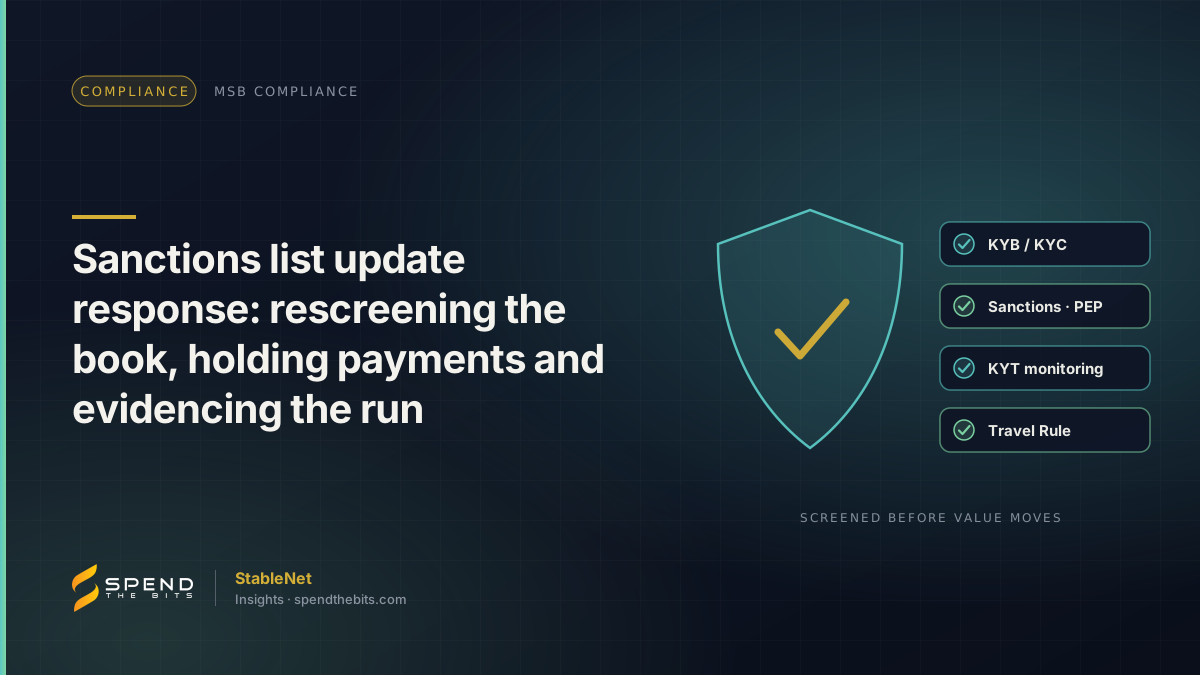
The strongest position is one where compliance is not a layer bolted on after settlement but a property of the transaction itself. StableNet is built on that principle, folding Travel Rule, KYC, KYB, KYT and sanctions screening into the payment and financial-messaging flow so that controls and settlement operate together rather than in sequence. Whichever vendor an MSB selects, the underlying test is the same: does the software let you onboard, monitor, screen, file and prove compliance across the entire lifecycle, with an audit trail you would be comfortable handing to an examiner.
See it on your corridors
Book a working session and we’ll map StableNet’s compliance and settlement to one of your live payment flows.