The pain.002 payment status report: how a bank tells its client what happened to a payout
A pain.002 payment status report answers a payout file. What its status and reason codes mean, why three levels mislead, and how to run the feed.
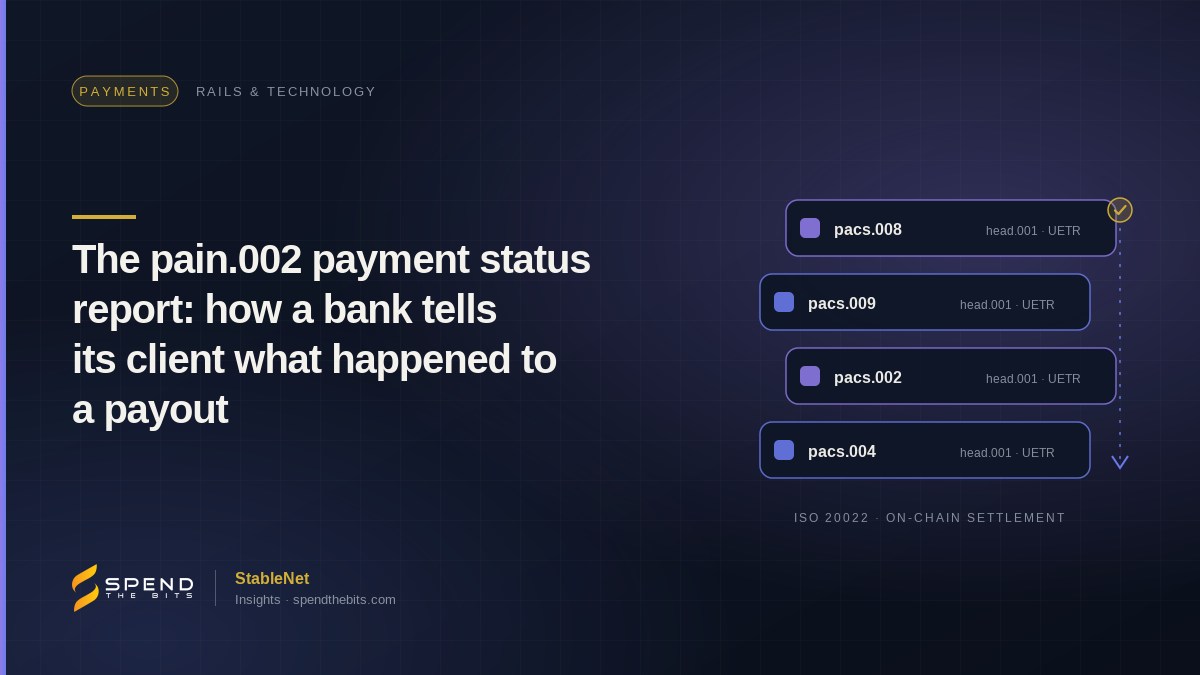
- The pain.002 is the ISO 20022 CustomerPaymentStatusReport, the message a bank sends back to the party that initiated a payment file. It reports status, it moves no value, and it answers a pain.001 or a pain.008.
- It faces the customer, which is what separates it from a pacs.002 between banks and from a camt.054 account notification. Only the pain.002 explains in the client's own references why a payment was refused.
- Status sits at three levels: the file, each batch and each transaction. A file level acceptance says the bank took the work, not that every payment settled, and reading it as payment is the main cause of a file marked paid that was not.
- A rejection is only actionable with a reason code and the client's own end to end identification echoed back. Without that reference, nobody can tell which invoice failed.
- On a stablecoin corridor the settlement leg is final in minutes while the last mile into a local account may not be. Report settlement completed and beneficiary credited as two separate statuses.
A payout file is not finished when it is sent. The bank that receives it has to say what happened. Which payments did it take, which did it refuse, and why. In ISO 20022 that answer is the pain.002 payment status report. It carries status and reason codes rather than value. It is the message a treasury team should read before it tells a supplier the money is on the way.
This article is written for payments operations, treasury and compliance leaders at credit unions, tier-2 and tier-3 banks and licensed money service businesses. It covers what the message is, how it differs from the interbank status report, which codes it carries, why its three levels mislead, how to run the feed, and what finality changes. It describes an operating practice and is not legal advice.
What is a pain.002 customer payment status report?
The pain.002 is the ISO 20022 CustomerPaymentStatusReport. It sits in the payments initiation family, the pain messages, which are the ones that pass between a customer and its own bank. A pain.001 customer credit transfer initiation asks the bank to make payments. A pain.002 reports back on what the bank did with that request.
The direction is the point. A pain.001 travels from the initiating party to its bank. A pain.002 travels the other way, from the bank to the initiating party. The same report also answers a pain.008 direct debit initiation, so one format serves both halves of a corporate to bank flow.
A pain.002 is not a single event either. A bank can send one as soon as it has validated the file, another when the payments enter settlement, and another when settlement completes. Each is a snapshot keyed to the original references. That makes the report a feed rather than a receipt.
How is pain.002 different from pacs.002 and camt.054?
Three messages report on a payment and they are not interchangeable. The audience separates them.
A pain.002 faces the customer. It answers a file the customer sent, and it speaks in the customer's own references: the original message identification, the payment information identification and the end to end identification the client put on each line.
A pacs.002 faces the other bank. It is the financial institution to financial institution payment status report used between agents on the interbank leg, and in cross border practice it carries the UETR. A client never sees it.
A camt.054 debit credit notification is account information. It says an entry was made, which is accounting rather than instruction status, and the camt.053 statement stays the record an audit is built on.
Mixing them up has a cost. A team that reports to clients from account notifications alone can say what posted, never why a payment was refused.
Which status codes does a pain.002 carry?
Status values come from an ISO 20022 external code list, so the set can change and each bank publishes the subset it uses. Confirm both before mapping anything. These are the codes an operations team sees most.
- RCVD received: the file arrived and nothing has been validated yet.
- ACTC accepted technical validation: the format passed. It says nothing about the account or the funds.
- ACCP accepted customer profile: the instruction passed the checks that depend on the customer and its mandates.
- ACSP accepted settlement in process: the payment is being worked. This is the code teams most often misread as final.
- ACSC accepted settlement completed: settlement on the debtor side is done.
- ACCC accepted credit settlement completed: the creditor account has been credited, which is the status a supplier actually cares about.
- PDNG pending: accepted but waiting, often on funds, a cut-off or a check.
- ACWC accepted with change: taken, but the bank altered a detail such as a date.
- PART partially accepted: used at file or batch level when some transactions failed and others did not.
- RJCT rejected: refused, and useful only when a reason code travels with it.
A rejection carries a reason code from a second external list. Codes for an incorrect account number, a closed or blocked account, insufficient funds, a suspected duplicate, an invalid date, a regulatory reason and a narrative explanation cover most real traffic. Insist on the code rather than the sentence, because a code can be routed and counted while a sentence has to be read first.
Why do three levels of status cause reconciliation errors?
A pain.002 reports status at three levels and they do not mean the same thing. There is a status for the message as a whole, a status for each payment information block, which is usually a batch with its own debit, and a status for each transaction.
The common error is to read a file level acceptance as payment. A group status of accepted customer profile says the bank took the file. Inside it, one transaction can still be rejected for a closed account and another can sit pending on funds. If the client's system marks the whole file paid on the group status, the failures are found by the supplier rather than by the payer.
The second error is matching on a field that was never sent. A bank echoes the original identifications back, so a client that keyed its ledger on a reference it kept to itself has nothing to match on and works the feed by hand.
A status report is only as useful as the reference it can be matched on. Put your own end to end identification on every line, and a rejection comes back pointing at the invoice instead of at the file.
How should a team run payout status reporting in production?
The habits below, in this order, are the work.
- Put a unique end to end identification on every transaction you send, derived from the invoice or the payment run, and never reuse one.
- Store every status report you receive, including one that supersedes an earlier status, so the history of a payment can be reconstructed later.
- Hold the status of a transaction separately from the status of its batch and of the file, and never promote one to the other.
- Decide the single status at which you tell a beneficiary the money is on the way, write it down, and make it a completed status rather than in process.
- Map every reason code to an action and an owner: fix and resend, go back to the client, raise a compliance case, or stop.
- Alert on silence. A transaction accepted and never reported again is the one that gets missed, so age open statuses and chase them.
- Reconcile the status feed against the camt.053 statement daily, because the statement is the accounting record and the status report is not.
- Report refusal rates by reason code monthly. The top three reasons are usually a data quality problem you can fix at the source.
One scoping rule avoids a second source of truth. A status report is operational data. It must never post to a ledger or change a balance.
What changes when the payout settles in stablecoins?
Two things change, in opposite directions.
The first is that completion becomes honest sooner. A stablecoin transfer on a public blockchain carries a hash, an amount and a timestamp both parties can read, and it is final in minutes. The window in which a payment sits in process shrinks, so a completed status can be reported while the payer is still at their desk. According to the Financial Stability Board's 2021 G20 roadmap targets, 75 percent of cross-border wholesale payments should be credited to the end beneficiary within one hour of initiation by the end of 2027, which leaves the reporting feed, rather than the settlement time, on the critical path.
The second is that the last mile does not always keep up. Settlement between institutions can be final while the payout into a local account waits for local hours, a cut-off or a payout partner. One completed status covering both would be wrong. Report the settlement leg and the beneficiary credit separately, which is what the distinction between accepted settlement completed and accepted credit settlement completed exists for.
Finality also changes what a refusal can do. There is no in flight window for a recall, so a payment has to be stopped before the transfer is signed. Screening, duplicate detection and beneficiary verification belong in the checks that produce a rejected status, not in an investigation afterwards.
One limit deserves stating plainly. A public ledger carries no originator or beneficiary data. Those parties live in the pacs.008 customer credit transfer, the pacs.009 interbank leg, the structured address fields and the Travel Rule payload under IVMS101. A status report that explains a refusal on sanctions or beneficiary grounds reads those messages, not the chain.
Where StableNet fits
StableNet, built by SpendTheBits, is a cross-border B2B payment and settlement platform for banks, credit unions, licensed money service businesses, exchange houses and remittance fintechs. Settlement is in regulated stablecoins such as USDC on public blockchains and completes in minutes with on-chain auditability, so a completed status can be reported from evidence rather than from an expectation. The platform is ISO 20022 native, with pacs.008 customer credit transfers, pacs.009 interbank legs, pacs.002 status reports, pacs.004 returns and head.001 envelopes, tracked end to end by UETR, so one payment can be followed from a client's file through settlement to the beneficiary credit. KYB and KYC onboarding, KYT, sanctions and PEP screening and Travel Rule data under IVMS101 run in the same path and write to a tamper-evident audit trail, where a reviewer can read the reason behind a refusal.
See it on your corridors
Book a working session and we’ll map StableNet’s compliance and settlement to one of your live payment flows.