camt.110 investigation request and camt.111 response: one typed pair for payment investigations
camt.110 and camt.111 replace the scattered ISO 20022 case messages with one typed pair. What they carry, what they retire, and how to prepare.
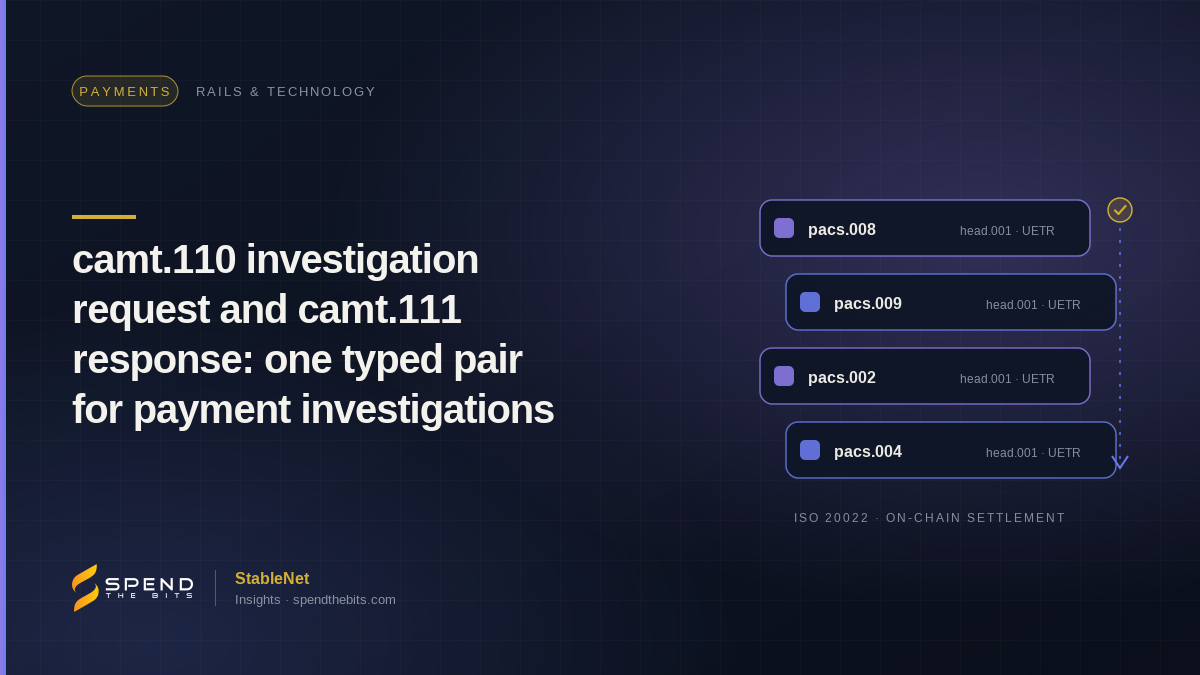
- The camt.110 investigation request and the camt.111 investigation response are the ISO 20022 pair that consolidates payment case handling. One message asks a typed question about a payment, the other answers it, and neither moves value.
- They target the scattered legacy set: unable to apply, claim of non receipt, additional payment information, case assignment and status, reject investigation, the proprietary free text message and request to modify payment.
- The gain is structure, not size. A typed investigation reason can be routed, aged and counted. A narrative field has to be read by a person first, which is why legacy case metrics were never trustworthy.
- Cancellation is not part of the change. A request to stop a payment still travels as a camt.055 from a customer or a camt.056 between institutions and is answered by a camt.029 resolution of investigation.
- On chain settlement splits investigations in two. Questions about what was sent are answerable in minutes from the transfer record. Questions that ask for a change arrive too late, so the control has to pass before the transfer is signed.
A cross border payment that goes wrong generates a question, not a payment. Where is the money. Why was the amount different. Which invoice was this for. For years those questions travelled as a scattered set of ISO 20022 case messages, carrying much of their real content in free text. The camt.110 investigation request and the camt.111 investigation response replace that set with one pair. One message asks, one message answers, and both carry structured fields instead of a paragraph somebody has to read.
This article is written for payments operations, compliance and treasury leaders at credit unions, tier-2 and tier-3 banks and licensed money service businesses. It covers what the two messages are, which legacy messages they consolidate, why the old set had to go, what a request must carry to be answerable, how to prepare, and what changes when the settlement leg ran on a public blockchain. It describes an operating practice and is not legal advice.
What are the camt.110 investigation request and the camt.111 response?
The camt.110 is the ISO 20022 InvestigationRequest message. The camt.111 is the InvestigationResponse. Both sit in the payments exceptions and investigations area, and neither carries value. One agent uses a camt.110 to ask another agent a question about a payment. The other agent replies with a camt.111.
The design idea is one conversation with a type. Instead of picking a different message for each kind of question, the requester sends one message and states the kind of investigation it is. The response carries a status and whatever information was asked for. A case can run several rounds, because one camt.111 can report that the case is open and a later one can close it.
Two things stay outside the pair. Money still moves in payment messages, so funds coming back remain a pacs.004 return with its own identifiers. And a cancellation is a request to act rather than a request to know, so it still travels as a camt.055 from a customer or a camt.056 between institutions, answered by a camt.029 resolution of investigation. Exact scope differs by community and by message, so confirm the position against Swift's own usage guidelines before building.
Which messages do camt.110 and camt.111 replace?
The legacy set grew one message at a time, and each message answered one narrow question. That is the traffic the new pair consolidates.
- camt.026 unable to apply: the receiving agent cannot allocate a credit, usually because a reference or an account detail does not resolve.
- camt.027 claim of non receipt: the beneficiary says the money never arrived.
- camt.028 additional payment information: extra detail supplied in answer to a question already asked.
- camt.030 notification of case assignment and camt.039 case status report: the administrative messages around a case.
- camt.031 reject investigation: a refusal to work the case, often because it reached the wrong party.
- camt.035 proprietary format investigation: the free text escape hatch that defeated structured processing.
- camt.087 request to modify payment: a request to change a detail of a payment already sent.
One pair with a typed reason does the same work. The gain is not fewer bytes. It is that a case arrives in a shape a system can route, measure and age, rather than a shape a person has to read before deciding where it belongs.
Why did the old exceptions and investigations set need replacing?
Three reasons, and any operations team will recognise all of them.
The first is free text. A legacy case often carried its real content in a narrative field. That cannot be routed automatically, cannot be matched to a payment with confidence and cannot be counted at the end of the month. Staff read cases to work out which queue they belonged in.
The second is fragmentation. With a message per question, two institutions could hold different views of the same case because each used a different message for the same step. Reconciling case state became a task of its own, done by email.
The third is measurement. Service quality in investigations comes down to time to first answer and the share of cases closed first time. Neither figure is reliable when the case type lives in prose. A typed request and a typed response make both computable.
An investigation is a question with a deadline. Put the question in a field and it can be routed, answered and counted. Leave it in a paragraph and it becomes somebody's reading list.
What does a camt.110 investigation request have to carry?
Four things, and the fourth is the one firms get wrong.
A case identification, so both sides can name the case in every later message. The identification of the underlying payment, which in cross border practice means the UETR as well as the original message and transaction references. A typed investigation reason taken from an ISO 20022 external code list, which is the field that tells the receiver what is actually being asked. And the supporting data the answer needs, supplied up front rather than after a second exchange.
That fourth point is the difference between a case that closes once and a case that bounces. A claim of non receipt with no value date and no amount cannot be worked. A question about an allocation with no remittance reference asks the receiver to guess. A request sent down the wrong leg of the chain comes back as a refusal, which costs both sides a cycle.
The UETR deserves its own line. One unique end to end transaction reference ties the investigation to the payment instruction, to the status reports that followed and, where settlement ran on chain, to the transfer itself. A search on party name and amount finds near matches. A search on the UETR finds the payment.
How should a team prepare for camt.110 and camt.111?
Adoption is a programme rather than a mapping exercise, because the shape of a case changes. The steps below are the order that keeps it small.
- Count current case traffic by type, including everything that arrives today as free text or by email, so you know what the typed reasons have to cover.
- Map each legacy message you send or receive to the investigation reason you would use instead, and have the mapping reviewed by the people who work the queue.
- Make the UETR the key of the case file, and stop opening cases keyed on a reference that only one side holds.
- Decide the data you will always attach for each reason, then refuse to send a request that is missing it.
- Build a case state machine that allows several responses per case, since one camt.111 can report progress before another closes it.
- Agree response times per reason with your counterparties, and instrument time to first answer and first time resolution from the day you go live.
- Keep a readable record of each case, with the request, every response, the decision and its author, because a reviewer reads the file and not the message log.
- Confirm your own obligations and dates against Swift's current documentation rather than a project plan written last year.
One scoping decision saves argument later. The investigation record is operational data. It must never post to a ledger or change a balance. The payment messages and the statement stay the accounting record, and a case links to them.
What changes when the payment settled on a public blockchain?
Two things, and they pull in opposite directions.
One class of investigation gets easier. A settled stablecoin transfer carries a hash, an amount and a timestamp that both sides can read independently. A question about whether the money was sent, when, and for how much is answerable in minutes rather than by correspondence. The evidence is shared rather than argued over.
Another class gets harder, and earlier. Settlement is final within minutes, so there is nothing in flight to stop. A case that asks for a payment to be changed or recalled will usually be answered with a refusal, however it is typed. The control has to pass before the transfer is signed. Beneficiary verification, duplicate checks and screening belong before release, not in an investigation afterwards.
A second order effect is worth planning for. As settlement gets faster, the case mix shifts from recall towards allocation and data questions. Which invoice, which account, which purpose. Those are answered from structured remittance data and the payment messages.
One limitation deserves stating plainly. A public ledger carries no originator or beneficiary data. The parties live in the pacs.008 customer credit transfer, the pacs.009 interbank leg, the structured address fields and the Travel Rule payload under IVMS101. An investigation about who was paid reads those messages, not the chain.
Where StableNet fits
StableNet, built by SpendTheBits, is a cross-border B2B payment and settlement platform for banks, credit unions, licensed money service businesses, exchange houses and remittance fintechs. Settlement is in regulated stablecoins such as USDC on public blockchains and completes in minutes with on-chain auditability, which is exactly why the evidence an investigation needs exists before the question is asked. The platform is ISO 20022 native, with pacs.008 customer credit transfers, pacs.009 interbank legs, pacs.002 status reports, pacs.004 returns and head.001 envelopes, all tied together by one UETR, so a case can be opened against a payment rather than against a name and an amount. KYB and KYC onboarding, KYT, sanctions and PEP screening and Travel Rule data under IVMS101 run in the same path and write to a tamper-evident audit trail, which is the file an investigation answer is built from.
See it on your corridors
Book a working session and we’ll map StableNet’s compliance and settlement to one of your live payment flows.