The camt.057 notification to receive: pre-advising an incoming stablecoin settlement
A camt.057 notification to receive says funds are coming before they arrive. What the message carries, why it still matters at speed, and how to run it.
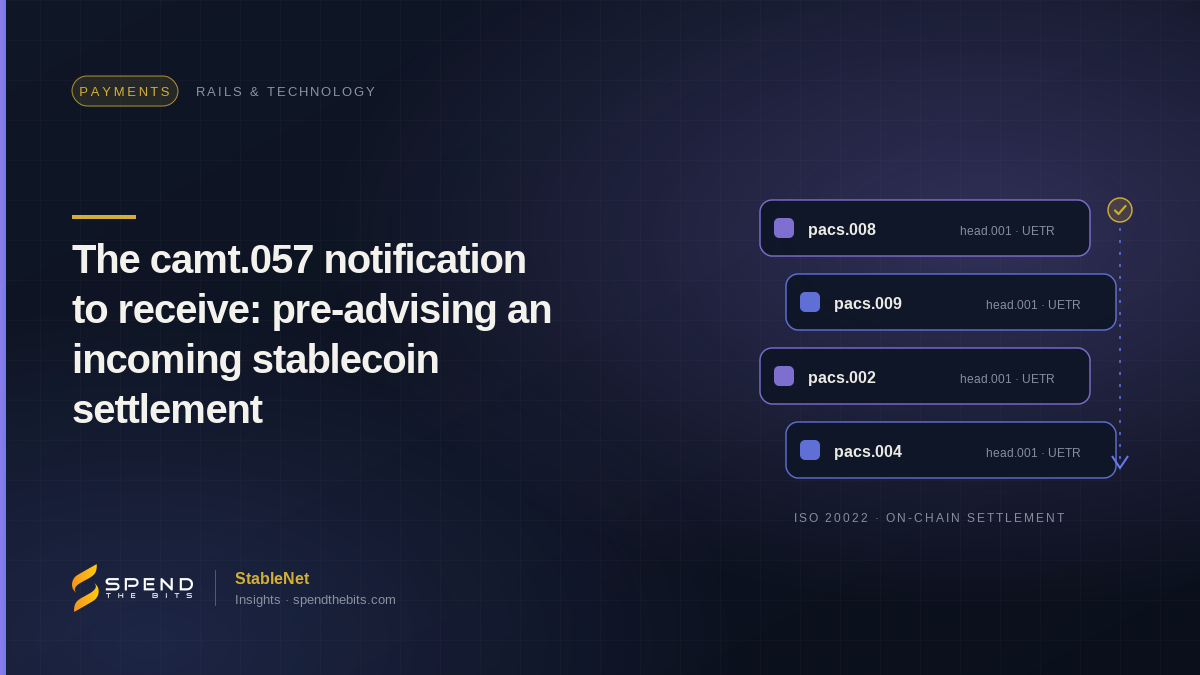
- A camt.057 notification to receive is a pre-advice, not an instruction. It tells an account servicer that funds are expected, naming the account, the amount and the expected value date, and it moves no value by itself.
- It is the forward looking member of the camt family. A camt.054 confirms an entry that was made, a camt.052 reports the intraday position and a camt.053 is the closing statement, so a pre-advice is only useful once it is matched to the event that follows.
- The UETR is the field that makes it work. One reference carried across the pre-advice, the pacs.008 or pacs.009 instruction, the on-chain transfer and later status messages removes amount-and-date guesswork from matching.
- Fast settlement raises the value of a pre-advice rather than removing it. Liquidity pre-positioning, screening of named parties, cut-off planning and exception handling all need to start before the funds arrive.
- Treat a pre-advice as operational data with a lifecycle: expected, matched, cancelled or expired. Support camt.058 for withdrawals and camt.059 for status, and never let a pre-advice reach a ledger or a balance.
A payout partner that learns about a payment when the money lands has no time to prepare. The camt.057 notification to receive is the ISO 20022 message that fixes that. It is a pre-advice: the sender tells the account servicer that funds are coming, which account they will reach, when they are expected and what they are for. No value moves. The message only sets an expectation, so the team that will receive the credit can plan around it.
This article is written for payments and treasury operations leaders at credit unions, tier-2 and tier-3 banks and licensed money service businesses. It covers what the message is, how it differs from the camt reports that follow a credit, which fields carry the weight, why a pre-advice still earns its place when settlement takes minutes, and how to run the flow without creating a second source of truth. It is a reading of the standard and not legal advice.
What is a camt.057 notification to receive?
In the ISO 20022 catalogue, camt.057 is the NotificationToReceive message. It sits in the cash management family with the account reports, not in the payment clearing and settlement family with pacs.008 and pacs.009. The distinction matters. A pacs message instructs or reports a transfer of value. A camt.057 notification to receive does neither. It announces an expectation.
The sender is the party that knows the credit is coming. That may be the account owner, the originating institution, or an agent acting for either. The receiver is the account servicer that will post the entry. A corporate treasurer pre-advises a bank of an inbound receipt. A sending institution pre-advises a correspondent of a cover payment. In a stablecoin corridor, the orchestrating platform pre-advises the payout partner that a settlement is on its way.
Because it carries no instruction, nobody is paid on the strength of a camt.057 alone. The pre-advice is an operational courtesy with real value. It converts a surprise into a scheduled event.
How is camt.057 different from camt.052, camt.053 and camt.054?
The four messages answer four different questions, and teams blur them often. A camt.057 is forward looking. The others look back at entries that already exist.
- camt.057 NotificationToReceive: funds are expected. It names an amount, an expected value date and the account that should be credited, before anything posts.
- camt.054 BankToCustomerDebitCreditNotification: an entry has been made. It confirms that one named credit or debit hit the account.
- camt.052 BankToCustomerAccountReport: an intraday view. It reports the position and the entries so far during the day.
- camt.053 BankToCustomerStatement: the closing record. It is the statement a reconciliation and an audit are built on.
A useful way to hold it in mind: camt.057 is the expectation, camt.054 is the event, camt.052 is the running view and camt.053 is the record. A pre-advice that is never matched to a camt.054 is an exception, and that pairing is one of the cheapest controls an operations team can run.
Two companion messages complete the set. A camt.058 NotificationToReceiveCancellationAdvice withdraws a pre-advice that will no longer happen. A camt.059 NotificationToReceiveStatusReport tells the sender whether its notification was accepted or rejected. Both are worth supporting from the start, because a pre-advice that can never be withdrawn becomes stale data the moment a payment is cancelled.
What does a camt.057 notification to receive actually carry?
The message has a group header and one or more notifications, and each notification can hold several items. The group header carries the message identification and the creation date and time. The notification level names the account to be credited and the party that services it. The item level is where the detail sits.
Each item carries its own identification, the expected amount and currency, and the expected value date. It can also carry an end to end identification, a UETR, the debtor and the debtor agent, any intermediary agent, and a purpose code. That set is close enough to the corresponding pacs.008 or pacs.009 fields that the receiving team can line the two up without a manual lookup.
The UETR is the field to insist on. One unique end to end transaction reference ties the pre-advice to the payment instruction, to the status reports that follow, and in a stablecoin corridor to the on-chain transfer that settles it. Without it, matching falls back to amount and date, which is guesswork as soon as two clients send similar amounts on the same day.
Two habits keep the message honest. Send a realistic expected value date rather than an optimistic one, because the receiving team will staff against it. And send an amount you can stand behind, since a pre-advice that is routinely wrong is worse than no pre-advice at all.
Why pre-advise a payment that settles in minutes?
Fast settlement removes the waiting, not the work. The on-chain leg of a stablecoin payment may complete in minutes, but the last mile into a local account still runs on local hours, local cut-offs and local liquidity. The pre-advice is what lets the payout side be ready at the moment the funds arrive instead of starting then.
Four things improve with a pre-advice in hand. Liquidity can be pre-positioned for the local payout rather than sourced after the credit lands. Compliance screening of the underlying parties can start before the money arrives, so a hit is a held payment rather than a reversal. Cut-off planning becomes possible, because a payment expected at a known hour can be lined up for the same business day. And reconciliation gets a prior expectation to match against, which is how an unexpected credit becomes visible as a risk event rather than a pleasant surprise.
The direction of travel in the official targets is toward this kind of readiness. According to the Financial Stability Board's 2021 G20 roadmap targets, 75 percent of cross-border wholesale payments should be credited to the end beneficiary within one hour of initiation by the end of 2027. An hour leaves no room for a payout team to discover a payment, find liquidity and screen the parties in sequence.
A pre-advice is not a promise of funds. It is a promise of attention. The payout side can only be ready for a payment it already knows about.
There is a control argument too. Any institution receiving value should be able to say, for every credit, whether it was expected. A pre-advice file gives an operations team that answer in one query, and it makes an unexpected inbound credit something to investigate rather than something to post.
How should a team run a camt.057 flow in production?
A pre-advice flow is easy to build and easy to let rot. The steps below keep it a live control rather than a feed nobody reads.
- Agree the flow bilaterally first. Confirm the message version, the transport, the cut-off for sending a pre-advice, and whether the counterparty will return a camt.059 status report.
- Require a UETR on every item, and use the same reference on the payment instruction, the on-chain transfer and every later status message.
- Store each pre-advice as a record with its own state: expected, matched, cancelled or expired. A pre-advice that is only an inbound file is not a control.
- Match each pre-advice to the camt.054 credit notification or the on-chain credit, and age anything unmatched past its expected value date into an exception queue.
- Send a camt.058 cancellation advice the moment a pre-advised payment is withdrawn, and treat a late cancellation as an incident worth reviewing.
- Screen the named debtor and any intermediary agent on receipt of the pre-advice, not on arrival of the funds, so a sanctions hit is handled before the credit posts.
- Alert on any credit that arrives with no matching pre-advice, and record what the investigation found.
- Report the quality of the feed monthly: how many pre-advices were matched, how many expired, and how far the stated amount and value date differed from the actual.
One scoping decision saves a lot of argument later. A pre-advice is operational data, not an accounting entry, so it must never post to a ledger and never appear in a balance. Keep it in the operations layer, show it on the dashboard the payout team uses, and let the camt.054 and the camt.053 statement remain the accounting record.
Support for the message is bilateral rather than universal, so ask before building. Many corporate to bank channels carry camt.057 today, while plenty of cross-border counterparties will prefer an API notification or a file. The design logic is the same whatever the transport. Send the expectation early, carry one reference through, match it to the event, and withdraw it when it changes.
Where StableNet fits
StableNet, built by SpendTheBits, is a cross-border B2B payment and settlement platform for banks, credit unions, licensed money service businesses, exchange houses and remittance fintechs. Settlement is in regulated stablecoins such as USDC on public blockchains and completes in minutes with on-chain auditability, which is precisely why the payout side needs to know a payment is coming before it lands. The platform is ISO 20022 native, with pacs.008 customer credit transfers, pacs.009 interbank legs, pacs.002 status reports, pacs.004 returns and head.001 envelopes, all tracked end to end by one UETR, so a pre-advice, the instruction, the on-chain transfer and the status that follows share a single reference. KYB and KYC onboarding, KYT, sanctions and PEP screening and Travel Rule data under IVMS101 run in the same path and write to a tamper-evident audit trail, which lets a payout partner screen a named party while the settlement is still in flight.
See it on your corridors
Book a working session and we’ll map StableNet’s compliance and settlement to one of your live payment flows.