pain.001 payment initiation: instructing a cross border payout that settles in stablecoins
A pain.001 tells your bank to make a payment. What the instruction must carry when the cross border leg settles on chain, and how pain.002 answers it.
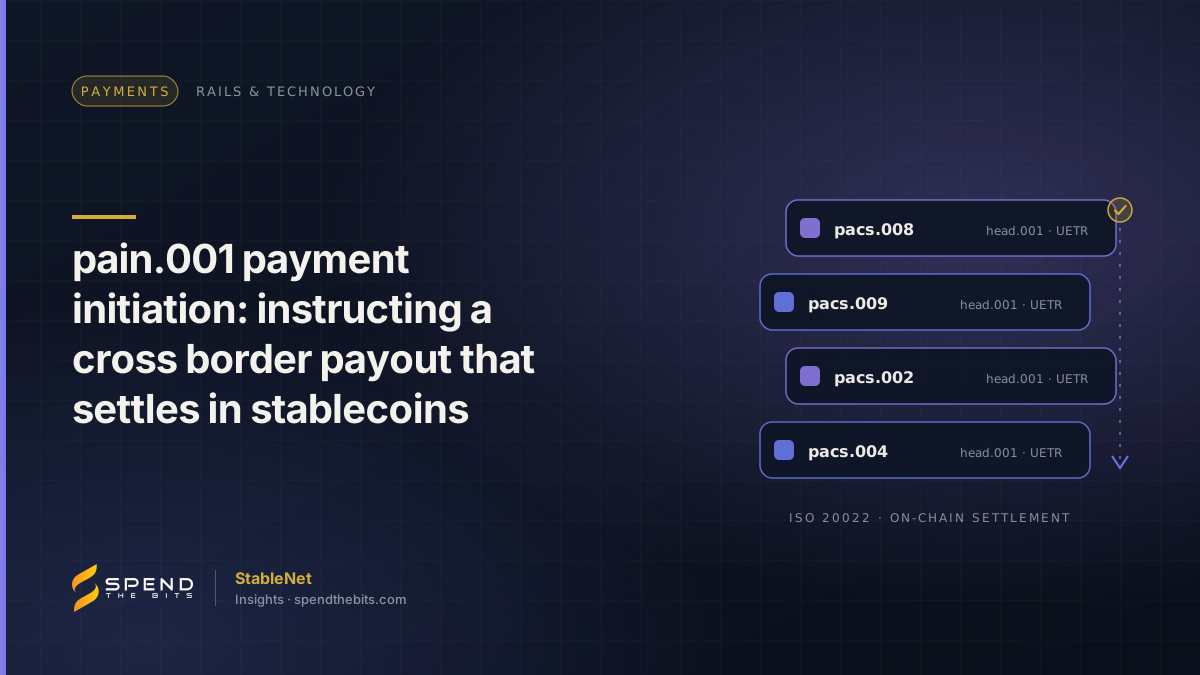
- pain.001 is customer to bank and pacs.008 is bank to bank. The customer instructs, the bank executes, and the bank owns the mapping between the two.
- The end to end identification set by the customer must survive into the pacs.008 and back into every status report, joined once to the UETR the bank assigns.
- An on chain settlement leg changes no field in the schema. It removes the tolerance, because there is no correspondent to chase a missing beneficiary name later.
- Report accepted settlement completed only at the confirmation depth your policy names, and attach a reason code to every rejection.
- Duplicate control, mandate checks, beneficiary account validation and a written rejection rule remove most of the traffic a payment operations team handles.
A pain.001 payment initiation message is how a corporate customer tells its bank to make a payment. It is the instruction, not the settlement. When the bank then settles the cross border leg in a regulated stablecoin, the pain.001 payment initiation does not change its job. It still has to name the debtor, the creditor, the amount, the currency and the requested execution date. It still has to be accepted or rejected in a way the customer can act on. This article sets out what the message carries, how it differs from pacs.008, what an on chain settlement leg demands of it, and how pain.002 answers it.
What is a pain.001 payment initiation message?
pain.001 is the ISO 20022 customer credit transfer initiation message. The initiating party sends it to its own bank. It says who is paying, who is being paid, how much, in which currency, and when the payment should leave. It is a request. Nothing has settled when it is sent.
The message has three levels. A group header identifies the file, its creation time and the initiating party. One or more payment information blocks each hold a debtor, a debtor account, a debtor agent, a requested execution date and a charge bearer. Inside each block sit the individual credit transfer transactions, one per beneficiary.
That shape matters in practice. A single file can carry one payout or several hundred. Grouping payments that share a debit account and an execution date into one payment information block is what makes a batch payout file readable. Splitting every transaction into its own block produces a file that validates and confuses everyone.
Two siblings complete the set. pain.002 reports the status of an initiation back to the customer. pain.007 requests the reversal of a transaction already initiated. An operation that implements pain.001 without pain.002 has built half a conversation.
How does pain.001 differ from pacs.008?
The distinction is who talks to whom. pain.001 is customer to bank. pacs.008 is bank to bank. The customer instructs and the bank executes. One does not replace the other.
A bank receiving a payment initiation validates it, screens it, debits the customer, and then constructs the interbank instruction itself. On a cross border payment that instruction is a pacs.008 customer credit transfer, or a pacs.009 when the leg moves between financial institutions on their own account. The bank owns that mapping and the customer never sees it.
The reference that survives the handover is the end to end identification. The initiating party sets it. The bank must carry it unchanged into the pacs.008 and back into every status report. Beside it the bank assigns a UETR, the unique end to end transaction reference that the Swift CBPR+ usage guidelines require on the interbank leg. The customer knows its own reference. The bank knows both. Joining them once, at initiation, is what lets a treasurer ask about a payment by the only reference they hold.
Charges are the other common confusion. The charge bearer sits in the pain.001, set by the customer. If the bank quietly changes it, the beneficiary receives an amount the customer never agreed to send.
What must a pain.001 carry when the settlement leg runs on a blockchain?
Nothing in the schema changes. What changes is how strict you have to be about the fields that used to be tolerant.
Beneficiary identity has to be complete. FATF Recommendation 16 requires originator and beneficiary information to travel with a transfer, and an on chain leg gives you no correspondent to chase a missing name from later. The name, address and account of the creditor belong in the initiation, not in a follow up email.
Currency has to be unambiguous. The instructed amount is in a fiat currency. The settlement asset is a stablecoin. Those are not the same field, and the customer is not choosing the token. Carry the instructed currency as the customer sent it, and let the bank record the settlement asset on its own leg.
Purpose and category purpose codes earn their place here. A screening engine that can read the purpose of a payment before execution rejects fewer payments after execution. On a public chain there is no after execution.
The requested execution date has to mean something. A stablecoin leg can settle in minutes on a Saturday. If your operating model only releases payments on business days, say so in the service description rather than letting the customer infer it from a field the rail no longer constrains.
Structured remittance information beats free text every time. Reconciliation on the beneficiary side will match on a structured reference. It will not parse a sentence.
A payment initiation is a promise about data, not about speed. If the instruction is complete, a settlement leg that finishes in minutes is a feature. If it is not, the same speed only makes the error arrive sooner.
How does a pain.002 status report answer the initiation?
pain.002 is the customer payment status report. It tells the initiating party what happened to the file, to each payment information block, and to each transaction. Status is reported at all three levels, and the levels can disagree. A file can be accepted while one transaction inside it is rejected.
The status codes are a short, fixed list. Accepted technical validation means the file parsed. Accepted customer profile means the debtor is permitted to send it. Accepted settlement in process means execution has begun. Accepted settlement completed means the value has moved. Rejected means it has not. Pending means the bank has not decided yet.
Two habits make the report useful. Send accepted settlement completed only when settlement is genuinely final, which on a chain means the confirmation depth your policy names rather than the moment a transfer is broadcast. And always attach a reason code to a rejection. An incorrect account number, a duplication and a regulatory reason are three different problems for the customer, and a bare rejection sends them back to your service desk.
Accepted with change deserves particular care. It means the bank executed something other than what was asked. That belongs on the face of the status report, not buried in a field nobody reads.
What does the initiation to settlement flow look like step by step?
The flow has a fixed shape. Each step produces a record, and those records are what an examiner or an auditor will ask to see.
- Receive the pain.001, validate it against the schema and your own usage guideline, and acknowledge the file.
- Screen the debtor, the creditor and the purpose before any debit, and hold anything that hits a list rather than executing and unwinding.
- Confirm the debit account holds cleared funds, debit the customer, and record the reference the customer gave you.
- Assign a UETR, map the instruction to a pacs.008, and carry the end to end identification through unchanged.
- Convert the fiat instruction into the settlement asset at a quoted and recorded rate, so the rate applied is the rate shown.
- Execute the on chain transfer, capture the transaction hash, and wait for the confirmation depth your policy sets before treating it as final.
- Instruct the payout leg in the beneficiary market and collect the evidence that the beneficiary was actually paid.
- Return a pain.002 at every material change of status, and a final one when settlement is complete.
The order is not negotiable. Screening after the debit means unwinding a payment that has already left. On a public chain that unwinding is a new payment, with its own screening, its own approval and its own risk.
Which pain.001 controls stop the most common failures?
Four controls remove most of the traffic a payment operations team handles.
Duplicate control comes first. Keyed on the message identification and on each end to end identification, it stops a file resubmitted by a nervous customer from paying everybody twice. On a rail measured in minutes, a duplicate cannot be recovered by telephoning someone.
Limit and mandate checks come next. The initiating party, the debit account and the amount have to be checked against the mandate the customer signed. A payment initiation is only as good as the authority behind it.
Then account validation. Verifying the beneficiary account and the beneficiary name before execution catches the most expensive error class in cross border payments, which is a correct payment sent to the wrong party.
Last is rejection discipline. Decide in advance whether one bad transaction rejects a whole file or only itself, write that into the service description, and report it the same way every time. Customers can build around a rule they know. They cannot build around a surprise.
Where StableNet fits
StableNet, built by SpendTheBits, is a cross border B2B payment and settlement platform for banks, credit unions, licensed money service businesses, exchange houses and remittance fintechs. Settlement runs in regulated stablecoins such as USDC and USDT on public blockchains and completes in minutes with on chain auditability, so a completed status report rests on a transfer anyone can verify. The platform is ISO 20022 native, with pacs.008 customer credit transfers, pacs.009 interbank legs, pacs.002 status reports and pacs.004 returns inside head.001 envelopes, tracked end to end by UETR, so a customer reference and an interbank reference resolve to one payment. Compliance is built in, with KYB and KYC onboarding, KYT, sanctions and PEP screening, FATF Travel Rule data in IVMS101 form, a compliance workbench and a tamper evident audit trail. SpendTheBits is a Bank of Canada registered payment service provider and a named finalist in the Swift Hackathon 2026 Technical Challenge.
See it on your corridors
Book a working session and we’ll map StableNet’s compliance and settlement to one of your live payment flows.