Neobank cross-border payments: launching international transfers without a correspondent relationship
Neobank cross-border payments without a correspondent bank: the sponsor question, on-ramp and off-ramp legs, compliance ownership and a corridor-first launch.
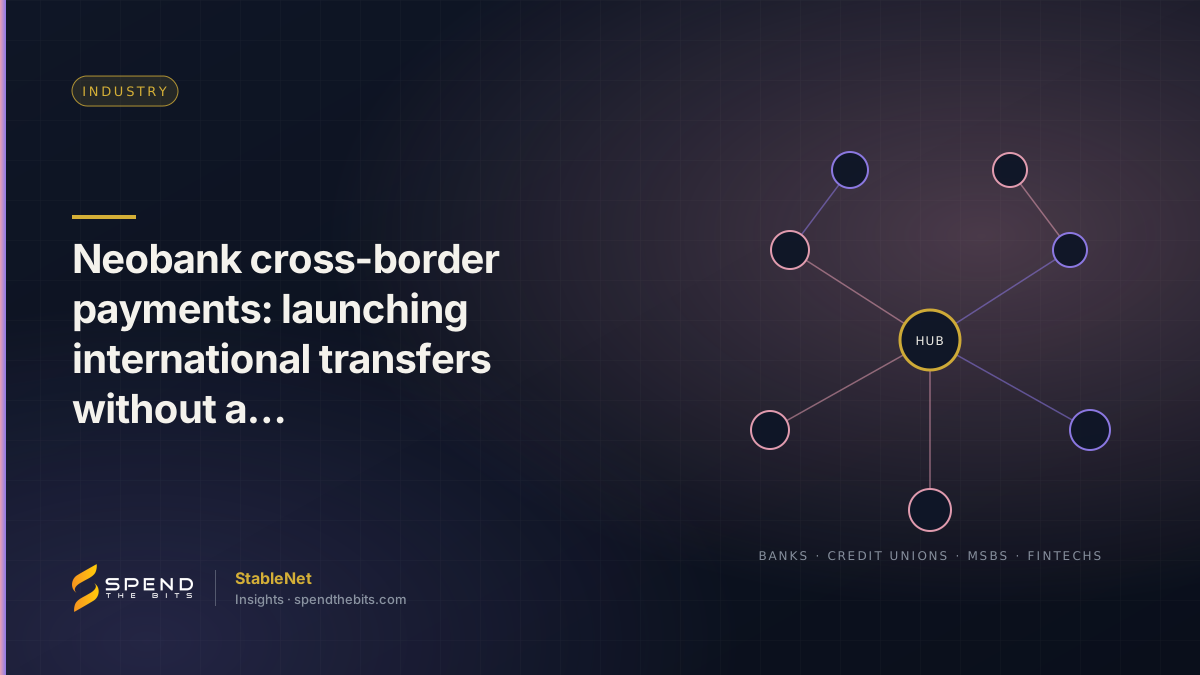
- A neobank cannot usually obtain a correspondent account because it is not a bank, and its sponsor bank rarely wants to extend its own correspondent lines to the programme. Stablecoin settlement replaces the correspondent leg with an on-chain transfer between regulated counterparties.
- The sponsor bank still matters. It holds the customer deposits, approves the product, owns the BSA programme the neobank operates under, and will need to approve the settlement provider as a third party before a single payment moves.
- Every international payment has three legs: an on-ramp from the customer's fiat balance into stablecoin, an on-chain settlement leg, and an off-ramp into the destination currency through a licensed payout partner. Each leg has an owner, a cut-off and a failure mode.
- Compliance ownership must be written down before launch: the neobank runs KYC and monitoring under the sponsor's programme, the settlement provider screens each transfer and attaches Travel Rule data, and the sponsor retains oversight and filing authority.
- Launch two or three corridors, not twenty. Pick corridors where the neobank already has customer demand, where a payout partner is live, and where both ends have clear rules on stablecoin settlement, then add corridors by the same test.
Neobank cross-border payments without a correspondent relationship are possible because stablecoin settlement replaces the correspondent leg with an on-chain transfer between regulated counterparties, while the sponsor bank continues to hold the customer's deposits and the neobank continues to own the customer. The neobank funds an on-ramp from its customer's fiat balance, a settlement provider moves value on chain to a licensed payout partner in the destination country, and that partner off-ramps into local currency and credits a local account. The parts that require care are the sponsor bank's approval, the ownership of compliance across three parties and the choice of corridors to launch first. This article covers each in turn.
Why can a neobank not simply open a correspondent account?
Correspondent accounts are opened by banks for banks. A neobank in the United States is typically a technology company operating on a sponsor bank's charter, with customer deposits held at the sponsor. In Canada it is more often a registered MSB or a payment service provider registered with the Bank of Canada under the Retail Payment Activities Act. In neither case does the neobank have the banking licence a foreign correspondent expects to see, and even where the sponsor has correspondent lines, it rarely wishes to expose them to a fintech programme whose customers it did not onboard itself.
The traditional workaround is to route international payments through the sponsor's wire desk or through a third-party remittance aggregator. Both work, and both leave the neobank with the correspondent chain's problems: unpredictable intermediary deductions, a delivery time measured in days, a status that cannot be seen until the beneficiary complains, and a cost stack the neobank does not control. The point of a stablecoin settlement layer is not that it avoids banks; it is that the value leg moves between two regulated institutions that can both see it, in minutes, with the fiat legs kept local at each end.
What does the sponsor bank actually do, and what does it not do?
The sponsor bank holds the customer deposits and is the regulated institution whose BSA or equivalent programme the neobank operates within. It approves the product before launch, usually through a product risk assessment, and it must approve the settlement provider as a third party under the 2023 Interagency Guidance on Third-Party Relationships. It retains oversight of the neobank's KYC and monitoring, and in most arrangements it retains the authority to file suspicious activity reports, because the customer accounts are on its books. A number of sponsor banks received regulatory enforcement actions in 2024 relating to oversight of their fintech programmes, and since then sponsors have become more exacting about what they will approve and how quickly.
What the sponsor does not do is move the international payment. Its role in the flow is the domestic debit: when the customer sends an international payment, the sponsor debits the customer's deposit account and credits a settlement account belonging to the neobank or to the settlement provider, through ACH, a wire or an internal book transfer. Everything after that credit happens outside the sponsor's ledger, and the sponsor needs to be comfortable with that. The document that makes it comfortable is a flow-of-funds diagram showing every account, every owner and every control between the customer's debit and the beneficiary's credit.
- The sponsor bank approves the product and the settlement provider, holds the deposits and performs the domestic debit that funds the on-ramp.
- The neobank owns the customer, performs KYC and ongoing monitoring under the sponsor's programme, sets the price and runs the customer-facing status and support.
- The settlement provider converts fiat to stablecoin or accepts stablecoin held by the neobank, screens each transfer, attaches Travel Rule data and settles on chain to the payout partner.
- The payout partner, a licensed institution in the destination country, off-ramps into local currency and credits the beneficiary's account through domestic clearing.
- Each party keeps its own record of the payment under a shared reference, and the neobank reconciles all four records daily.
How do the on-ramp and off-ramp legs work?
The on-ramp begins with the sponsor's domestic debit. Funds arrive in a fiat settlement account and are converted into a regulated stablecoin such as USDC or USDT, either per payment or, more commonly, in advance so that a stablecoin float already exists when the customer presses send. The neobank should keep custody of that float in its own wallet arrangement, with the settlement provider orchestrating transfers under the neobank's policy rather than holding the value in its own name. The decision of how much float to pre-position per corridor is a treasury decision, and it should be sized to a day's expected sends with a sweep back to fiat at a fixed time.
The settlement leg is the on-chain transfer to the payout partner's wallet. Before it is sent, the provider screens the destination wallet, screens originator and beneficiary against sanctions lists and attaches the Travel Rule data in IVMS101 form. Once confirmed on chain, the transfer is final in the sense that matters to treasury: the value has moved and cannot be recalled by the sender, which means any error must be handled as a return, not a cancellation.
The off-ramp is the payout partner's job. It converts the stablecoin to local currency at a rate that should have been quoted to the neobank before the settlement leg, and it credits the beneficiary through the local rail: SEPA in the euro area, ACH in the United States, EFT in Canada, or the domestic instant rail where one exists. Where the beneficiary bank cannot be reached on a local rail, a SWIFT payout by MT103 or pacs.008 is the fallback, and the neobank should know in advance which beneficiary banks in a corridor fall into that category, because the delivery time and cost promise changes.
The correspondent chain is replaced by two local legs and one on-chain hop. The local legs are familiar. The discipline lies in the handovers between them.
Who owns compliance when three parties touch the payment?
The safest answer is a written responsibility matrix, agreed by the sponsor, the neobank and the settlement provider before launch, that names one owner for every control. The neobank identifies and verifies the customer, rates the risk and monitors the account, under the sponsor's programme and subject to the sponsor's audit. The settlement provider screens each payment against sanctions and PEP lists, screens the destination wallet, runs KYT on the stablecoin leg and attaches Travel Rule data, and returns every result to the neobank as a structured event. The neobank decides on each alert, escalates to the sponsor where the sponsor's policy requires it, and the sponsor files any report that its regulator requires. The payout partner performs its own beneficiary screening under its own local obligations.
Two points in that matrix cause the most argument. The first is who may release a payment that screening has flagged as a possible match: it should be the neobank's compliance team, with a documented four-eyes check, and never the settlement provider. The second is data retention: each party must retain the records its own regulator requires, and the neobank must be able to retrieve the provider's screening record and Travel Rule exchange for any payment for as long as the sponsor's programme specifies. Write the retention period into the provider agreement rather than assuming it.
How should a neobank launch in a few corridors first?
Corridor selection is a separate discipline, but the launch principle is simple: two or three corridors, chosen by evidence, run to a high standard, before any expansion. The evidence is the neobank's own data. If a meaningful share of customers already hold a second nationality, receive salary from abroad or have asked support about sending money to a particular country, that is the demand signal. On the supply side, the corridor needs a live payout partner with a local rail, a clear regulatory position on stablecoin settlement at both ends, and enough FX liquidity in the stablecoin pair to quote a firm rate.
For each launch corridor, set a per-customer and per-day limit, publish a delivery promise the payout partner has agreed in writing, and run a soft launch to a small group of existing customers with a support channel that a person answers. Track four numbers from day one: the share of payments delivered within the promise, the share held for review, the share returned and the reconciliation breaks. When those numbers are stable for a period the sponsor accepts, raise the limits, then add the next corridor using the same test. Corridors that fail the test are paused, not patched.
- Confirm customer demand from the neobank's own data before speaking to any payout partner.
- Confirm a live payout partner with a local clearing rail and an agreed delivery promise for the corridor.
- Confirm the regulatory position on stablecoin settlement at both the send and receive ends, in writing from counsel or the provider.
- Confirm firm FX quoting in the stablecoin pair for the corridor at the sizes the neobank expects.
- Set limits, soft launch, measure delivery, holds, returns and reconciliation breaks, and only then expand.
What will the sponsor bank's examiner ask the neobank for?
The examiner examines the sponsor, but the sponsor will pass the request straight through. Expect to produce the product risk assessment, the flow-of-funds diagram, the responsibility matrix, the provider's due diligence file with its assurance reports and registration references, the wallet address inventory and custody arrangement for the stablecoin float, the daily reconciliation between the customer ledger, the float and the provider's transfer log, a sample of held and returned payments with the decision record for each, and the Travel Rule data-flow diagram showing which fields left the neobank and to whom. A neobank that assembles that folder before launch will find the sponsor's approval faster and the first examination shorter.
Where StableNet fits
StableNet, built by SpendTheBits, is a cross border B2B payment and settlement platform for banks, credit unions, licensed money service businesses, exchange houses and remittance fintechs, including neobanks that need international payments without a correspondent relationship. Its settlement flows cover the legs described here: a fiat-to-crypto on-ramp from the sponsor's domestic debit, digital asset settlement in regulated stablecoins such as USDC and USDT on public blockchains, completing in minutes with on chain auditability, and a crypto-to-fiat off-ramp through local clearing on ACH, SEPA or EFT, with SWIFT payout by MT103 or pacs.008 as the fallback. Customers keep custody of their float. Sanctions and PEP screening, wallet screening, KYT and FATF Travel Rule data in IVMS101 form are built in, with a compliance workbench and a tamper evident audit trail that supports the responsibility matrix a sponsor bank will ask to see. SpendTheBits is a Bank of Canada registered payment service provider and a named finalist in the Swift Hackathon 2026 Technical Challenge.
See it on your corridors
Book a working session and we’ll map StableNet’s compliance and settlement to one of your live payment flows.