Stablecoin supply has stalled near 300 billion dollars: why payment volume is the number that matters
Stablecoin supply has stalled near 300 billion dollars, yet that figure measures balances parked, not money moved. Here is what a payment operator should track.
- Stablecoin supply, or market capitalisation, measures how much value is parked in tokens at a point in time. It says little about how much value moves through settlement.
- Supply can plateau while payment use grows, because a token used for settlement may be held for minutes and then recycled many times.
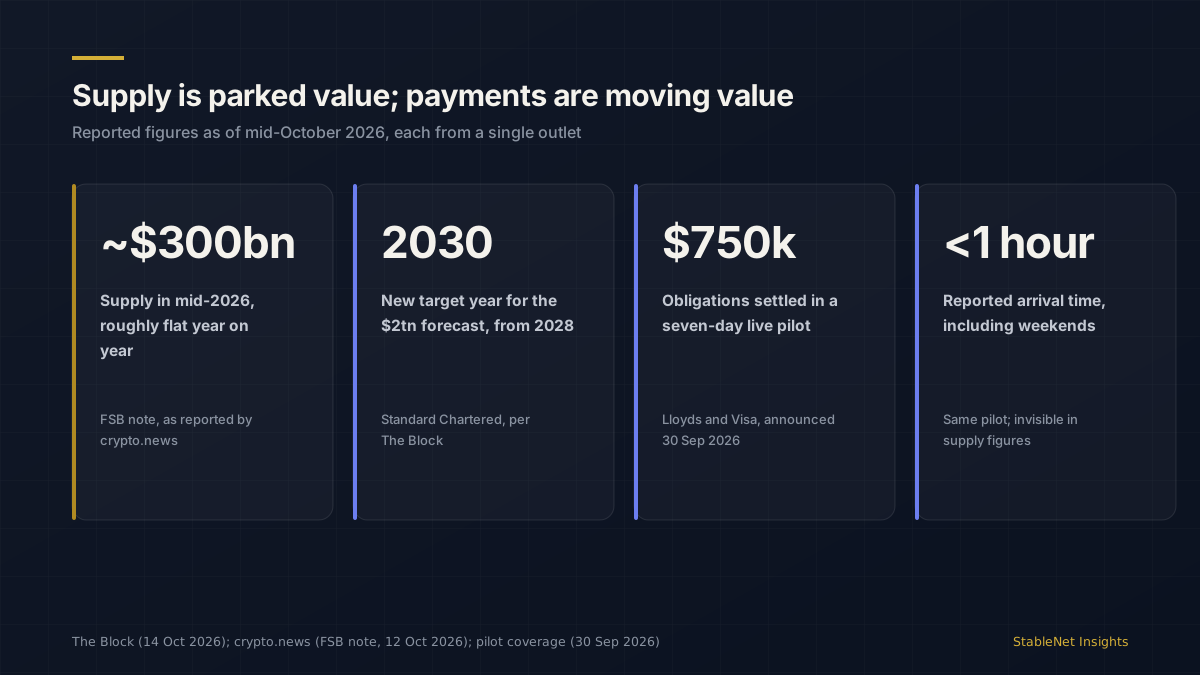
- According to reporting by The Block on 14 October 2026, Standard Chartered moved its 2 trillion dollar market forecast from 2028 to 2030, citing stalled supply growth.
- A Financial Stability Board note of 12 October 2026, as reported by crypto.news, flags that cross-border holdings, reserves and flows are hard for any single authority to observe.
- An operator should track settled volume, time to finality, cost per payment, return rate, reconciliation breaks and peak balance held, not the headline supply figure.
Stablecoin supply has stalled near 300 billion dollars, but that number measures how much value is parked in tokens, not how much money moves through settlement. For a payment operator, settled volume, speed, cost and exception rates are the figures that describe real use. Supply tells you the size of the pool; payment volume tells you how hard the pool is working.
Headlines in mid-October 2026 treated the plateau as a verdict on the whole market. This article argues that the verdict is premature for anyone who moves money rather than holds it. All figures below are reported by single outlets as of mid-October 2026 and should be read as approximate.
What do the latest supply figures actually say?
According to reporting by The Block on 14 October 2026, Standard Chartered kept its 2 trillion dollar stablecoin market forecast but moved the target date from 2028 to 2030. The report reportedly attributes the delay to stalled supply growth this year, which its author describes as cyclical rather than structural. The same reporting puts current supply at about 309 billion dollars, within a band of roughly 300 to 320 billion dollars over the past twelve months.
A separate source points the same way. As reported by crypto.news, a Financial Stability Board note of 12 October 2026 puts the market at about 300 billion dollars in mid-2026, essentially unchanged from a year earlier. A third outlet, Stablecoin Insider, reported in its third quarter 2026 review that supply stalled near 304 billion dollars at the end of September, and warned that trackers differ by a few billion dollars.
The three figures differ slightly because each uses a different tracker and date. What they share is the shape: a market that stopped growing in balance terms during 2026. Our broader overview of adoption data sits in the stablecoin adoption statistics article, which is a useful companion to this one.
Why does supply measure the wrong thing for a payment operator?
Supply is a stock. It counts tokens outstanding at one moment, in the same way that a balance sheet counts cash on a given date. A payment business cares about a flow: how many payments settled, how quickly, and at what cost over a period.
Much of the supply figure is also held for reasons unrelated to payments. Traders keep tokens as a dollar position between trades, savers hold them as a store of value, and exchanges and protocols hold large working balances. None of these holders needs the token to move, so growth in their balances can swamp or mask growth in payment activity.
The reverse is also true. A payment operator that funds a transfer, settles it and sweeps the balance within minutes adds almost nothing to supply, yet may settle a large value over a month. Two firms with identical supply footprints can differ by an order of magnitude in settled volume.
How can supply plateau while payment use grows?
The mechanism is recycling. A settlement token is minted or bought, sent to a counterparty, converted or redeemed, and the same unit is then available for the next payment. If each unit is reused more often, the same supply carries more payments.
Stablecoin Insider reported that identified payments from January to August 2026 reached at least 401 billion dollars, up 42 percent on 2025, while supply stalled. The outlet notes that this covers identified payments only and rests on aggregated tracker data, so it is a single-source indication, not an audited measure. It is nonetheless consistent with the argument that use and balances can move in different directions.
Pilots show the same pattern at the institutional end. Lloyds and Visa announced on 30 September 2026 that they had settled about 750,000 dollars of obligations in USDC over a seven-day live pilot, with individual transfers reportedly reaching Visa in under an hour, including over the weekend. A pilot of that size is invisible in a 300 billion dollar supply figure, yet it demonstrates the use that matters to a treasurer.
Supply tells you how much is parked. Payment volume tells you how much work the rail is doing. An operator is paid for the second number.
What do the Standard Chartered revision and the FSB note signal?
The Standard Chartered revision signals a change in timing, not in direction. The forecast of 2 trillion dollars is reportedly retained and moved two years later. For an operator, the practical reading is that balance growth may be slower than earlier planning assumed, so business cases should not depend on a rising tide of supply.
The Financial Stability Board note signals an oversight concern. As reported by crypto.news, it flags that cross-border holdings, reserves and flows are difficult for any single authority to observe. An issuer may not know where its holders are, blockchain records do not reliably show residence or purpose, and reserves may sit in several jurisdictions.
That concern has a direct consequence for regulated operators. If supervisors cannot see flows from the outside, they will expect firms to supply the visibility: who sent what, to whom, through which wallet, and with what screening result. Firms that can produce flow data on request will be better placed than firms that can only quote a balance.
Which metrics should a payment operator track instead?
Six measures describe whether a stablecoin settlement operation is healthy. Each is observable from the operator's own records, and none depends on the market-wide supply figure.
- Settled volume: the value and count of payments that reached final settlement in a period, split by corridor and by chain.
- Time to finality: the elapsed time from submission to confirmed settlement, reported as a median and as a high percentile, including weekends and holidays.
- Cost per payment: network fees, liquidity provider spreads, conversion costs and screening costs divided by the number of payments settled.
- Return rate: the share of payments that came back through a return message or a manual reversal, with the reason code.
- Reconciliation breaks: the count and age of items where the ledger, the chain and the bank statement disagree.
- Peak balance held: the highest token balance carried during the period, which shows how much capital the rail actually ties up.
The last measure connects the two worlds. Dividing settled volume by peak balance held gives a rough turnover figure for your own operation. We do not offer a market-wide velocity number here, because none of the sources above publishes one, and an invented ratio would mislead more than it informs.
For the treasury and control side of these measures, see our articles on stablecoin treasury management for MSBs and on reconciliation breaks in stablecoin settlement.
What should a reader do with a stalled headline?
Treat the supply figure as context, not as a performance indicator. If a board paper or a vendor deck cites market capitalisation to argue that stablecoin payments are growing or shrinking, ask which flow measure supports the claim. If none is offered, the claim is a statement about holders, not about payments.
Also keep the limits in view. Supply remains relevant for liquidity depth and for issuer risk, because a larger and better-reserved token is easier to source in size. The point is narrower: supply is an input to your risk assessment, not a measure of your business.
Where StableNet fits
StableNet is built by SpendTheBits as a cross-border B2B payment and settlement platform for banks, credit unions, licensed MSBs, exchange houses and remittance fintechs. Settlement runs in regulated stablecoins such as USDC and USDT on public blockchains, completes in minutes, around the clock including weekends, with on-chain auditability. Payments are ISO 20022 native, with pacs.008, pacs.009, pacs.002 and pacs.004 messages tracked end to end by UETR, so settled volume, status and returns can be read from one reference per payment.
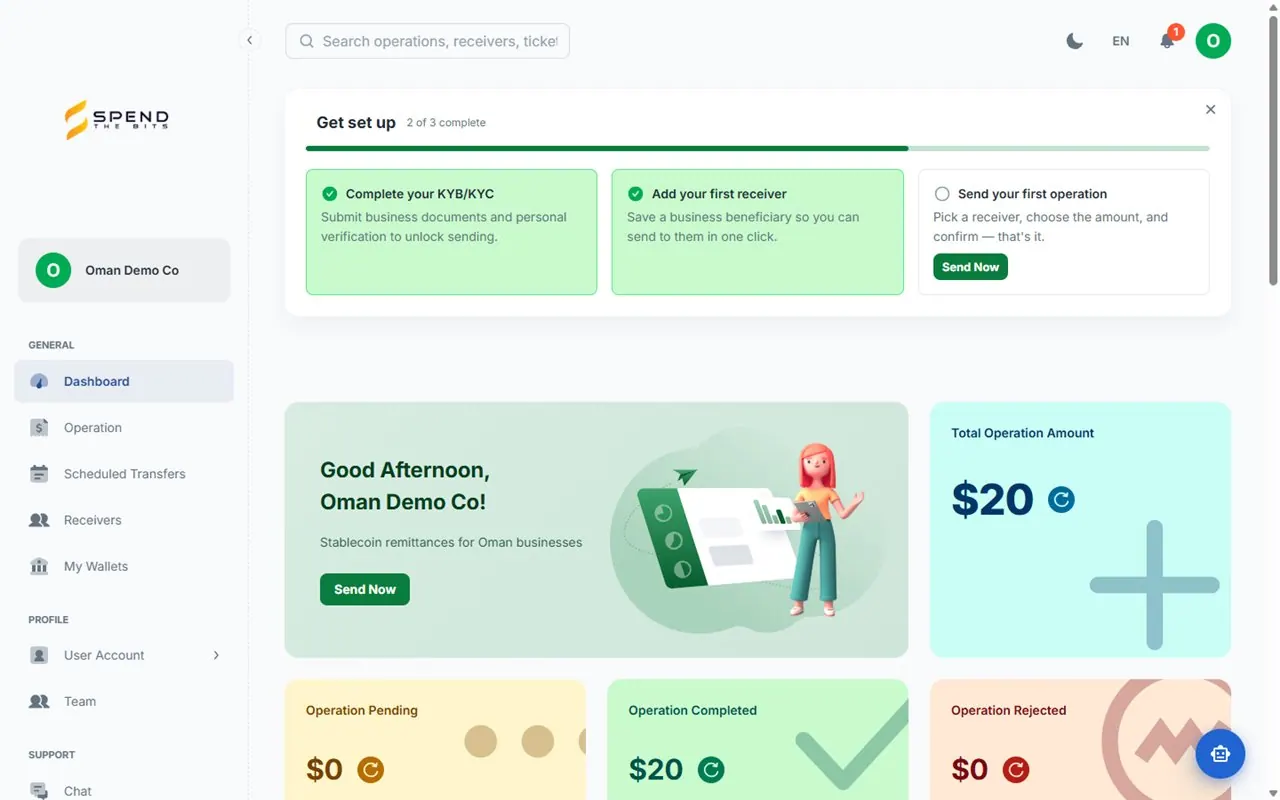
The operator portal provides a dashboard and transaction monitoring, and the compliance layer records screening and a tamper-evident audit trail. When you evaluate any provider, ask for the flow measures described above rather than the market supply figure: settled volume by period, median and high-percentile time to finality, return rate and the ageing of reconciliation breaks. A provider that can answer those from its own records is describing its service, not the market.
See it on your corridors
Book a working session and we’ll map StableNet’s compliance and settlement to one of your live payment flows.