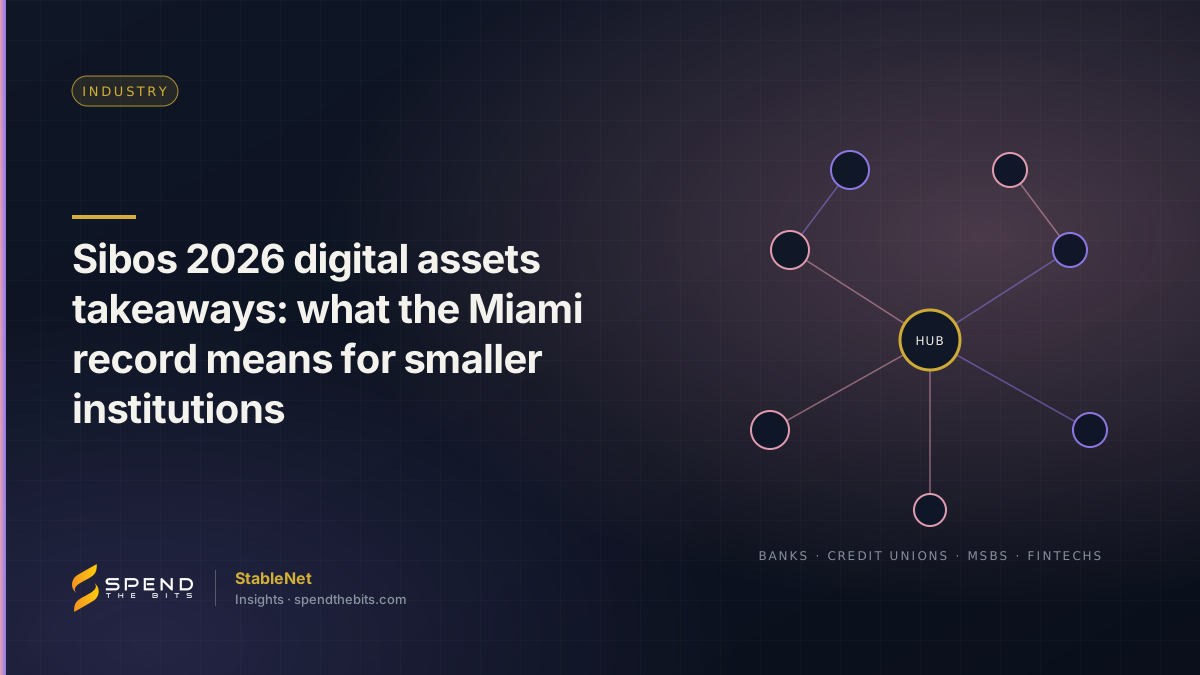
Sibos 2026 digital assets takeaways: what the Miami record means for smaller institutions
Sibos 2026 moved tokenised settlement into production. What Miami said about tokenised deposits, stablecoins and the interoperability of controls.
- Sibos 2026 ran in Miami from 28 September to 1 October 2026. The question of whether tokenised settlement happens is closed. The open question is who gets access and whose controls travel with the value.
- Swift said at Sibos 2026 that its blockchain based shared ledger is in live use and that at least 19 banks are expected to be on it by the end of 2026, across five major currencies, for always on payments in tokenised deposits.
- Tokenised deposits led the agenda because they sit inside a bank's own balance sheet. They work between institutions on the same ledger and do nothing for a counterparty that is not on it, which is why regulated stablecoins still answer the corridor question.
- The binding constraint named all week was safe interoperability, and the thing that has to interoperate is the control rather than the token. One policy and one evidence record across chains, not one per network.
- A smaller institution does not need a seat on a shared ledger to act. Name one corridor, write the control policy before picking the rail, get pacs.008 and pacs.009 with a carried UETR right, and set a review date.
The digital assets takeaways from Sibos 2026 are easier to read than those from any Sibos before it. The argument about whether tokenised settlement would happen is finished. Swift held Sibos in Miami from 28 September to 1 October 2026, under the theme of digital finance for AI driven economies, and the digital asset sessions dealt with systems in production rather than proofs of concept. That is good news and a problem at once, because most of the infrastructure announced in Miami was built by and for the largest global banks. A credit union, a tier-2 bank or a licensed money service business still has to work out what the week changed for an institution of its size.
What did Sibos 2026 settle about digital assets?
Three things.
The first is that tokenised settlement has left the innovation track. Coverage of the week described large banks folding their digital asset teams into core banking groups and naming specific use cases rather than running open ended experiments. That is an organisational signal, and those are the ones that stick.
The second is that the plumbing is being built in public. Swift said at Sibos 2026 that its blockchain based shared ledger is in live use, and that at least 19 banks are expected to be on it by the end of 2026, covering five major currencies for always on payments in tokenised deposits.
The third is that the hard problem has moved. It is no longer custody, or whether a token can represent money. It is whether value and the controls over it can cross between systems safely. FinTech Futures, in its 2026 Sibos coverage, framed the week around moving beyond digital islands.
For a smaller institution the direction is settled and the seats are not. Waiting for consensus is no longer cautious, because the consensus arrived.
Why did tokenised deposits take the spotlight from stablecoins?
Because they are the version of the idea a bank can run inside its own balance sheet.
A tokenised deposit is a claim on a commercial bank, represented on a ledger. The liability is familiar and the regulatory treatment is largely the one the bank already lives under. FXC Intelligence, in its 2026 analysis of Sibos, reported that tokenised deposits were the focus for many of the largest banks, with stablecoins a lower priority, and that institutions treated the two as a question of fit rather than a choice between them.
A tokenised deposit works well between institutions on the same ledger. It does nothing for a payment to a counterparty that is not.
A global bank with correspondents everywhere can treat a shared ledger as an upgrade to a network it already has. A credit union with two corridors and no correspondent of its own cannot, because that network does not include it yet.
Regulated stablecoins solve a narrower problem and solve it now. They move value between parties who share no ledger and no banking relationship, in minutes, at any hour. For a corridor payment that is the claim that matters.
What does Swift's shared ledger mean for a bank that is not one of the first nineteen?
Less than the headlines suggest, and more than nothing.
Swift's own account of Sibos 2026 puts at least 19 banks on the ledger by the end of this year across five major currencies. Those are large institutions and major pairs. A tier-3 bank sending to a secondary corridor is not in that first wave, and the currencies it needs may not be in the first five.
So the ledger is not an option this year. Read it as a specification rather than a product.
What it specifies is useful: always on settlement, tokenised representations of money, and ISO 20022 messaging over the top rather than a replacement for it. The Committee on Payments and Market Infrastructures named harmonised ISO 20022 adoption as a building block of its 2020 roadmap for enhancing cross border payments, and nothing in Miami contradicted that.
So work done now on message quality is not wasted. An institution that can already produce a clean pacs.008 for a customer credit transfer, a pacs.009 for an interbank leg, a pacs.002 status report and a pacs.004 return is building the capability the shared ledger will ask for. The rail underneath can change. The messages carry forward.
Why is interoperability the hardest problem on the agenda?
Because the thing that has to interoperate is not the token. It is the control.
Moving value between two chains is a solved engineering problem with known trade-offs. Moving a sanctions screening outcome, a Travel Rule data set and an evidence trail between them is not. Each network has its own idea of what an allow list is, who may write one, and what a compliance check looks like on chain.
FinTech Futures reported interoperability, and specifically safe interoperability, as the largest obstacle to scaling tokenisation in its 2026 coverage of the event. Global Custodian, also in 2026, made a related point from the securities side: the next test is whether tokenised assets can be mobilised and reused as collateral rather than simply issued.
A control that holds only inside one network does not travel with the payment.
For a compliance officer the implication is direct. If you settle across more than one chain, you need one policy and one evidence record, not one per network. Writing the same rule twice in two enforcement models is how two different answers get produced on the same customer.
Sibos 2026 did not ask whether tokenised settlement works. It asked whose controls travel with the token. That is a question a smaller institution can answer this quarter, without waiting for a seat on anyone's ledger.
What should a credit union, tier-2 bank or MSB do in the next ninety days?
The useful response to a conference is a short list of decisions.
- Name one corridor: the lane with real volume, a known counterparty and a payout partner you can call. Scope the work to that lane only.
- Write the control policy before choosing the rail: screening thresholds, the Travel Rule data you send and demand, the confirmation depth you treat as final, and who may halt settlement.
- Decide the settlement asset on written criteria: reserve composition, attestation cadence, redemption mechanics and the issuer's own regulatory standing.
- Fix the messaging early. Make the corridor produce a complete pacs.008 and pacs.009 with a UETR carried end to end, because that work survives a later change of rail.
- Pick the chain by policy rather than by fee: finality behaviour, liquidity in your pair, screening coverage and the quality of the data you get back.
- Rehearse the reconciliation and exception paths before the first live payment. A credit with no advice, a short payment and a chain reorganisation each need a written answer in advance.
- Set the review date. Put the shared ledger, your issuer and your corridor partner back on the agenda in six months, because the ground will have moved again.
None of that requires a seat on a shared ledger, a new core system or a change in regulatory status. It is work an institution can do with the corridor it has.
What did Sibos 2026 not answer?
Three questions stayed open, and naming them stops optimism being mistaken for a plan.
The first is access. The infrastructure described in Miami is being built by large institutions for large institutions, and the path by which a smaller institution joins has not been published. Sibos organisers describe the event as bringing together more than 10,000 participants from more than 160 countries, a reminder of how many institutions sit outside the first wave.
The second is the control standard itself. Everyone agreed interoperability matters. Nobody left with a portable way to express a compliance decision so that two networks enforce it identically. That is a standards problem, and those settle slowly.
The third is sequencing for institutions that cannot wait. A bank losing money to correspondent fees today cannot defer the decision until the shared ledger covers its currency pair. It should solve the corridor with the rails available now and keep its messaging and controls portable, so the eventual migration is a change of settlement leg rather than a rebuild.
The Fintech Times reported that Citi's chief executive, Jane Fraser, opened the week by urging the industry to move quickly without breaking trust. That is the tension in one line. For a smaller institution the resolution is sequence: controls first, then the rail.
Where StableNet fits
StableNet, built by SpendTheBits, is a cross border B2B payment and settlement platform for banks, credit unions, licensed money service businesses, exchange houses and remittance fintechs. It settles in regulated stablecoins on public blockchains, in minutes, with on chain auditability, and it is ISO 20022 native, so a corridor produces pacs.008 customer credit transfers, pacs.009 interbank legs, pacs.002 status reports and pacs.004 returns, tracked end to end by UETR. Compliance is built in: KYB and KYC onboarding, KYT, sanctions and PEP screening, FATF Travel Rule data in IVMS101, a compliance workbench and a tamper evident audit trail. Universal Compliance Control addresses the interoperability problem Sibos kept naming: an off chain compliance oracle issues one signed attestation, and on chain gates enforce it identically across chains, so no valid attestation means no settlement, tested on Solana and an EVM chain with unmodified USDC. SpendTheBits is a Bank of Canada registered payment service provider and a named finalist in the Swift Hackathon 2026 Technical Challenge on controls for digital assets.
See it on your corridors
Book a working session and we’ll map StableNet’s compliance and settlement to one of your live payment flows.