Sibos 2026 takeaways: tokenised deposits or stablecoins, and which should a bank or MSB settle on?
Tokenised deposits vs stablecoins after Sibos 2026: a flow-by-flow framework for banks and MSBs covering treasury, correspondent, payout and weekend settlement.
- Neither instrument wins outright. Most banks and money service businesses will use both, because each one fits a different kind of payment flow.
- A tokenised deposit is a claim on one bank, best suited to flows inside that bank or a shared ledger of participating banks. A payment stablecoin is a claim on a regulated issuer and can move across institutions and public chains.
- Reporting from Sibos 2026 in Miami suggests banks are working out which use case suits which instrument, rather than choosing one for everything.
- Intra-group treasury and interbank flows lean towards tokenised deposits, while payout corridors that reach MSBs, fintechs and other non-bank partners lean towards stablecoins.
- Weekend liquidity depends on the operating hours of the ledger and of the redemption path, so both instruments should be tested against a real Saturday scenario.
Neither instrument wins outright, and most banks and money service businesses will end up using both. A tokenised deposit suits flows that stay inside one bank or inside a shared ledger of participating banks, while a payment stablecoin suits flows that must cross institutions, reach non-bank partners or move on public blockchains. The sensible approach is to choose per payment flow, not once for the whole institution.
What did Sibos 2026 in Miami signal about tokenised deposits and stablecoins?
Sibos 2026 ran in Miami from 28 September to 1 October 2026. According to coverage by The Fintech Times, the conference was dominated by AI, tokenised money and the ledger, and stablecoins drew less bank attention than tokenised deposits. The same coverage characterised banks as working out which use case suits which instrument, rather than choosing one.
Several announcements were reported. Swift's chief executive said at the opening plenary that the blockchain-based ledger announced at Sibos 2025 is now live, and Swift reportedly expects at least 19 banks across five currencies to be on it by the end of 2026. DBS, OCBC and UOB reportedly completed the first live tokenised Singapore dollar payments over the ledger. Oracle reportedly announced an integration for bringing tokenised deposits into interbank flows over that ledger, and IBM reportedly released an ISO 20022 adapter for tokenised deposit instructions.
Citi reportedly added the UAE and Japan to Citi Token Services, which moves client deposits around the clock, and expanded work with Coinbase on stablecoin payments for merchant clients. The Clearing House reportedly selected Quant technology for on-chain capabilities in its tokenised deposit network. HSBC's view, as reported, is that the next phase is interoperability, meaning whether tokenised deposits can move into a shared settlement layer. These items are reported rather than independently verified, and details may change.
What is the difference between a tokenised deposit and a payment stablecoin?
A tokenised deposit is a deposit liability of a specific bank, recorded on a ledger instead of only in the bank's core system. The holder has a claim on that bank, protected in the way any deposit is protected under local rules. It normally moves between customers of that bank or between participating banks on a shared ledger.
A payment stablecoin issued under the United States GENIUS Act of 2025 is a different kind of claim. It is issued by a permitted issuer, backed one to one by reserves and redeemable at par. Because it is a bearer-style token on a blockchain, it can be held by any onboarded party and transferred between institutions that have no direct relationship with one another.
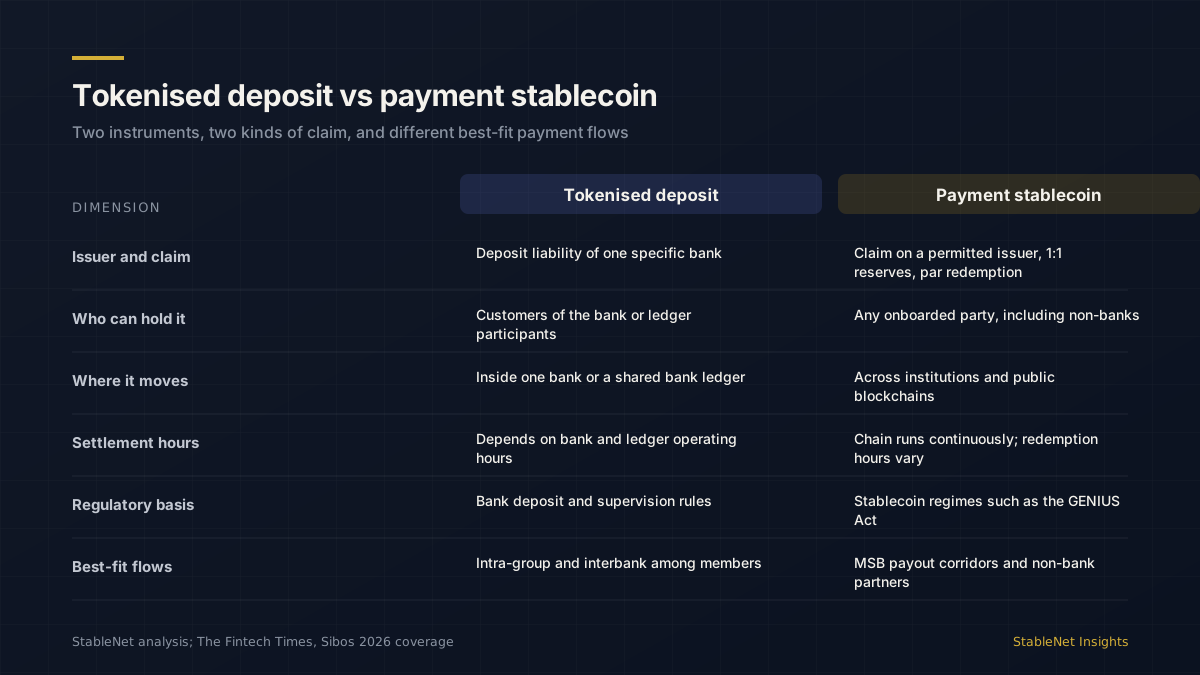
The practical consequence is a trade between depth and reach. A tokenised deposit keeps the money inside the banking perimeter, with familiar liability and supervision. A stablecoin extends reach to parties outside that perimeter, but introduces issuer, reserve and chain considerations that a treasury team must assess.
Which instrument fits intra-group treasury?
Intra-group treasury moves money between entities that share an owner, a risk framework and often a bank. Here a tokenised deposit is a natural fit, because every party already sits inside one network and the claim is on a bank the group already knows. The benefit is faster, more programmable movement between group accounts without introducing a new issuer.
A stablecoin can still make sense where a group has subsidiaries in jurisdictions or banking relationships that do not overlap. In that case the decision turns on whether the group needs one common instrument across entities that bank with different institutions.
Which instrument fits interbank correspondent flows?
Interbank flows are where the reported Sibos activity concentrates. A shared ledger of participating banks lets a tokenised deposit move between members, and the reported integrations from Oracle and IBM suggest that instructions can be carried in ISO 20022 form. For banks already inside such a group, this keeps settlement within regulated bank money.
The limitation is membership. A tokenised deposit moves easily among participants, but a counterparty outside the ledger cannot receive it directly. Where a bank needs to settle with an institution that has not joined the same network or currency scope, a stablecoin leg, or a conventional correspondent route, remains the practical alternative. The reported interoperability discussion at Sibos is precisely about narrowing this gap.
Which instrument fits MSB payout corridors?
Payout corridors usually involve a licensed MSB, exchange house or remittance fintech, a partner in the destination country and a local-currency payout at the end. Many of these parties are not members of any bank ledger, and some have limited access to the banking system in the first place. A stablecoin is the more natural instrument here because it can be received by any onboarded partner and settled on a public chain.
This does not remove the need for controls. The sender and receiver data, sanctions and politically exposed person screening and transaction monitoring still apply, and the payout partner still needs a reliable route from stablecoin to local currency. A tokenised deposit may play a role at either end, for example where the MSB holds its operating funds at a bank that offers one.
Which instrument fits weekend liquidity?
Weekend liquidity is a test of operating hours, not of instrument type. Public blockchains run continuously, so a stablecoin transfer can complete on a Saturday, but converting it to bank money depends on the redemption path being open. A tokenised deposit can also move around the clock, as Citi's reported service illustrates, yet only where the issuing bank and the ledger operate outside business hours and the counterparty is on the same network.
The useful question is therefore where the last step of the payment lands. If the beneficiary holds an account at a participating bank, a tokenised deposit may complete the journey. If the beneficiary is a non-bank partner, a stablecoin is more likely to arrive without waiting for Monday.
- Intra-group treasury: lean towards tokenised deposits when all entities bank with one institution.
- Interbank correspondent: lean towards tokenised deposits among participating banks, with stablecoin or conventional routes for those outside the ledger.
- MSB payout corridors: lean towards stablecoins for reach to non-bank partners.
- Weekend liquidity: test the full path, including redemption or conversion, on an actual weekend.
What should an institution ask before choosing?
Five questions help to settle the choice for each flow. Who is the counterparty and which network are they on? Whose liability is the claim, and how is it protected? What are the hours of the ledger and of the redemption path? Which regulatory regime governs the instrument in each jurisdiction involved? How will messages, references and audit evidence be carried, so that a payment can be reconciled and reported?
Few institutions will answer all five the same way across every flow. That is why a dual approach is more likely than a single choice, with the instrument matched to the counterparty and the destination.
The instrument should follow the payment flow, not the other way round. Money that stays inside a bank network and money that must reach beyond it are different problems.
Where StableNet fits
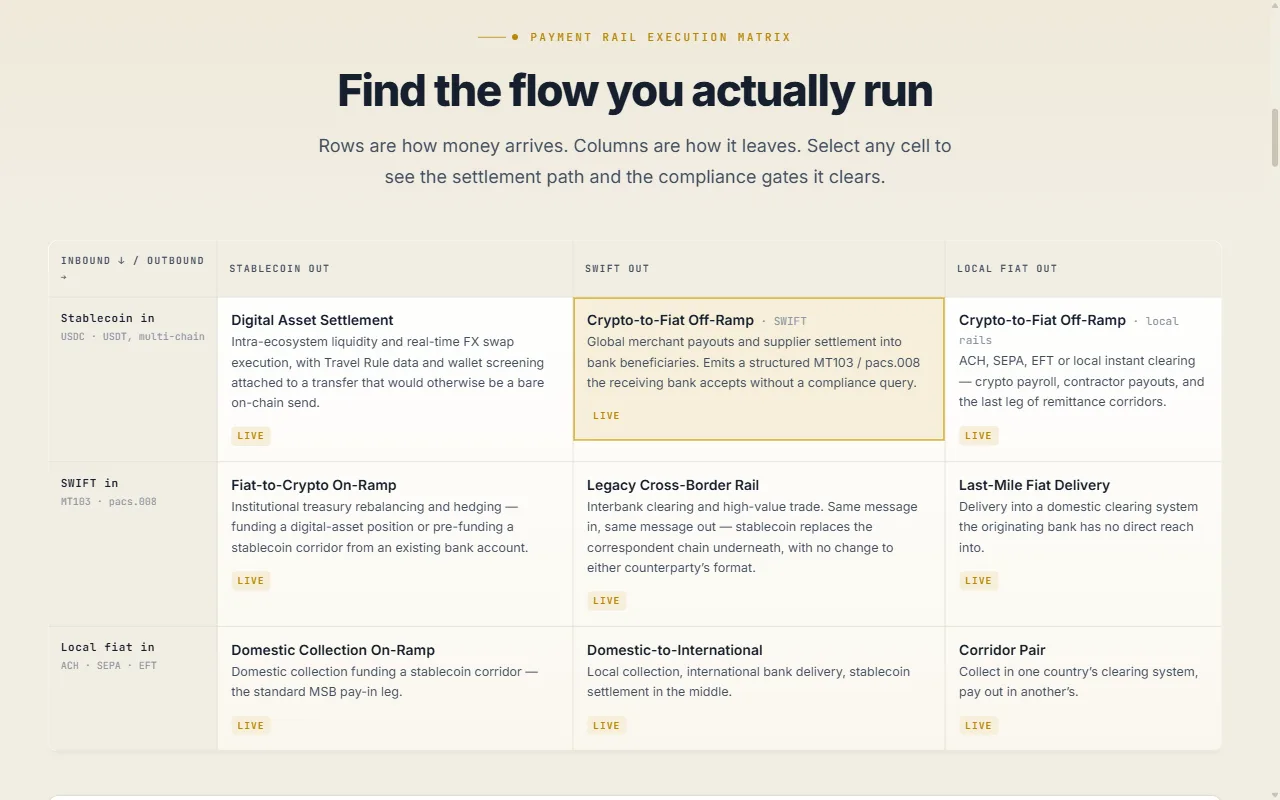
StableNet is built by SpendTheBits as a cross-border B2B payment and settlement platform for banks, credit unions, licensed MSBs, exchange houses and remittance fintechs. It addresses the stablecoin side of this decision: settlement in regulated stablecoins such as USDC and USDT on public blockchains, completing in minutes around the clock including weekends, with on-chain auditability. Messages are ISO 20022 native, using pacs.008, pacs.009, pacs.002 and pacs.004 inside head.001 envelopes, tracked end to end by UETR. Compliance is built in, with KYB and KYC onboarding, KYT, sanctions and PEP screening, and FATF Travel Rule data in IVMS101 form.
StableNet does not claim to cover the tokenised deposit side. SpendTheBits is a Bank of Canada registered payment service provider under the Retail Payment Activities Act. When evaluating any provider, ask which flows it settles, which instruments it supports, how it carries ISO 20022 data and references, and what evidence it produces for an examiner.
See it on your corridors
Book a working session and we’ll map StableNet’s compliance and settlement to one of your live payment flows.