Last mile fiat delivery: what happens after the stablecoin leg settles and the beneficiary wants local currency
Last mile fiat delivery turns a settled stablecoin leg into local currency in a local account over ACH, SEPA or EFT, with verification, timing and returns.
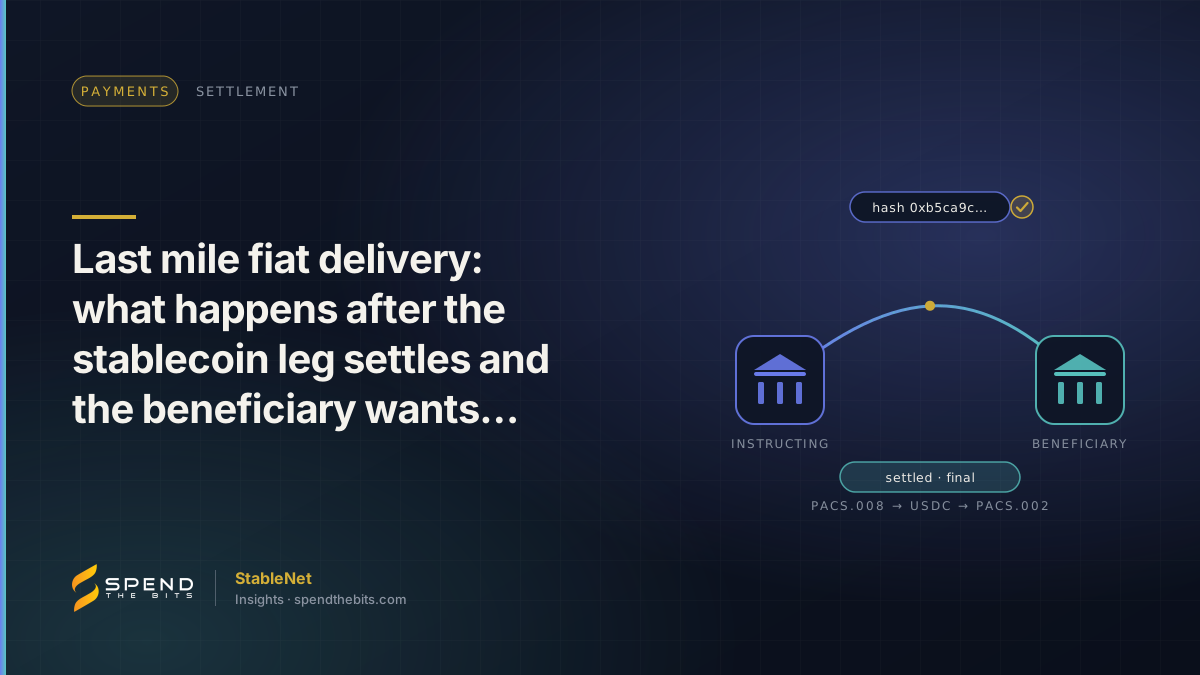
- Stablecoin settlement discharges the interbank obligation; report ACSP at that point and reserve ACCC for the confirmed local credit.
- Run the local payout from a pre-funded float with a stated ceiling and replenishment trigger, reconciled daily to the clearing participant's statement.
- Verify the beneficiary with what the domestic scheme offers: identifier format checks, account-name verification where mandated, and sanctions screening before release.
- Promise the beneficiary the later of interbank settlement and the next domestic window; ACH, SEPA and EFT cut-offs do not move because the settlement leg was fast.
- Domestic returns carry scheme reason codes and must be settled back between institutions by netting or a reverse on-chain transfer; the pacs.004 alone moves no value.
Last mile fiat delivery is the leg that follows stablecoin settlement between two institutions: the receiving institution converts the settled USDC to local currency and credits the beneficiary's account through the domestic clearing system, ACH in the United States, SEPA in the euro area, EFT in Canada. The interbank leg is final in minutes; the beneficiary's experience depends on how the last mile is run. This article explains how the local clearing leg works, how the beneficiary is verified, what timing to promise, how returns come back, and where the value and the message travel separately and must be reconciled.
What has actually happened when the interbank leg settles in stablecoin?
When the sending institution's USDC arrives in the receiving institution's wallet and reaches the confirmation depth in the policy, the interbank obligation is discharged. The receiving institution now holds value and a message. The message is the pacs.008, or the MT103 mapped into it, carrying the debtor, the creditor, the creditor's account, the creditor agent, the amount and the remittance information. The UETR ties the message to the on-chain transaction hash through the sending institution's reference, and the pacs.002 the receiving institution sends back at this point reports ACSP, accepted and settlement in process, not ACCC. The beneficiary has not been paid.
This distinction matters commercially. A sending institution that tells its client the payment is complete because the stablecoin settled has told the truth about the interbank leg and nothing about the beneficiary. The status that the client wants is the one the receiving institution issues when the local credit is confirmed, and the operating agreement between the two institutions should require that second status, with the local clearing reference inside it.
How does the receiving institution get local currency to pay out?
The receiving institution needs local currency in its own account at a domestic clearing participant to fund the credit. It gets there in one of three ways. It liquidates the USDC with a local liquidity provider or the issuer and receives fiat to its clearing account, which takes the time of a domestic transfer and, for issuer redemption, of a bank wire. It runs a pre-funded local fiat float sized to a day's expected payouts and replenishes it from periodic liquidation, treating the stablecoin as the settlement asset and the float as the till. Or it is itself a bank with a fiat balance sheet and simply pays from existing liquidity, holding the USDC as a treasury asset until it chooses to convert.
The float model is the usual answer for a payout partner. The policy names the float ceiling, the replenishment trigger, the liquidation counterparties and the person who signs the replenishment. The float is reconciled daily: opening balance plus liquidations minus payouts plus returns re-credited equals closing balance, and the closing balance matches the clearing participant's statement. A float that is drawn down without a replenishment because a liquidation was late is the cause of most missed payout windows.
FX sits at this point where the local currency is not the dollar. The rate should already be agreed between the institutions in the settlement terms, so that the receiving institution is paying out a known local amount and the InstructedAmount in the pacs.008 is what the beneficiary receives. The receiving institution's spread is its revenue and its risk between settlement and liquidation.
How is the beneficiary verified before the local credit is released?
The beneficiary in a last-mile flow is a customer of some other domestic bank, not of the receiving institution. The receiving institution therefore verifies what it can. It screens the beneficiary name and account against sanctions lists. It validates the account identifier format, an IBAN check digit in SEPA, a routing number and account number in ACH, a transit and institution number in Canadian EFT. Where an account-name verification service exists, it uses it: Verification of Payee is required for euro credit transfers in the euro area as of October 2025, the United Kingdom has Confirmation of Payee, and account validation services exist for ACH. Where no such service exists, the receiving institution relies on the sending institution's verification of the beneficiary and on the return process to catch a mismatch.
The receiving institution also decides whether the beneficiary is within its own risk appetite. A payout to an account at a domestic bank the receiving institution has flagged, or to a beneficiary whose name hits an internal list, is held even though the sending institution cleared it. The operating agreement states that the receiving institution may refuse and return, and states the reason codes it will use.
- Sanctions and PEP screening of the creditor name and account before the local credit is released.
- Format validation of the account identifier: IBAN check digit, routing and account number, or transit and institution number.
- Account-name verification where the domestic scheme provides it, with the result recorded on the case.
- A local risk-appetite check against the receiving institution's own lists of banks and beneficiaries.
- A second pacs.002 to the sending institution when the local credit is confirmed, carrying the local clearing reference.
What timing does the beneficiary really experience on ACH, SEPA and EFT?
Timing is where promises go wrong, so it should be stated by rail and by cut-off. Same-day ACH in the United States has fixed submission windows during the business day and settles in the same day's cycle; standard ACH settles the next business day or later. SEPA credit transfers are typically same day or next day depending on cut-off, while SEPA instant credit transfers settle in seconds around the clock. Canadian EFT through the Automated Funds Transfer system runs on business-day exchange cycles, while Interac e-Transfer delivers in near real time to an email or mobile identifier rather than to an account number. None of these rails runs on the stablecoin clock.
The practical rule is to state the beneficiary's expected credit as the later of the interbank settlement time and the next domestic window, and to tell the sending institution the window at the time the pacs.008 is accepted. A stablecoin leg that settles at 17:30 local time on a Friday is followed by an ACH credit on Monday unless the receiving institution offers an instant rail. Clients accept that when it is stated; they do not accept it when they were told minutes.
The stablecoin leg buys the receiving institution time and certainty. It does not buy the beneficiary a faster domestic clearing cycle, and the honest promise names the local window.
What happens when the local leg returns?
Returns are the second place where the last mile differs from the interbank leg. A stablecoin transfer does not return; it is final. The domestic credit can return for days. ACH returns carry reason codes such as R01 for insufficient funds, R03 for no account or unable to locate, R04 for an invalid account number, and R16 for a frozen account, and most must be initiated within two banking days of settlement, with longer windows for certain consumer returns. SEPA returns carry ISO reason codes such as AC01 for an incorrect account number and AC04 for a closed account, and a sending institution may also issue a recall. Canadian EFT returns come back through the same exchange cycles with their own reason codes.
When a return arrives, the receiving institution re-credits its float, marks the case as returned with the reason code, and raises a pacs.004 to the sending institution referencing the original UETR and carrying the return reason in the ReturnReasonInformation block. The pacs.004 does not move the stablecoin back by itself. The institutions settle returns either by netting the returned amount against the next stablecoin settlement or by an on-chain transfer in the opposite direction, and the operating agreement states which. A return that is re-credited to the float and never settled back is a reconciliation break that grows quietly.
Where do value and message part ways, and how are they reconciled?
The interbank leg moves value on chain and the message over ISO 20022. The local leg moves value through the domestic clearing system and the message, such as it is, in that system's own format, an ACH entry with its addenda, a SEPA pacs.008 inside the scheme, an EFT record. The remittance information that started in the sending institution's pacs.008 must survive the translation, and it often does not in full. ACH addenda are limited, and the receiving institution may have to truncate. The operating agreement should say what is carried and what is dropped, so the beneficiary's bank can still apply the credit.
Reconciliation therefore runs on three keys. The UETR ties the pacs.008 to the on-chain transaction. The receiving institution's case identifier ties the pacs.008 to the domestic clearing entry. The domestic clearing reference ties the entry to the return, if one arrives. A daily control lists every settled stablecoin receipt with no domestic entry within the promised window, every domestic entry with no settled receipt, and every return with no pacs.004. Each list should be empty by close of business, and the exceptions that are not are the ones the operations manager reviews by name.
Where StableNet fits
StableNet, built by SpendTheBits, runs last-mile fiat delivery as one of its nine settlement flows: the interbank leg settles in USDC or USDT on public blockchains in minutes with on-chain auditability, and the local leg pays out over ACH, SEPA or EFT. The platform is ISO 20022 native, so the pacs.008 that carried the payment, the pacs.002 status reports at both the settlement and the local-credit stages, and the pacs.004 that carries a domestic return all travel inside head.001 envelopes and are tracked end to end by the same UETR, which is also the key of the tamper evident audit trail. Sanctions and PEP screening of the beneficiary and KYT run before the local credit is released, the institution keeps custody of its own wallets, and the compliance workbench holds the exception lists described above. SpendTheBits is a Bank of Canada registered payment service provider and a named finalist in the Swift Hackathon 2026 Technical Challenge.
See it on your corridors
Book a working session and we’ll map StableNet’s compliance and settlement to one of your live payment flows.