Weekend cross-border settlement: what a Saturday or public holiday payment actually needs
Weekend cross-border settlement works on stablecoin rails, but local clearing may be closed. How to design cut-offs, rotas, buffers and exception paths.
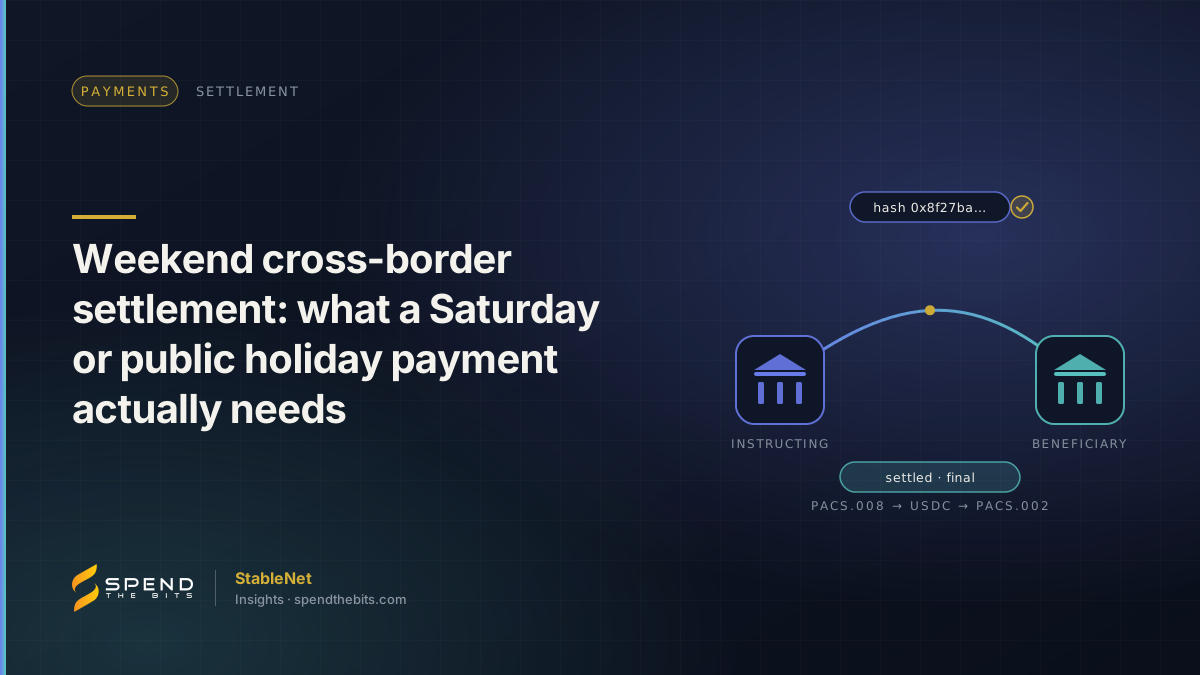
- A public blockchain settles on Saturday and on public holidays, but the fiat systems on either side of it mostly do not. The design problem is the join between a rail that never closes and rails that close every weekend.
- Cut-offs should be set per leg, not per payment: an on-chain cut-off that is late or absent, a fiat cut-off that mirrors the local clearing calendar, and a published rule for what happens to instructions received between them.
- Weekend rotas need named approvers with real limits, a compliance reviewer on call for holds and Travel Rule exceptions, and a treasury contact who can move a buffer under dual control.
- The beneficiary bank can receive and hold a stablecoin credit at the weekend, but it can only credit the end customer in local currency when its own clearing or an instant rail is open, so the promise to the customer must say which of those two events it refers to.
- The exception paths, wrong-address holds, compliance holds, liquidity shortfalls and a failed off-ramp, must be written, tested and staffed before the first weekend, not after.
Weekend cross-border settlement is possible because a public blockchain processes transactions on Saturday, on Sunday and on every public holiday, and a regulated stablecoin credit received on those days is final when the chain says it is. What is not possible is to complete the fiat leg on the other side while the beneficiary's local clearing system is closed, unless that country runs an instant rail that operates around the clock. The operating design therefore has to separate the two events and be honest about which one the customer is being promised. This article covers cut-off design, staffing and approval rotas, liquidity buffers, what the beneficiary bank can and cannot do when its clearing is closed, and the exception paths that must exist before the first weekend of live operation.
Why does weekend settlement need its own operating design?
The large-value fiat systems keep business-day hours. Fedwire Funds, CHAPS, the Eurosystem's T2 and Canada's Lynx do not operate at the weekend or on their national holidays. Instant retail rails are different: FedNow and RTP in the United States, SEPA Instant and TIPS in the euro area, and Faster Payments in the United Kingdom run continuously, subject to their own value limits. Swift's network is available around the clock, but the banks on either end release and process instructions on their own business days. A blockchain has no calendar at all. So a Saturday payment from a US corporate to a supplier in Mexico can be settled on chain within minutes, and can then wait until Monday for the last mile in pesos, unless the receiving institution has an instant domestic rail and a funded local account.
That mismatch produces four concrete questions. When does the sending institution stop accepting instructions for same-day on-chain settlement, if ever? Who approves a release when the Monday-to-Friday approvers are unavailable? How much stablecoin and how much local fiat must be pre-positioned to cover a weekend's flow with no ability to top up? And what does the beneficiary institution actually do with a credit it cannot yet pass on? Each needs a written answer, because each is a question an examiner will ask when reviewing weekend activity.
Where should the cut-offs sit on a Saturday?
Cut-offs should be set per leg rather than per payment. The on-chain leg needs no clearing cut-off, but it does need a control cut-off: the last time at which a payment can be released with an approver awake to handle a hold or a reject. Many institutions set that to a fixed local time on Saturday and Sunday, later than the weekday fiat cut-off but earlier than the weekday on-chain cut-off, because the rota is thinner. Instructions received after it are queued with a status of accepted for later settlement, and the customer confirmation states the next release window explicitly rather than implying same-day completion.
The fiat leg's cut-off mirrors the calendar of the rail it uses. For a beneficiary country whose local clearing is closed, the fiat cut-off on Saturday is simply the next business day's cut-off, and the message to the customer should say so in words, not in a footnote. Where the beneficiary bank uses an instant rail for the last mile, the fiat cut-off can be continuous, but the value limit of that rail then becomes the operative constraint and a payment above it falls back to the next business day. The rule for the gap between the two cut-offs must also be written: a payment that clears the on-chain cut-off but misses the fiat cut-off is settled on chain on Saturday and is credited in local currency on Monday, and the reference the customer receives on Saturday is the on-chain settlement reference, not a fiat credit confirmation.
Who needs to be on the rota, and what can they approve?
A weekend rota is not a duplicate of the weekday team at lower strength. It is a small number of named people with defined authority, because the payments that need a human on a Saturday are the ones that did not pass straight through. Each role needs a primary and a backup with contact details in the operations runbook.
- A payment approver with a release limit that is explicitly set for the weekend, often lower than the weekday limit, and with dual control required above it.
- A compliance reviewer on call who can clear or escalate a sanctions hit, a wallet screening alert or a Travel Rule data gap, and who has access to the case tools from outside the office.
- A treasury contact who can move balances between the operating wallet and the reserve wallet under dual control, and who knows the on-chain balance below which releases must stop.
- A technical on-call engineer who can read the chain, confirm whether a transaction was broadcast, and re-broadcast a stuck transaction with a higher fee where the chain requires it.
- A named escalation owner, usually the head of operations, who can invoke the exception paths and who is the only person permitted to override a hold.
Approval limits matter more than headcount. A Saturday approver working alone should not be able to release the same value that two weekday approvers can release together, and a first payment to a newly whitelisted address should wait for the full weekday control set.
The blockchain does not know it is Saturday. The control framework has to, because the people who would catch a mistake on Tuesday morning are not in the building.
How large a liquidity buffer does a weekend need?
The operating wallet is a till, not a vault, and at the weekend it is a till that cannot be refilled from the bank account. Stablecoin issuers mint and redeem against fiat on business days, and a treasury's own bank moves fiat into an on-ramp only when its clearing is open. So the stablecoin balance that exists on Friday evening has to cover Saturday and Sunday, plus Monday morning until the first business-day top-up settles. The sizing rule is straightforward to state: expected weekend outflow at a chosen confidence level, plus the Monday morning gap, minus reliable weekend inflow, rounded up to the nearest operational unit. The confidence level is the hard part, and a treasury should decide it deliberately.
The same logic applies in reverse at the beneficiary end. A receiving institution that credits customers in local currency at the weekend through an instant rail is spending its own fiat balance on that rail against a stablecoin it cannot off-ramp until Monday. Its local currency buffer therefore has to cover the weekend's expected last-mile credits, and its stablecoin holding grows over the weekend by the same amount. Both sides should agree in the service level document who bears the cost of that float and what happens if the buffer runs out: usually a stop on further weekend credits with an automatic notification.
What can the beneficiary bank do when its own clearing is closed?
It can do more than most people assume, and less than the customer wants. On receipt of the stablecoin credit it can confirm the on-chain settlement, screen the transaction and the originator data, match it to an expected payment, and post an internal credit to the customer's account in stablecoin or in a local currency memo balance if its ledger and its licence permit that. What it cannot do is create a final local currency credit through a clearing system that is not running. If it has an instant rail and a funded settlement account on that rail, it can pay the end customer immediately in local currency, within the rail's limit. If it does not, the customer is credited on the next business day and the bank holds the stablecoin in the interval.
The important operational point is that the pacs.002 status report should say which of these has happened. A status of ACSC, accepted settlement completed, is correct when the on-chain leg has reached the agreed confirmation depth. A status of ACCC, accepted credit settlement completed, should be reserved for the moment the end customer has actually been credited. Sending ACCC on Saturday for a credit that will post on Monday misleads the originator, and it is the kind of detail that surfaces in a dispute. The same discipline applies to the customer-facing notification: settled on chain and credited in local currency are two different events, and both dates belong on the advice.
Which exception paths must exist before the first weekend?
Weekends concentrate the situations that weekday teams handle by walking across the office. Each of the following needs a written procedure, a person on the rota who owns it, and a record of a test run before go-live.
- A wrong-address hold, where a payment is released to an address that later fails a match, with a defined process to contact the receiving institution and, if the funds are recoverable, to return them with a pacs.004 quoting the original UETR.
- A compliance hold, where a sanctions or wallet screening alert stops a payment mid-flow, with a defined maximum hold time before the originator is told and a decision on whether the funds sit in the operating wallet or a segregated hold wallet.
- A liquidity stop, where the operating wallet falls below its floor, with an automatic pause on releases, a notification to the treasury contact and a customer message that states the next release window.
- A failed off-ramp at the beneficiary end, where the instant rail rejects or times out, with a fallback to next-business-day credit and a corrected pacs.002 that changes the status without changing the UETR.
- A chain-level incident, such as a network halt or a fee spike that leaves transactions unconfirmed, with a rule for when to re-broadcast, when to wait and when to declare the weekend window closed.
Each path should also say what the examiner will see afterwards: the audit trail entry for the hold, the name of the approver who released or returned it, and the timestamp in UTC so that a Saturday evening in Toronto and a Sunday morning in Manila appear in the same order in the record as they happened.
Where StableNet fits
StableNet, built by SpendTheBits, is a cross border B2B payment and settlement platform for banks, credit unions, licensed money service businesses, exchange houses and remittance fintechs. Settlement runs in regulated stablecoins such as USDC and USDT on public blockchains and completes in minutes on any day of the week, with on chain auditability and customers keeping custody, which allows a Saturday release from an institution's own operating wallet under its own rota. Fiat legs run over SWIFT and local rails such as ACH, SEPA and EFT, so last-mile fiat delivery follows the calendar of the rail the beneficiary chooses. The platform is ISO 20022 native, so a weekend payment carries one UETR from the pacs.008 to the pacs.002 that reports whether the credit is settled on chain or delivered in local currency, and built-in screening and a tamper evident audit trail give the weekend reviewer the weekday team's tools. SpendTheBits is a Bank of Canada registered payment service provider and a named finalist in the Swift Hackathon 2026 Technical Challenge.
See it on your corridors
Book a working session and we’ll map StableNet’s compliance and settlement to one of your live payment flows.