Exchange house cross-border settlement: what changes when the settlement leg moves to stablecoin
Exchange house cross-border settlement on correspondent accounts depends on pre-funding and cut-offs. What changes, and what does not, when the leg moves to stablecoin.
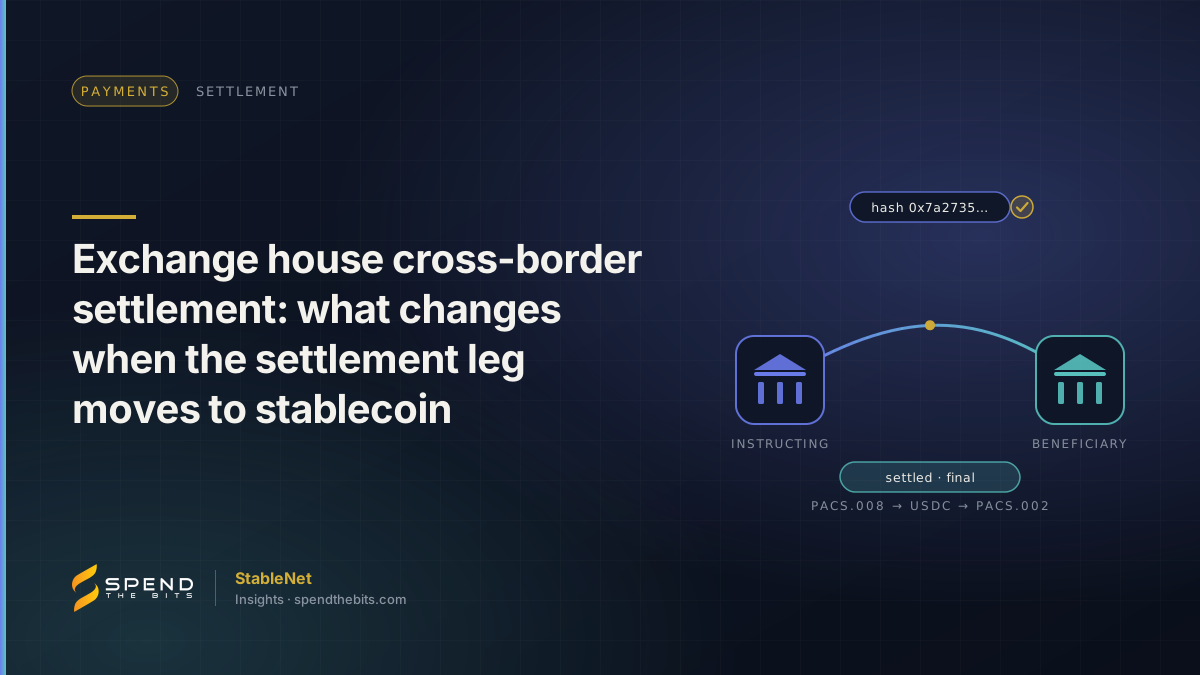
- Partner pre-funding falls from days of payouts to the interval between settlements; the trapped liquidity moves into a single stablecoin inventory the exchange house holds itself.
- The stablecoin leg has no cut-off, so settlements can run several times a day and through the weekend; the binding constraint becomes the partner's local clearing window.
- Every sender-side and beneficiary-side control stays; the additions are wallet screening, Travel Rule data to the partner as a VASP, a stablecoin selection policy and a custody policy.
- The home central bank licence still governs the exchange business, and the virtual asset regime at home, the destination regulator and the issuer's regime each add rules to map to the flow.
- Pilot one corridor with a partner already permitted to receive stablecoin, run both legs in parallel, and write the pilot documents for the supervisor who will read them later.
Exchange house cross-border settlement today runs on correspondent accounts: the exchange house pre-funds a nostro or a partner account in each destination market, collects from senders through the day, and instructs payouts against the pre-funded balance before a daily cut-off. Moving the settlement leg to stablecoin changes the pre-funding and the cut-offs, leaves the sender-side and beneficiary-side controls where they are, and adds a virtual asset dimension that the exchange house's regulator will want to see governed. This article walks through what changes, what stays, and which authorities are involved, using the Gulf corridors as the example because the operating model there is the clearest case.
How does an exchange house settle a high-volume corridor today?
A large exchange house runs corridors from a collection market, say the United Arab Emirates or Saudi Arabia, to payout markets in South Asia, South East Asia and Africa. Senders pay in local currency at branches, at kiosks or in an app. The exchange house aggregates the day's instructions per corridor, converts at a rate it has already quoted to senders, and settles the payout partner in the destination through a correspondent bank, typically by MT103 or MT202 against a nostro it maintains in the destination currency or in dollars. The partner, itself a bank or a licensed payout agent, pays beneficiaries from the balance.
The dependence on pre-funding is structural. Because the correspondent leg takes at least a day and runs on banking hours, the partner must already hold the money when the payout instruction lands. The exchange house therefore forecasts each corridor's volume days ahead, funds the partner in advance, and carries the balance as a receivable. At the end of the working week in the Gulf, with a weekend and perhaps a destination-market holiday ahead, the pre-funded balance can represent several days of payouts. The cost is the cost of that trapped liquidity plus the correspondent's charges, and the risk is the partner's credit.
The message layer is SWIFT MT or, increasingly, ISO 20022 pacs.008 and pacs.009 through the correspondent, with the exchange house's own reference in field 20 and the beneficiary detail in field 59. The exchange house reconciles the correspondent's MT940 or camt.053 against its own instructions each morning, and the unmatched items are the day's first task.
What changes in pre-funding when the settlement leg is stablecoin?
With the settlement leg on stablecoin, the exchange house sends USDC or USDT to the partner's wallet per batch, or per transfer, and the transfer confirms in minutes at any hour. The partner no longer needs to hold days of the exchange house's money; it needs a local fiat float sized to the payouts between one settlement and the next, which can be hours rather than days. The exchange house's receivable from the partner shrinks to the payouts confirmed since the last settlement, and the trapped liquidity in destination nostros is replaced by a stablecoin inventory the exchange house holds itself.
That inventory is the new pre-funding, and it is different in three ways. It is held in the exchange house's own custody rather than at a correspondent, so key management and signing authority become the exchange house's control. It is a single dollar-denominated pool that serves every corridor, rather than a balance per destination currency, so the forecasting problem collapses from many corridors to one. And it is replenished from the collection market by purchase or minting, which brings in a liquidity provider or an issuer relationship and a local regulatory question about the acquisition of virtual assets. The treasury policy names the ceiling of the inventory, the replenishment sources and the approval to move funds from the treasury wallet to the operating wallet. The operating wallet is a till funded for the day.
- Partner pre-funding falls from days of payouts to the interval between settlements, and the partner receivable shrinks with it.
- Destination-currency nostros are replaced by a single stablecoin inventory in the exchange house's own custody.
- Forecasting moves from one balance per corridor to one inventory across corridors, with the replenishment schedule as the main decision.
- Key management, signing authority and the segregation of treasury and operating wallets become controls the exchange house owns.
- The FX conversion from stablecoin to destination currency moves to the partner at the last mile, and the partner's rate becomes a term of the agreement.
What happens to cut-offs and the payout promise?
The correspondent leg imposed two cut-offs: the exchange house's own cut-off to compile the day's batch, and the correspondent's cut-off to accept it for same-day value. Instructions after the second cut-off waited a day, and a weekend added more. The stablecoin leg has no cut-off of its own. Settlement can run several times a day and through the weekend, so the binding constraint becomes the partner's local clearing window in the destination, and the honest payout promise names that window rather than the exchange house's batch time.
In practice most exchange houses that make the change move from one settlement a day to several. A morning settlement clears the overnight instructions, a mid-day settlement clears the branch traffic, and an evening settlement clears the app traffic, each sized to what the partner can pay out before its next local window. The batch file per settlement carries the individual transfers, each with a UETR, and the on-chain transfer carries the batch total. The pacs.002 from the partner reports each transfer as paid, and the exchange house's status to the sender updates from that report, not from the on-chain confirmation.
The correspondent gave the exchange house a bank's opening hours and a bank's balance sheet. Stablecoin settlement gives it back the hours, and asks it to run the balance sheet itself.
Which controls stay exactly where they are?
Everything on the sender side stays. Branch and app onboarding, identification, sanctions and PEP screening of senders and beneficiaries, transaction monitoring for structuring and velocity, the recordkeeping thresholds, and the suspicious transaction reporting obligation are unchanged, because the sender and the beneficiary have not changed. Everything on the beneficiary side stays too. The partner still verifies the account, still runs the local clearing leg, and still returns payouts that fail with a reason code, now carried back in a pacs.004 referencing the original UETR.
What is added is a virtual asset layer with its own controls. The partner's wallet address is screened and locked to the address the partner declared at onboarding. The Travel Rule applies to the stablecoin leg, and the exchange house transmits originator and beneficiary data for the batch in IVMS101 form to the partner as a VASP counterparty. The stablecoin itself is chosen against a policy: which issuer, which chain, what reserve attestation the exchange house has reviewed, and what happens if the issuer freezes an address. And the custody of the inventory is governed by a key management policy with named signers and thresholds. None of these replaces an existing control. They sit beside it.
Which regulators are involved, and what will they ask?
An exchange house in the Gulf is licensed and supervised as an exchange business by its central bank: the Central Bank of the UAE, the Saudi Central Bank, the Central Bank of Bahrain, the Qatar Central Bank, the Central Bank of Kuwait or the Central Bank of Oman, according to where it operates. That licence governs the sender-side activity, the AML programme, the capital and the reporting, and it does not change because the settlement leg changes. The exchange house should assume its supervisor will want to be told before the settlement leg moves, and in several Gulf jurisdictions will want to approve it.
The virtual asset layer brings a second set of rules. In the United Arab Emirates the Central Bank's payment token regime and the virtual asset frameworks of the Dubai Virtual Assets Regulatory Authority and the ADGM Financial Services Regulatory Authority each define activities that require a licence, and the treatment of foreign-currency stablecoins for payment purposes is restricted in ways the exchange house must map to its specific flow. Other Gulf jurisdictions are at different stages, and reports suggest the rules continue to develop as of mid-2026. The destination market's regulator governs the partner, including whether the partner may receive stablecoin at all and how it converts to local currency. And the issuer's home regime, for a dollar stablecoin the United States framework under the GENIUS Act signed in July 2025, governs the reserve and redemption rights the exchange house is relying on.
The examination questions follow from that map. The home supervisor asks for the board approval of the change, the risk assessment, the AML programme update covering the virtual asset leg, the stablecoin selection policy, the custody policy, the partner due diligence including the partner's own permission to receive stablecoin, and evidence that the sender-side controls are untouched. The exchange house should also expect its correspondent banks to ask why nostro balances are falling, and should have the answer ready before the question arrives.
What should an exchange house pilot first?
The first corridor to move should be one where the partner is already a licensed VASP or a bank with permission to receive stablecoin, where the destination regulator's position is clear, and where the volume is large enough to make the pre-funding saving visible but not so large that a settlement failure would be a headline. The exchange house runs the stablecoin leg alongside the correspondent leg for a period, settling part of the daily volume on each, and reconciles both to the partner's confirmations. The metrics to watch are the partner receivable at close of business, the inventory turnover, the number of settlements per day, and the pacs.004 rate, which should be unchanged from the correspondent period because the last mile has not changed.
The pilot's documents are the ones the supervisor will ask for later, so they should be written for that reader from the start: the operating agreement with the partner including settlement frequency, rate and return handling; the treasury policy for the inventory; the custody and key management policy; the stablecoin selection policy; the Travel Rule procedure for VASP counterparties; and the daily reconciliation across the collection float, the inventory, the on-chain transfers and the partner confirmations.
Where StableNet fits
StableNet, built by SpendTheBits, is designed for exactly this settlement leg. An exchange house settles its payout partners in USDC or USDT on public blockchains, in minutes and at any hour, while keeping custody of its own inventory and operating wallets. The platform is ISO 20022 native, so the batch of transfers travels as pacs.008 messages with the interbank leg as pacs.009, the partner's confirmations come back as pacs.002 status reports and failed payouts as pacs.004 returns, all inside head.001 envelopes and tracked by UETR, and the exchange house's existing MT103 traffic to correspondents continues alongside. KYB of payout partners, wallet screening locked to declared addresses, sanctions and PEP screening, KYT, Travel Rule data in IVMS101 form and a tamper evident audit trail give the exchange house's supervisor the records described above. SpendTheBits is a Bank of Canada registered payment service provider and a named finalist in the Swift Hackathon 2026 Technical Challenge.
See it on your corridors
Book a working session and we’ll map StableNet’s compliance and settlement to one of your live payment flows.