ISO 20022 purpose codes: what they carry, who reads them, and why they decide a payment
An ISO 20022 purpose code says what a payment is for. Where it sits, who reads it, how it differs from category purpose, why an on chain leg makes it urgent.
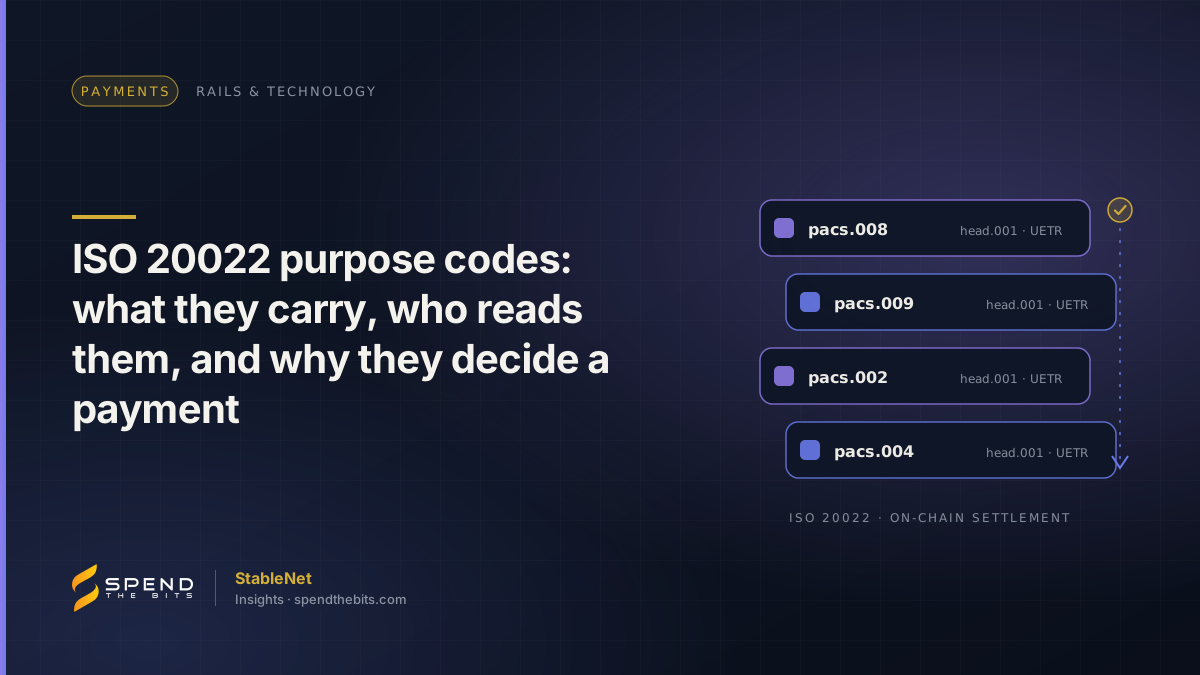
- ISO 20022 purpose codes answer one question in a structured field: what is this payment for. The value comes from the external purpose code set published by the ISO 20022 Registration Authority, and it sits on the individual transaction in a pacs.008 or a pacs.009.
- Purpose, category purpose and remittance information do three different jobs. Category purpose tells the receiving institution how to handle the payment, purpose tells it why the payment exists, and remittance information tells the beneficiary which invoices it settles.
- Several central banks require their own domestic purpose code on cross border transfers for balance of payments reporting, and those lists do not map one to one onto the ISO list. Paying into those corridors needs a mapping table and a rule for the gaps.
- A purpose code is a statement from the sender, not a verified fact. Use it as an input to monitoring, and treat any disagreement between the code, the invoice and the client's expected activity as the signal.
- On a stablecoin settlement leg the purpose never travels on the chain and the payment cannot be recalled. The purpose check has to happen before release, not in the next day exception queue.
ISO 20022 purpose codes answer a question that free text never answers reliably: what is this payment for. The answer matters to three different readers. A central bank wants it for statistics. A compliance team wants it to decide whether the payment looks like the client's business. A beneficiary's bank wants it to post the credit without asking. A four letter code in a structured field serves all three. A sentence typed into a reference field serves none of them.
What are ISO 20022 purpose codes, and where do they sit in a payment?
The purpose sits on the transaction itself. In a pacs.008 customer credit transfer it is the Purpose element inside the credit transfer transaction information. A pacs.009 interbank leg carries the same element. The value is taken from a published list, the external purpose code set, maintained by the ISO 20022 Registration Authority and republished on a regular cycle.
The codes are four letters. GDDS covers the purchase or sale of goods. SCVE covers services. SUPP is a supplier payment, SALA a salary payment, TAXS a tax payment, DIVI a dividend and INTC an intra company transfer. TRAD marks a trade transaction. OTHR exists for everything else, which is the problem discussed below.
The element is optional in the base schema. Optional is not the same as unused. Market practice, scheme usage guidelines and several domestic regimes make a purpose code mandatory in practice, and because the list is republished, a code that was valid for last year's traffic may since have been added or retired. Validate against a known version rather than against a copy pasted table.
How is a purpose code different from category purpose and remittance information?
These three elements are often treated as interchangeable. They are not. Category purpose, taken from its own external list, describes the type of payment for processing and routing: SALA for a payroll run, CORT for a trade settlement, CASH for a cash management transfer. It is an instruction to the processing chain.
Purpose describes the underlying reason for this one transaction. Remittance information describes what the money settles, invoice by invoice. An unstructured occurrence of remittance information holds 140 characters, so it cannot carry a reliable purpose and a document list at the same time.
Consistency across the legs is part of the same discipline. A pacs.009 settling a customer payment should not contradict the pacs.008 it covers. Where the two legs carry different purposes, one of them is wrong, and a reconciliation team will find it before the client does.
Category purpose tells the receiving institution how to handle a payment. Purpose tells it why the payment exists. Remittance information tells the beneficiary what it settles. Collapsing the three into one free text line is how avoidable investigations begin.
Why do central banks and regulators ask for a purpose code?
Balance of payments statistics are the oldest reason. A country has to classify money crossing its border, and the reporting banks supply the classification. The Reserve Bank of India requires purpose codes on cross border receipts and payments for its balance of payments returns under the Foreign Exchange Management Act reporting framework. The Central Bank of the UAE requires a purpose of payment code on outward transfers processed through its funds transfer system. The South African Reserve Bank requires balance of payments reporting categories on cross border transactions.
Two consequences follow for a payment firm. First, those domestic lists are not the ISO external list, and the codes do not map one to one. Second, a payout can be held or returned where the code is missing, or where it is implausible for the beneficiary's registered activity. Exchange control corridors are the least forgiving. A mapping table and a documented rule for the gaps are not optional work there.
Tax reporting uses the same field. Codes such as TAXS and VATX let a receiving institution route a payment to the right internal process without reading the narrative. That is the quiet value of a code list: it moves a decision from a person to a rule.
How do purpose codes change screening and monitoring outcomes?
Sanctions screening works on names, addresses and countries. A purpose code adds nothing there. Transaction monitoring is different, because monitoring asks whether this payment fits the client. The code is what makes that question answerable without a human reading every reference field.
A supplier payment from a clothing importer to a fabric mill is unremarkable. The same amount, between the same parties, coded as an intra company transfer to a country where the client has no registered entity is not. Neither alert needs new data. It needs the purpose recorded in a field a rule can read.
Purpose codes also shorten the questions. A request for information is the most expensive event in a cross border payment, because it stops the payment and occupies two operations teams. Where the code is present, plausible and consistent with the invoice reference, the receiving institution has less to ask. Where every payment arrives as OTHR, the field has told nobody anything and the exception queue absorbs the cost.
One control weakness deserves to be named. A purpose code is an assertion by the sender, not a verified fact. It belongs in the risk model as an input, never in the file as evidence. Where the code, the remittance information and the client's expected activity disagree, the disagreement is the finding.
How should an institution choose and map purpose codes?
The work is mostly set up, done once per corridor and reviewed. A workable sequence looks like this.
- Record expected payment purposes at onboarding, in the client's own words, alongside expected corridors, currencies and volumes. Every later test depends on that baseline.
- Build one mapping table: the option the client sees, the ISO external purpose code it becomes, and the domestic code required by each corridor you pay into.
- Remove the free text purpose box wherever a code exists. A list the client picks from produces data. A text field produces prose.
- Default to the narrowest accurate code. Make OTHR an exception that requires a typed reason, and report on how often it is used.
- Validate the code at capture against the code set version you have adopted, and record which version was used for that payment.
- Compare the code against the remittance information and the recorded expected activity before release, and hold the mismatches rather than scoring them.
- Review queried, held and returned payments by purpose code each month. A pattern of returns under one code usually means the mapping is wrong, not the client.
Ownership matters as much as the table. The mapping belongs to one named owner, usually in payment operations with compliance sign off, because a code list nobody owns drifts within a quarter. Keep every change dated. A payment is judged against the rules that applied on the day it was sent.
What changes when the settlement leg runs on a public blockchain?
Nothing in the message, and everything in the timing. A blockchain transfer carries no purpose field. Some chains offer a memo or a destination tag, and those are public, so nothing identifying and nothing commercially sensitive belongs in them. The purpose stays in the messaging layer and is joined to the on chain transfer by the UETR, the same identifier that ties the pacs.008 to the settlement.
Timing is the real change. A stablecoin settlement completes in minutes and cannot be recalled. A purpose code review that runs in the next working day's exception report is a review of something already final. The check has to sit before release, next to screening and beneficiary verification, which means the code must be captured, validated and compared at instruction time.
There is a gain in exchange. The settlement is timestamped and permanent, so the purpose code, the invoice reference, the screening result and the settlement record can sit in one file for that payment. That file is what an examiner, an auditor or a counterparty's compliance team actually reads. It is easier to produce from a chain than from a correspondent chain of statements.
Where StableNet fits
StableNet, built by SpendTheBits, is a cross border B2B payment and settlement platform for banks, credit unions, licensed money service businesses, exchange houses and remittance fintechs. It is ISO 20022 native, so pacs.008 and pacs.009 messages are generated per transfer with a head.001 envelope and tracked end to end by UETR, which is where a purpose code belongs and how it stays joined to the settlement. Settlement runs in regulated stablecoins on public blockchains and completes in minutes with on chain auditability, while KYB and KYC onboarding, KYT, sanctions and PEP screening, Travel Rule data and a tamper evident audit trail sit in the same flow. That combination is what makes a purpose check before release practical rather than aspirational.
See it on your corridors
Book a working session and we’ll map StableNet’s compliance and settlement to one of your live payment flows.