remt.001 remittance advice: telling the payee what a stablecoin payment is for
A remt.001 remittance advice says what a payment settles. What it carries, why a pacs.008 cannot hold it all, and why an on chain leg makes it urgent.
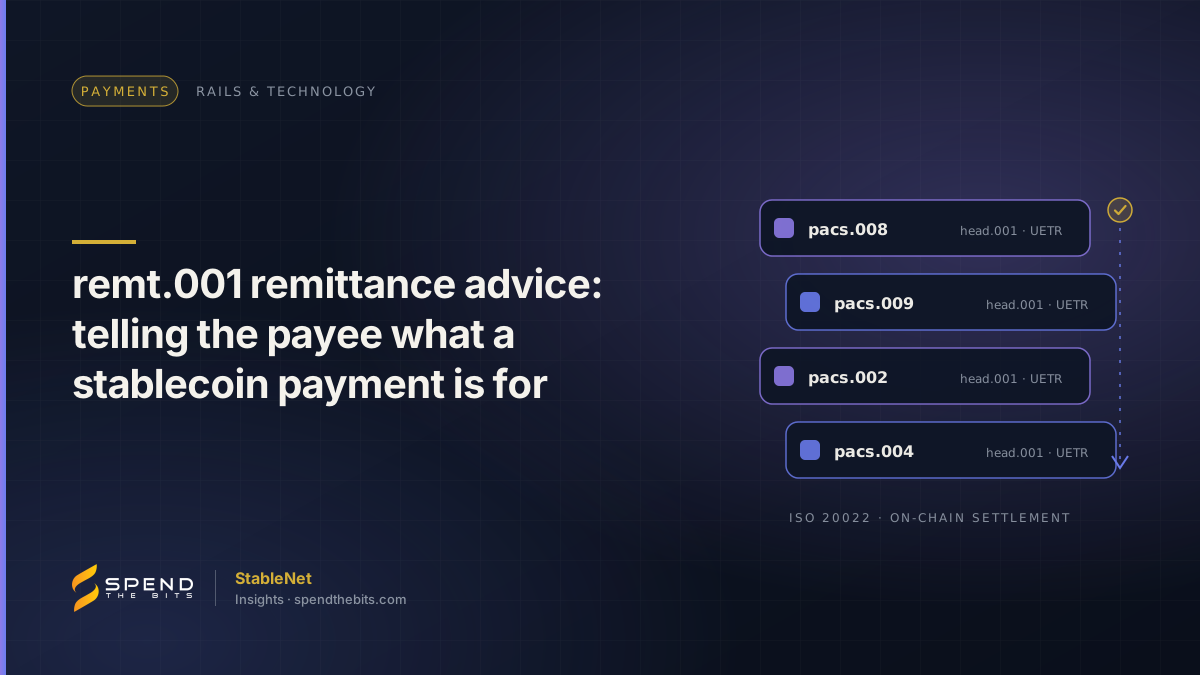
- A remt.001 remittance advice describes the documents a payment settles. It moves no money. The payment travels as a pacs.008 or a pacs.009, and the advice is joined to it by the remittance identification and the UETR.
- Remittance information inside a pacs.008 is capped: an unstructured occurrence holds 140 characters, the same ceiling as four lines of 35 characters in field 70 of an MT 103. A payment covering twenty invoices needs a standalone advice.
- Carry one referred document block per invoice, each with a document type code, number, date, amount due and amount remitted, and state discounts and credit notes explicitly rather than quietly remitting less.
- Send the advice when the payment is instructed, not after settlement confirms. On a stablecoin leg the value lands in minutes, so a next day advice is the only slow step left in the flow.
- Match an advice to a credit on the UETR or the end to end identification, never on amount alone, and open an exception the same day for any credit with no advice or any advice whose total does not equal the credit.
A remt.001 remittance advice is the message that tells a payee what a payment is for. The payment travels as a pacs.008 or a pacs.009. The advice travels separately, and it carries the invoice detail the instruction has no room for. For a cross border B2B payment, that separation decides whether the receiving company applies the cash on the day it lands or leaves it sitting as an unapplied credit for a week. When the settlement leg runs on a public blockchain, the money arrives in minutes, which makes a late advice the slowest part of the whole flow.
What is a remt.001 remittance advice?
remt.001 is the ISO 20022 RemittanceAdvice message. It sits in the payments remittance advice business area, the one ISO 20022 labels remt, alongside remt.002, the RemittanceLocationAdvice.
The message has one job. It describes the documents a payment settles, and it points at the payment that settles them. It moves no money and it carries no settlement instruction.
Its shape is straightforward. A group header identifies the advice and names the sender. One or more transaction blocks each describe a payment, with its amount, the references that identify it, and the remittance detail underneath.
That remittance detail is the substance. Each referred document carries a document type code, a document number and a document date. Each referred document amount can state the amount due, any discount applied, any credit note taken and the amount actually remitted. A creditor reference can carry the payee's own structured reference.
Structure is the whole point. A list of invoice numbers in a free text line has to be read by a person. A referred document block can be matched by software against an open receivable.
How does a remittance advice differ from the remittance information inside a pacs.008?
Both carry the same kind of content. They differ in where it sits and how much of it there can be.
A pacs.008 carries remittance information inside the instruction itself. That information can be unstructured, as free text, or structured, as referred document blocks. An unstructured occurrence is capped at 140 characters, which is room for one invoice reference and little else.
The constraint is not new. In the MT world, field 70 of an MT 103 allowed four lines of 35 characters, so 140 characters in total. A payment covering twenty invoices did not fit then, and it does not fit now.
Market practice narrows the field further. Swift's CBPR+ usage guidelines for cross border payments restrict the remittance information a pacs.008 may carry, because every agent in the chain has to pass it on unchanged.
A standalone remt.001 has no such ceiling. It goes to the payee rather than through the payment chain, so it can describe a hundred invoices without asking any intermediary to carry them.
The two are not alternatives. The instruction should carry a remittance identification, and the advice should quote the same identification. One points at the other, and the payee's system joins them.
Why does a missing remittance advice cost the payee money?
A credit with no advice behind it becomes unapplied cash. The money is in the account. Nobody can say which receivables it clears.
The cost lands in three places. Collections chases invoices that are already paid. Days sales outstanding reads worse than the actual cash position. And somebody opens the payment by hand, which is the most expensive way to process one.
There is a compliance cost as well. A payment whose purpose cannot be evidenced from the record is harder to explain to an examiner than one that arrived with its invoice detail attached.
The direction of travel in the industry is settled. The Committee on Payments and Market Infrastructures, in its 2020 report on building blocks for enhancing cross border payments, named the adoption of a harmonised ISO 20022 version for message formats as one of those building blocks. Better payment data is not a convenience. It is a stated objective.
What must a remt.001 remittance advice carry to be reconcilable?
An advice is reconcilable when the payee can match it to a credit, and to its own open items, without a person reading it.
Start with the join to the payment. Carry the UETR that the Swift CBPR+ usage guidelines require on cross border payment instructions, and carry the original end to end identification. Those two references tie the advice to the credit the payee can see in its account.
Carry the remittance identification too. It is the reference the instruction quotes, and the first thing the payee's system will search on.
Then the document detail, one block per invoice. Each block needs a document type code from the ISO 20022 external code sets, the document number, the document date, the amount due and the amount remitted. Where a deduction has been taken, state it as a discount or a credit note rather than quietly sending less.
Then the parties. Name the debtor and the creditor, and name the invoicer and the invoicee where they differ from the paying and receiving companies. Group companies settle each other's invoices often enough for that to matter.
Finally, currency discipline. State each document in the currency it was issued in, and state the remitted amount in the currency that actually moved. If the two differ, the advice has to say so, or the payee will book a conversion as a short payment.
How does an on chain settlement leg change the remittance advice?
The content does not change. The timing does.
On a correspondent rail the money can take days. An advice that arrives the next morning is still early. That tolerance is what allowed the advice to become an afterthought.
A stablecoin settlement leg removes the tolerance. Value arrives in minutes, at any hour, and the payee can see it on the chain before any message explains it. An advice that arrives the next business day is now the only slow step in a flow that was supposed to be fast.
So send the advice when the payment is instructed, not after settlement confirms. The payee holds it against an expected credit, then applies it the moment the credit appears.
An on chain leg also allows a stronger join. Carry the chain, the token and the transaction hash alongside the references. The payee can then confirm for itself that the payment the advice describes is the payment that landed, instead of trusting a reference it cannot check.
On a correspondent rail, a remittance advice that arrived the next morning was early enough. When settlement completes in minutes, the next morning makes the advice the slowest thing in the payment.
How should an institution send and reconcile a remittance advice?
The work is routine once it is written down. The failure mode is treating any of it as optional.
- Agree the channel with each counterparty in writing, and agree one channel rather than several, so no advice is sent twice by two routes.
- Generate the advice from the same record that generated the pacs.008, so amounts and references cannot drift between the two messages.
- Quote the remittance identification in both the instruction and the advice, and carry the UETR in the advice, so either reference finds the payment.
- Send the advice when the payment is instructed rather than after settlement confirms, and let the payee hold it against an expected credit.
- Carry the chain, the token and the transaction hash for an on chain leg, so the payee can verify the advice against the chain.
- Match the advice to the credit on the UETR or the end to end identification, never on the amount alone, because two payments of the same size on the same day are ordinary.
- Open an exception the same day for a credit that has no advice after the window you publish, and for an advice whose total does not equal the credit.
One more rule keeps the process honest. Reconcile the advice against the camt.054 credit notification or the camt.053 statement, and treat a total that does not agree as a break rather than a rounding question.
The aim of the whole exercise is that nothing arrives unexplained. A credit the payee cannot apply is not a completed payment, however fast the settlement leg was.
Where StableNet fits
StableNet, built by SpendTheBits, is a cross border B2B payment and settlement platform for banks, credit unions, licensed money service businesses, exchange houses and remittance fintechs. It settles in regulated stablecoins on public blockchains, in minutes, and it is ISO 20022 native, so a payment carries the identifiers a payee's receivables system already matches on: the UETR, the end to end identification and the pacs.008 or pacs.009 behind the movement. Every settled leg leaves a transaction hash and a tamper evident audit trail, which is what lets a payee verify an advice instead of trusting it. SpendTheBits is a Bank of Canada registered payment service provider and a named finalist in the Swift Hackathon 2026 Technical Challenge.
See it on your corridors
Book a working session and we’ll map StableNet’s compliance and settlement to one of your live payment flows.