ESMA's 8 January 2027 deadline: what happens to non-MiCA stablecoins in EU payment corridors
ESMA non-MiCA stablecoin deadline: what the 8 October 2026 opinion means for non-EU banks, MSBs and remitters paying out through EU CASPs, and how to re-plan.
- According to reporting from 8 October 2026, ESMA told national authorities that MiCA-authorised crypto-asset service providers should stop serving EU clients with non-compliant stablecoins, with remaining exposures resolved by 8 January 2027 at the latest.
- The opinion is aimed at regulated EU service providers, not at a non-EU firm directly, but it reaches your corridors through your EU partners, who must change what they accept, hold and transfer.
- The three months are described as a ceiling, not a grace period, so a national authority may require earlier action and a partner may stop accepting a token well before January.
- Reporting does not describe a general ban on individuals holding non-MiCA stablecoins outside regulated services, and ESMA reportedly named no specific token.
- The practical response is to confirm token status with each EU partner in writing, move EU payout flows to a MiCA-compliant e-money token, wind down legacy balances in order and review the FX legs.
For a bank, MSB or remittance firm outside the EU, the ESMA deadline means that any EU partner holding a MiCA authorisation should stop handling non-compliant stablecoins for EU clients, with remaining exposures to be resolved by 8 January 2027 at the latest. It is not a ban on holding such tokens, and it does not bind you directly, but it changes which tokens your EU payout partners will accept, hold and transfer. Corridors that settle in a non-compliant token need a replacement token, and legacy balances need a wind-down plan, before the partner closes the door.
This summary relies on press reporting of the opinion as of mid-October 2026. Confirm the details against the text published by ESMA and the guidance of the relevant national authority before you act.
What did ESMA actually say on 8 October 2026?
According to reporting by Cointelegraph, Crypto News and Altcoin Buzz, ESMA issued an opinion to national competent authorities on 8 October 2026. It states that crypto-asset service providers authorised under the Markets in Crypto-Assets Regulation (MiCA) should stop providing services to EU clients that involve asset-referenced tokens and e-money tokens that do not comply with MiCA. The reporting adds that this includes tokens relying on exemptions or transitional arrangements.
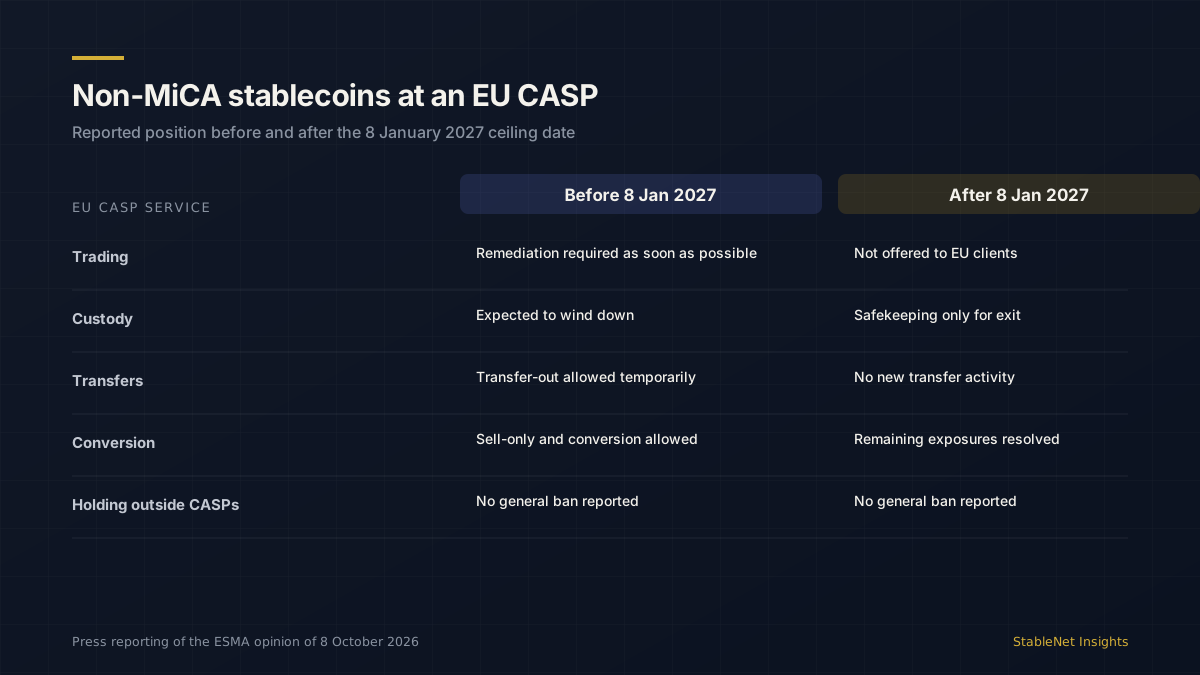
National authorities are reportedly told to require remediation as soon as possible. The date of 8 January 2027 is described as the latest point by which remaining exposures should be resolved, and national authorities may set earlier dates. In other words, the three months are a ceiling and not a period in which business can continue unchanged.
Which services does it cover, and what may continue?
The reported scope is wider than delisting. It covers trading, exchange, custody, transfers and advice. Cointelegraph notes that earlier ESMA guidance from January 2025 had been read as allowing custody and transfers to continue, and that this opinion extends the expectation to those services. The opinion does not reverse the January 2025 guidance, but it tightens how it applies to authorised providers.
Reporting also says that limited services may continue temporarily so that clients can leave in an orderly way. These are sell-only functions, conversion into a compliant asset, transfer out, withdrawal and safekeeping of existing balances. The purpose is wind-down, not continued use, and supervisors are expected to watch it closely.
- Covered, reportedly: trading, exchange, custody, transfers and advice involving non-compliant asset-referenced tokens and e-money tokens, for EU clients of MiCA-authorised providers.
- Allowed temporarily, reportedly: sell-only, conversion, transfer-out, withdrawal and safekeeping to support wind-down.
- Not described in the reporting: a general ban on individuals holding such tokens outside regulated services, or a named list of affected tokens.
Does it apply to a firm outside the EU?
Not directly. The opinion is addressed to national authorities and, through them, to authorised EU providers. A bank in Toronto, an MSB in Texas or a remittance firm in Manila is not the subject of the instruction. The effect arrives through counterparties. If your payout partner, liquidity provider or custodian in the EU is a MiCA-authorised CASP, it will have to stop handling the affected tokens for its EU clients, and your flow may be one of them.
Our companion article on MiCA and stablecoin payouts explains when a non-EU sender is itself in scope of the regime. The point here is narrower. Even where you are outside MiCA, your partner is inside it, and its obligations become your operational constraint.
Which tokens are in question, and what about USDT?
ESMA reportedly named no tokens. The relevant test is whether a token is issued in compliance with MiCA, which for an e-money token means issuance by an authorised credit institution or e-money institution. Circle's USDC and EURC are widely described as issued in the EU under an e-money institution authorisation held by Circle's French entity, and an institution should verify that status directly with the issuer and the partner rather than rely on a general statement.
Reporting has highlighted that Tether's USDT is not authorised under MiCA, a position widely known since several EU venues removed it for EU customers in 2024 and 2025. Cointelegraph reports that one large exchange has told its European Economic Area customers to withdraw affected balances by 30 October, with remaining amounts converted automatically into USDC or another supported asset. We make no new claims about any issuer. Our earlier comparison of USDC and USDT for institutional settlement sets out the non-regulatory differences between the two.
How should an EU corridor be re-planned?
The sequence below is deliberately conservative. It assumes that partners will tighten before the ceiling date, not on it, and that the cost of moving early is lower than the cost of a stranded balance.
- Inventory every EU-touching flow: payout partners, liquidity providers, custodians and exchange counterparties, with the token each one accepts and the token your balances sit in.
- Obtain written confirmation from each EU counterparty of its MiCA status, which tokens it will support after the opinion is applied by its national authority, and the date from which it will stop accepting others.
- Move EU payout flows to a MiCA-compliant e-money token issued by an authorised institution, and keep the previous token only where a partner confirms in writing that it remains supported.
- Wind down legacy balances in order. Use the sell-only and conversion windows early, convert in tranches to limit price impact, and keep the on-chain evidence of every conversion for reconciliation and audit.
- Review the FX legs. Where the beneficiary is paid in euros, a euro e-money token such as EURC can remove a conversion step, while a USD token keeps the treasury in dollars and moves the exchange at the last mile. Choose per corridor, not once for all.
A deadline addressed to an EU provider is a deadline for every firm that depends on it. The date that matters is the one your partner sets, not the one in the opinion.
What should the contracts and risk files say?
Update the third party risk file for each EU partner to record its authorisation, its supported token list and its notice period for changing that list. Add a clause that obliges the partner to give written notice before it stops supporting a token, and agree what happens to balances in transit on the day it does. Our guidance on third party risk management for stablecoin providers lists the questions to ask.
Treat a sudden token change as a continuity event. Settlement in a token that a partner cannot accept is a failed payment, so the contingency plan should name the fallback token, the fallback partner and the person who authorises the switch.
Where StableNet fits
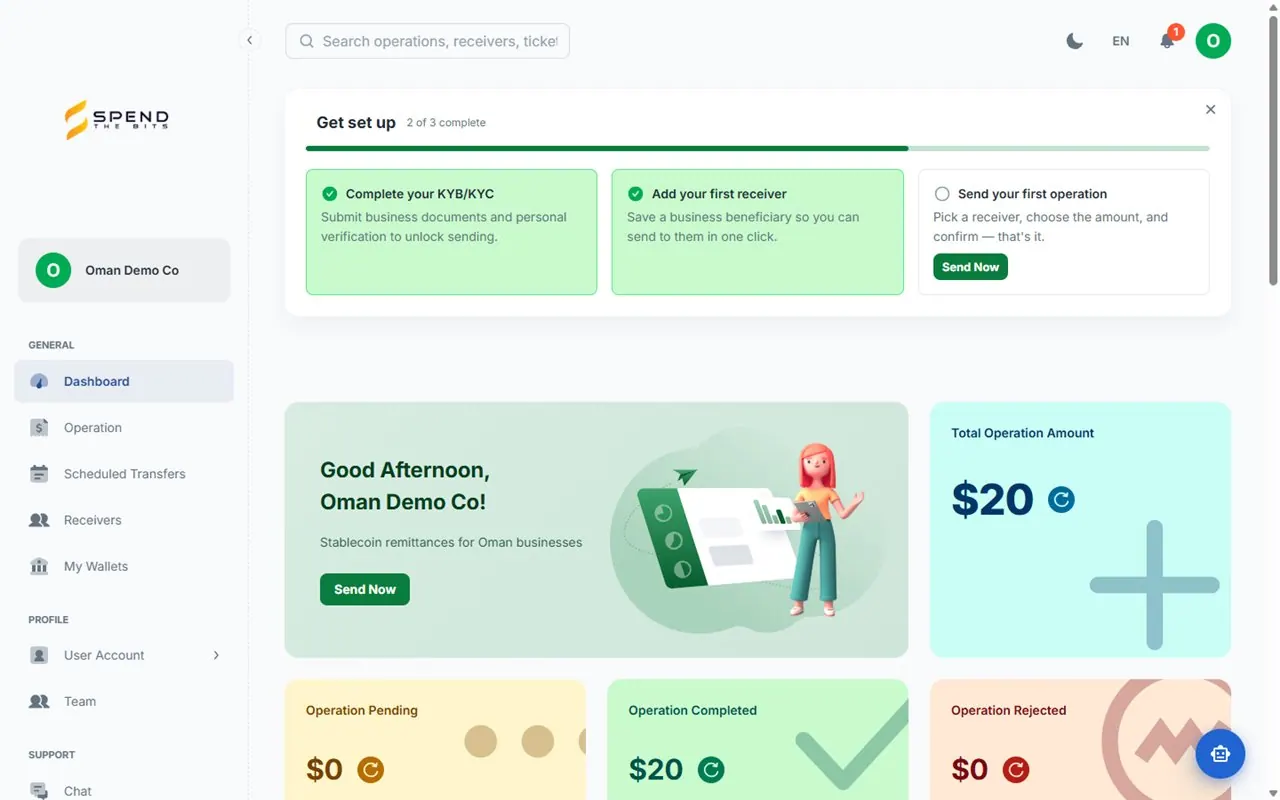
StableNet is built by SpendTheBits as a cross-border B2B payment and settlement platform for banks, credit unions, licensed MSBs, exchange houses and remittance fintechs. Settlement runs in regulated stablecoins such as USDC and USDT on public blockchains, completes in minutes at any hour including weekends, and leaves an on-chain audit trail. Payments are ISO 20022 native, tracked end to end by UETR, and compliance controls such as KYB and KYC onboarding, KYT, sanctions and PEP screening and Travel Rule data in IVMS101 form are built in. SpendTheBits is a Bank of Canada registered payment service provider under the Retail Payment Activities Act. StableNet does not hold a MiCA authorisation and does not issue a stablecoin.
Whichever platform you use, ask three questions of any provider before January: which token does each EU corridor settle in, can the provider show its partner confirmations in writing, and how quickly can a corridor switch token without a change to the message flow or the audit record.
See it on your corridors
Book a working session and we’ll map StableNet’s compliance and settlement to one of your live payment flows.