The GENIUS Act takes effect on 18 January 2027: what banks and MSBs that use stablecoins should do in the next 90 days
GENIUS Act effective date: expected 18 January 2027. A 90-day plan for banks and MSBs that use stablecoins, covering inventory, AML and token substitution.
- Treasury says the GENIUS Act effective date is expected to be 18 January 2027, but as of mid-October 2026 the implementing rules are proposed and not final.
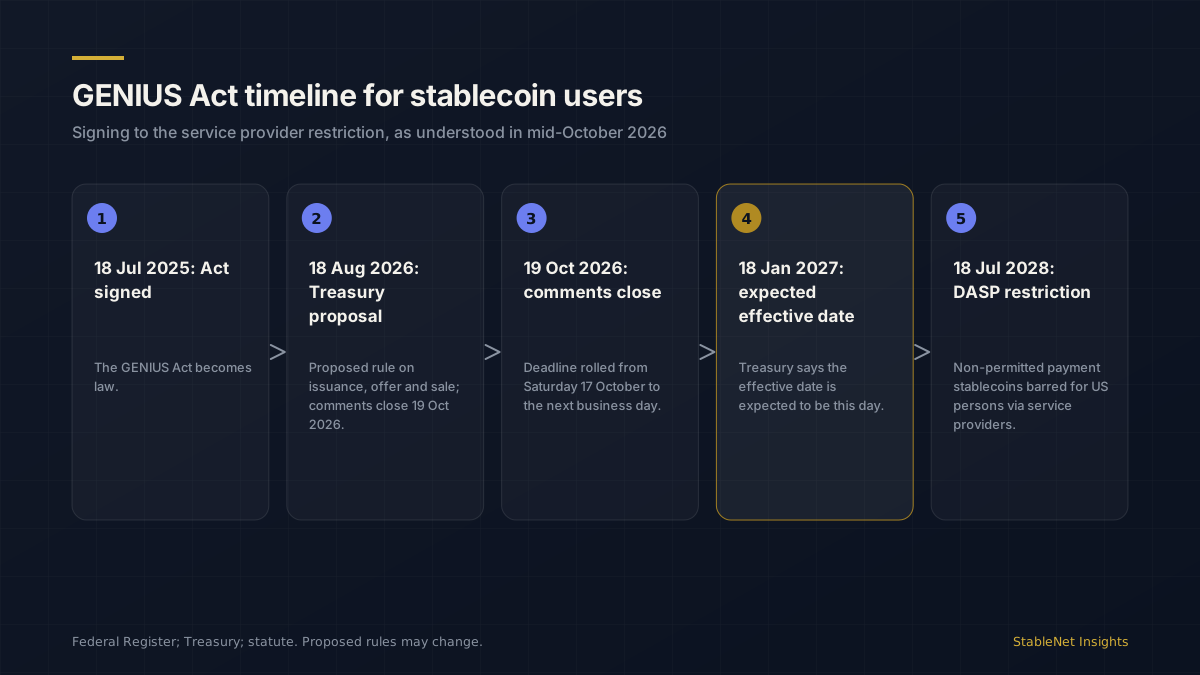
- Day one mainly affects issuers. The restriction on digital asset service providers offering non-permitted stablecoins to US persons applies from 18 July 2028.
- Treasury's issuance proposal was published on 18 August 2026 and comments close on 19 October 2026, which does not by itself move the effective date.
- A practical 90-day plan starts with a token inventory by issuer, then covers redemption terms, third party risk files, the AML programme and a substitution plan.
- Treat both dates as planning dates, confirm them against the Federal Register and brief the board before the final rules arrive.
The GENIUS Act is expected to take effect on 18 January 2027, according to Treasury's proposed rule published on 18 August 2026, and as of mid-October 2026 the implementing rules are still proposed rather than final. For a bank or money service business that uses stablecoins rather than issues them, day one changes little in daily operations, but it starts the clock on a harder date: from 18 July 2028, digital asset service providers may not offer non-permitted payment stablecoins to US persons. The next 90 days are best spent building the inventory, due diligence and substitution plan that both dates will require.
What is the GENIUS Act timeline, and which dates are firm?
The statute is the anchor. The Act was signed on 18 July 2025. Under its terms, it takes effect on the earlier of 18 months after enactment, which is 18 January 2027, or 120 days after final implementing regulations are issued. As of mid-October 2026 no final regulations exist, so the 18-month date is the operative one.
The rulemaking is moving in parallel. The Office of the Comptroller of the Currency published a proposed rule on reserves, redemption and custody in the Federal Register on 2 March 2026. Treasury published its proposed rule on payment stablecoin issuance, offer and sale on 18 August 2026 under docket TREAS-DO-2026-0496, and comments close on 19 October 2026, according to reporting by CoinPaprika. The sixtieth day fell on a Saturday, so the deadline rolled to the next business day. Treasury has indicated that the effective date is expected to be 18 January 2027, and the comment deadline does not move it.
Other agencies have also acted. The FDIC proposed application procedures in December 2025 and later prudential proposals, and Treasury has proposed illicit-finance rules for issuers covering anti-money laundering and sanctions. Treasury has also proposed a path for foreign issuers whose home regimes are found comparable, as described by the law firm Freshfields.
What changes for a payment firm on day one, and what waits until 2028?
The Act regulates issuers first. From the effective date, the framework for permitted payment stablecoin issuers applies: one-for-one reserves held in cash and short-dated Treasuries, monthly reserve disclosure, and redemption at par. Those obligations fall on issuers, not on the bank or MSB that accepts or moves the token.
What a user feels on day one is indirect. Issuers will be moving into the permitted regime, disclosures should become more standardised, and your counterparties, auditors and examiners will start asking which of your tokens sit on a compliant path. Your own anti-money laundering programme does not change by statute on that date, but the illicit-finance proposals show where supervisory expectations are heading.
The sharper consequence arrives later. From 18 July 2028, three years after enactment, a digital asset service provider may not offer a payment stablecoin to US persons unless a permitted issuer issued it. If your firm qualifies as a digital asset service provider, or relies on one, any token without a permitted status will need to be replaced in your flows before that date. That is a migration of balances, liquidity relationships, integrations and customer terms, and it takes longer than the calendar suggests.
Are these rules final, and could the dates change?
No. As of mid-October 2026 the Treasury, OCC and FDIC proposals are proposals. Final text may differ on definitions, on how foreign issuers qualify and on supervisory detail. Agencies may also adjust timing, and the effective date has been described as expected, not fixed. Treat 18 January 2027 and 18 July 2028 as planning dates, confirm them against the Federal Register, and build a plan that tolerates movement in either direction.
A rule that is still proposed is a planning input, not a plan. The firms that cope best are the ones that finish their inventory before the final text arrives.
What should a bank or MSB do in the next 90 days?
The following list is sequenced so that each step feeds the next. It assumes a compliance owner, a treasury owner and a technology owner are named at the start.
- Inventory every payment stablecoin you hold, accept, settle in or custody for clients, and record the issuer, the chains used, typical balances and the business flows that depend on each token.
- Check each issuer's likely route to permitted status: a federally supervised subsidiary of an insured institution, an entity under a state regime, or a foreign issuer that may qualify under Treasury's comparability path. Record what the issuer has publicly said and what remains unconfirmed.
- Review redemption terms. Confirm who may redeem, the minimum size, the stated timing, the fees and the legal entity that owes the redemption, because par redemption is the control the Act is built around.
- Update third-party risk files for issuers, custodians, liquidity providers and any platform that touches the token. Our guide to third party risk management for stablecoin providers sets out the assessment areas.
- Review the anti-money laundering programme against the Treasury illicit-finance proposals, including sanctions screening, transaction monitoring on chain, Travel Rule data and escalation when a token issuer can freeze or block balances.
- Draft a token substitution plan for July 2028: which tokens could replace which, the liquidity and pricing needed, the integration changes, the customer notices and the point at which each flow would switch.
- Brief the board or risk committee. Give it the dates, the proposed status of the rules, the inventory, the exposure by issuer and the decisions you will need from it, including a budget for the substitution work.
Two habits keep the work honest. First, record every assumption about permitted status with a date and a source, so that when final rules arrive you can see precisely what changed. Second, keep the depeg and issuer-failure contingency plan current, because a change in an issuer's regulatory standing is also an operational event. The reserve analysis in our article on GENIUS Act reserve requirements helps with what to verify, and the compliance checklist covers the issuer side that your counterparties will be working through.
How should the inventory be structured so it survives a rule change?
Build it as a register with one row per token and per business flow, not as a single list of coins. Useful columns are the issuer legal entity, the jurisdiction, the reserve and attestation disclosures you have reviewed, the redemption terms, the chains supported, the custody arrangement and the internal owner. Add a column for the current permitted-status assessment, with three values: confirmed, expected and unknown.
A register of that kind answers most examiner and auditor questions without a new project. It also exposes concentration: a firm that discovers that most of its settlement volume rests on a single issuer with an unconfirmed path has learned something its board should hear in the same meeting.

Where StableNet fits
StableNet is a cross-border B2B payment and settlement platform built by SpendTheBits for banks, credit unions, licensed MSBs, exchange houses and remittance fintechs. Settlement runs in regulated stablecoins such as USDC and USDT on public blockchains, completes in minutes, runs around the clock including weekends, and is auditable on chain. The customer portal shows each operation and its status, and compliance controls such as KYB and KYC onboarding, KYT, sanctions and PEP screening, and Travel Rule data in IVMS101 form sit alongside it. SpendTheBits is a Bank of Canada registered payment service provider under the Retail Payment Activities Act. StableNet does not issue a stablecoin, and this article is not legal advice.
Whatever platform you use, ask three questions of any provider before the July 2028 date: which tokens it supports and how it will handle a token that loses permitted status, whether token and chain exposure can be reported by issuer on demand, and how its audit trail will support your examination file.
See it on your corridors
Book a working session and we’ll map StableNet’s compliance and settlement to one of your live payment flows.