What the Lloyds and Visa USDC settlement pilot means for cross-border settlement at smaller institutions
Lloyds Visa USDC pilot: a UK bank settled 750,000 dollars with a card network, weekends included, in under an hour. What it proves and what it does not.
- The pilot tested settlement between two institutions, not customer payments. That scope makes it evidence for stablecoins as a back-office tool.
- According to Visa and The Block, 750,000 dollars of USDC-based obligations reached Visa in under an hour, including over a weekend, across two different blockchains.
- The pilot does not show behaviour at scale, cost at volume, or customer-facing flows. It should be cited as proof of feasibility, not of economics.
- Smaller banks, credit unions and MSBs cannot run their own node, so they need a platform that covers on-ramp, chain choice, compliance and reconciliation.
- Before running a pilot, agree success measures, a value cap, stopping conditions, and include at least one weekend in the test window.
The Lloyds and Visa pilot shows that a major UK bank can settle real obligations with a card network in USDC, around the clock, with funds arriving in under an hour. It tested institution-to-institution settlement, not customer payments, so its main message is that stablecoins are becoming a back-office settlement tool rather than a consumer product.
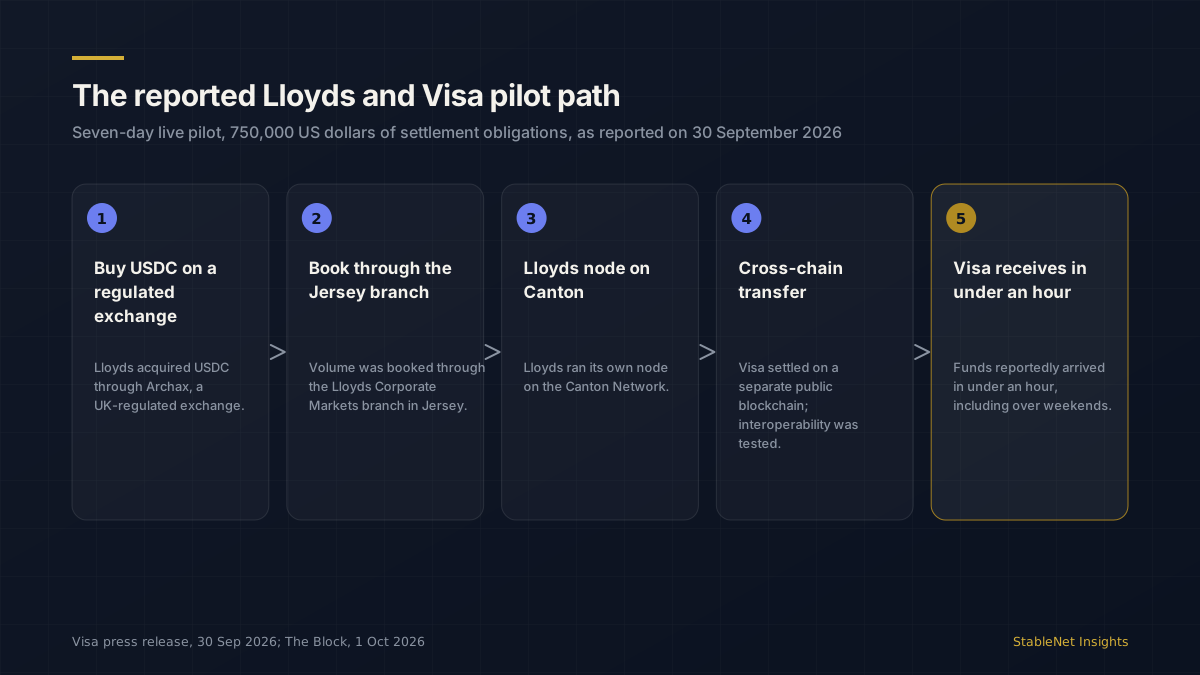
According to a Visa press release dated 30 September 2026 and reporting by The Block on 1 October 2026, Lloyds Banking Group and Visa ran a seven-day live pilot that settled 750,000 US dollars of US dollar obligations using USDC. This article sets out what was tested, what the result supports, where the evidence stops, and what a smaller institution should ask before running a pilot of its own.
What did Lloyds and Visa actually test?
The pilot covered settlement, which Visa describes as the behind-the-scenes process through which institutions exchange funds to complete and reconcile payment activity. It did not cover how a cardholder or a business customer pays for anything. The parties were two institutions settling what they owed each other.
The reported mechanics were as follows. Lloyds bought USDC through Archax, an exchange regulated in the United Kingdom. The volume was booked through the Corporate Markets branch of Lloyds in Jersey and then sent to Visa in the United States. Lloyds ran its own node on the Canton Network, while Visa supported settlement on a separate public blockchain that the release does not name. The trial therefore also examined whether the two networks could interoperate.
Funds reportedly reached Visa in under an hour, including over a weekend. Both sources note that traditional cross-border settlement can take a day or more when it starts outside banking hours. The release describes the work as the first stablecoin settlement trial between Visa and a major UK banking group, and as part of a broader Lloyds effort to explore digital assets and tokenised money for moving value between businesses and financial institutions.
Why does this point to an institutional back-office tool?
Three features of the design point in the same direction. First, the counterparties were a bank and a card network, both of which already hold the customer relationships and the compliance obligations. Neither needed a consumer wallet. Second, the scope was a settlement obligation, which is a recurring and measurable liability between two known parties. Third, the entry point was a regulated exchange, which gave the bank a supervised route from fiat into the asset.
Stablecoin settlement is not new to Visa. It has offered USDC settlement to some issuers and acquirers since the period between 2021 and 2023, and The Block reports that Visa stablecoin settlement volume passed a 20 billion dollar annualized run rate in September 2026. What is notable here is the identity of the other party: a major UK banking group, using its own infrastructure, on a live basis and with a published scope.
The significant result is not that a stablecoin moved quickly. It is that a regulated bank treated it as ordinary settlement plumbing and tested it against the calendar that matters, the weekend.
What does the pilot prove?
Read carefully, the reported results support four conclusions.
- Round-the-clock settlement is operationally possible. Funds reached the counterparty within an hour over a weekend, a period in which correspondent settlement has traditionally been unavailable.
- Speed is measurable. Under an hour, against a day or more for a payment started outside banking hours, is a concrete difference that a treasurer can value in terms of liquidity management and certainty of arrival.
- Chain interoperability can be handled. A node on one network and a public chain on another were bridged in a live setting, so the choice of network does not have to be identical on both sides.
- A regulated on-ramp is available. Buying the asset through a UK-regulated exchange shows that the front end of the process can sit inside an existing supervisory perimeter.
What does the pilot not prove?
Seven days and 750,000 dollars is a small sample. The pilot says nothing about behaviour at the volumes that a card network settles in a normal quarter, and nothing about what happens during a market stress event, a stablecoin price deviation, or a chain outage.
It also does not show cost at volume. The sources do not report fees, spreads, exchange margins, or the internal cost of operating a node. A comparison with the cost of correspondent settlement therefore cannot be made from the published material. Finally, the pilot did not touch customer-facing flows. Questions such as sender and beneficiary data, sanctions screening on individual payments, returns, and local currency delivery were outside its scope.
A narrow pilot is a sensible way to test one hypothesis. The result should be cited for what it is: evidence of feasibility for one institutional settlement path.
What should smaller banks, credit unions and MSBs take from it?
Lloyds could run its own node, use a Corporate Markets desk in Jersey, and work directly with a regulated exchange and a card network. Most smaller banks, credit unions and licensed money service businesses cannot do all of those things, and they should not need to.
The transferable lesson is that the work is divided into layers, and each layer needs an owner. Someone must provide the regulated on-ramp and off-ramp. Someone must decide which chain settles which flow and prove that the decision was followed. Someone must run compliance checks on counterparties and wallets. Someone must reconcile the on-chain movement with the accounting ledger and produce evidence for an auditor. A large bank can staff all of these internally. A smaller institution will usually need a platform that handles them as a single service.
The weekend result matters most to this group. A credit union or remittance business that serves clients in several time zones carries the cost of every closed window, and our analysis of weekend and holiday settlement requirements covers that in more detail.
What questions should you ask before running your own pilot?
- Counterparty: which institution on the other side accepts stablecoin settlement, on which chain, and under what agreement?
- On-ramp: which regulated exchange or liquidity provider supplies the asset, and what are its limits and cut-off times?
- Chain choice: which network is acceptable to both parties, and who documents the policy?
- Compliance: how are counterparties, wallets and transactions screened, and where is the evidence stored?
- Reconciliation: how does each on-chain transfer map to a ledger entry and a unique payment reference?
- Failure handling: what happens if the stablecoin deviates from its peg or a chain is unavailable on a Sunday?
- Cost: what are the full fees, spreads and internal costs at the volume you expect, not at pilot volume?
- Exit: how are funds converted back to fiat, and how quickly, if the pilot ends?
The checklist is deliberately operational. A pilot is most useful when it is designed to produce evidence for a risk committee rather than a headline. Before it begins, agree the success measures in writing. Examples include the time from instruction to confirmed receipt, the number of reconciliation exceptions, and the full cost per transfer.
Agree also the stopping conditions. A pilot with a fixed value cap, a fixed duration, and named approvers can be stopped cleanly. Include at least one weekend in the test window, since that is where the largest difference from existing settlement is expected, and record how the team handled any exception during that period.
Where StableNet fits
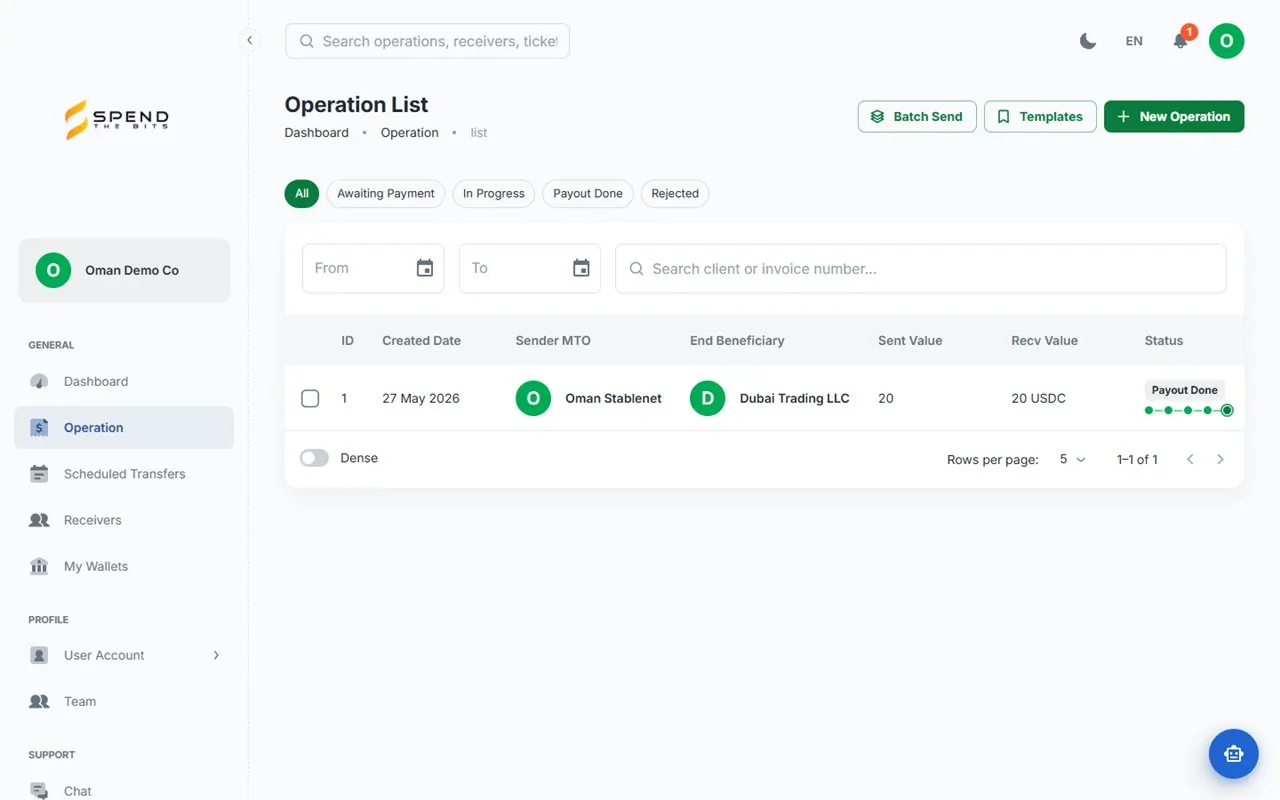
StableNet is built by SpendTheBits as a cross-border B2B payment and settlement platform for banks, credit unions, licensed MSBs, exchange houses and remittance fintechs. Settlement runs in regulated stablecoins such as USDC and USDT on public blockchains, completes in minutes, around the clock including weekends, with on-chain auditability. Messaging is ISO 20022 native, with pacs.008, pacs.009, pacs.002 and pacs.004 messages inside head.001 envelopes, tracked end to end by UETR. Compliance is built in, including KYB and KYC onboarding, KYT, sanctions and PEP screening, FATF Travel Rule data in IVMS101 form, a compliance workbench and a tamper-evident audit trail.
StableNet is not part of the Lloyds and Visa arrangement, and it makes no claim about that pilot. It addresses the point made above for institutions that cannot run their own node: the compliance, auditability and reconciliation layers delivered as one platform, with operator and customer web portals for monitoring. SpendTheBits is a Bank of Canada registered payment service provider under the Retail Payment Activities Act. Whichever provider you consider, ask it to show a weekend transaction from instruction to reconciled ledger entry, with the evidence an examiner would want.
See it on your corridors
Book a working session and we’ll map StableNet’s compliance and settlement to one of your live payment flows.